
About TRIANGLE STRATEGY
In Norzelia, a continent divided by rival powers and a history of conflict over salt and iron, Serenoa Wolffort must guide his house through political choices and tactical battles. Explore to gather information, persuade allies at the Scales of Conviction, and command distinctive units across grid-based maps where elevation and terrain shape each fight.
TRIANGLE STRATEGY follows Serenoa Wolffort, heir to House Wolffort in the Kingdom of Glenbrook, as political tensions reopen the wounds of the Saltiron War. Norzelia’s three powers are bound to the resources that shaped that conflict: the Holy State of Hyzante controls salt, the Grand Duchy of Aesfrost is associated with iron and a harsh northern climate, and Glenbrook lies between them. A fragile balance begins to fracture after a destabilizing incident, drawing Serenoa and his companions into a struggle involving rulers, military houses and competing ideas of justice. His betrothed Frederica Aesfrost connects him to the neighboring duchy and to the persecuted Roselle through her maternal lineage; Roland, the prince of Glenbrook, brings a royal perspective to the conflict, while Benedict Pascal serves as steward and adviser to House Wolffort. Rather than presenting the war as a simple contest between good and evil, the story repeatedly asks the player to choose between outcomes that serve different priorities. The political setting is therefore also a decision system: resource control, alliances, and the consequences for Serenoa’s companions affect how the campaign unfolds.
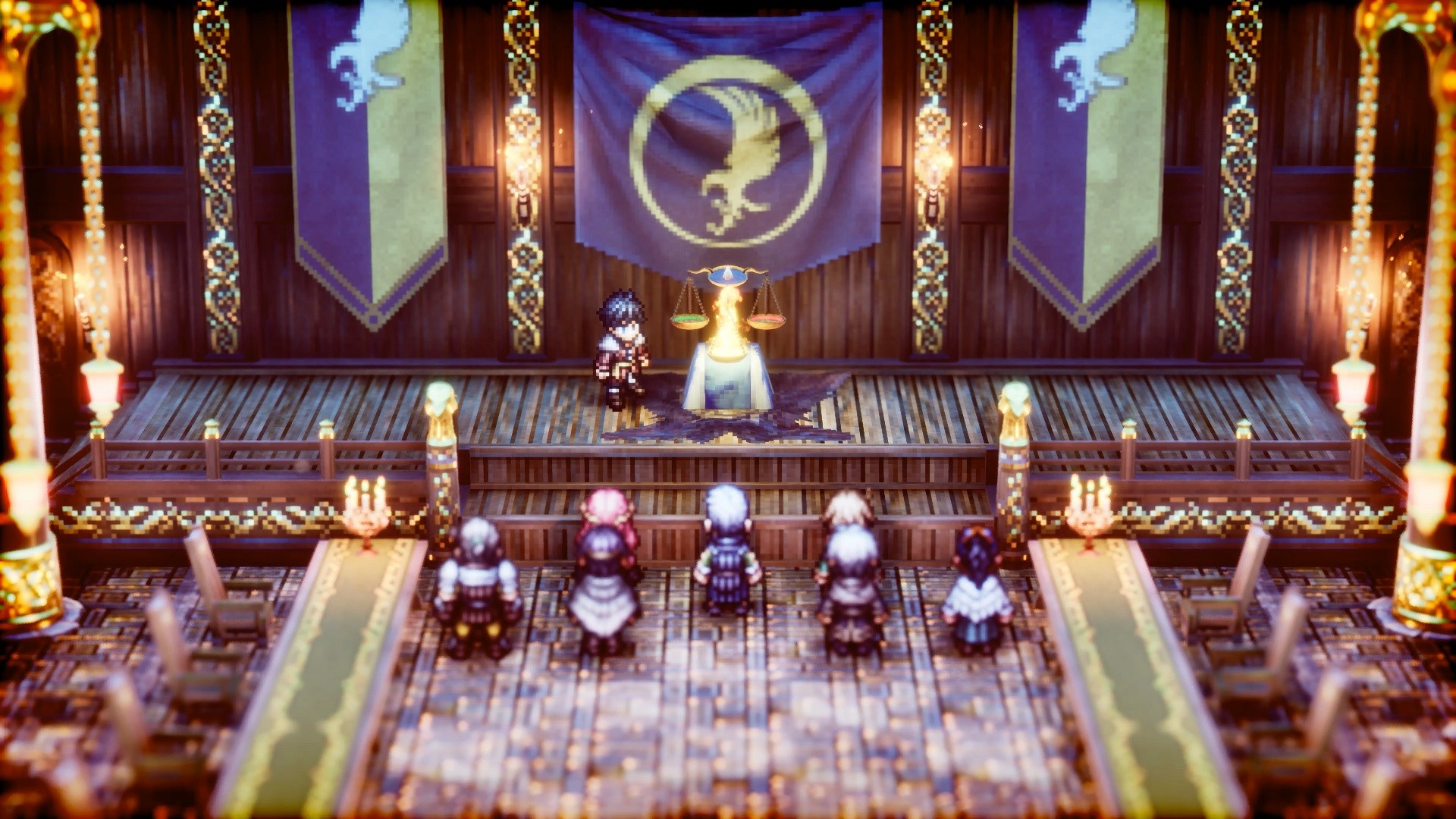
Between major battles, the player explores compact locations and speaks with people who can provide information, objects or context for decisions. Exploration is purposeful: conversations can reveal a change in Serenoa’s convictions or supply evidence that helps him persuade his companions during a vote. The player can inspect the surroundings rather than treating each scene as a direct path from story event to combat, and the information gathered can affect which argument is available later. At key points the party consults the Scales of Conviction. Serenoa’s allies cast votes, and the player can try to sway them by discussing their reasoning; the decision is not simply a menu with Serenoa choosing alone. When the player has not settled on a course, searching the area and listening to locals can offer material for discussion. Evidence collected during exploration can be presented when trying to persuade an ally, connecting investigation to the vote. Outcomes can send the party down different routes and influence which allied units join. Choices also contribute to Utility, Morality and Liberty values, which track Serenoa’s priorities and shape how the story branches. At the ballot, the party can follow a route Serenoa did not initially propose, so discussion can redirect the campaign rather than simply confirm his initial preference.
Movement is divided between investigation scenes and grid-based tactical battlefields. In exploration segments, the player walks through a small area, inspects its surroundings and talks to people; conversations let the player gather information and attempt to persuade allies. In combat, each unit moves across a square grid according to its position and capabilities. Elevation matters: occupying high ground can improve an attack, while approaching an enemy from behind can create a follow-up opportunity with an ally on the other side. This makes route selection across a map part of the battle plan, not simply a way to reach the nearest target. Terrain can also affect how abilities work. A fire spell can melt icy ground into wet squares, and water can conduct electricity; ice can freeze the surface again. Wind and consumable items can also interact with battlefield conditions, adding further ways to alter positioning and damage. A spell can prepare a surface for a later attack, letting one character create an opening that an ally can exploit on a subsequent turn. Each battle’s victory conditions may differ, with some asking for more than defeating every enemy, so the player must read the map objective alongside enemy positions before deciding where to move.
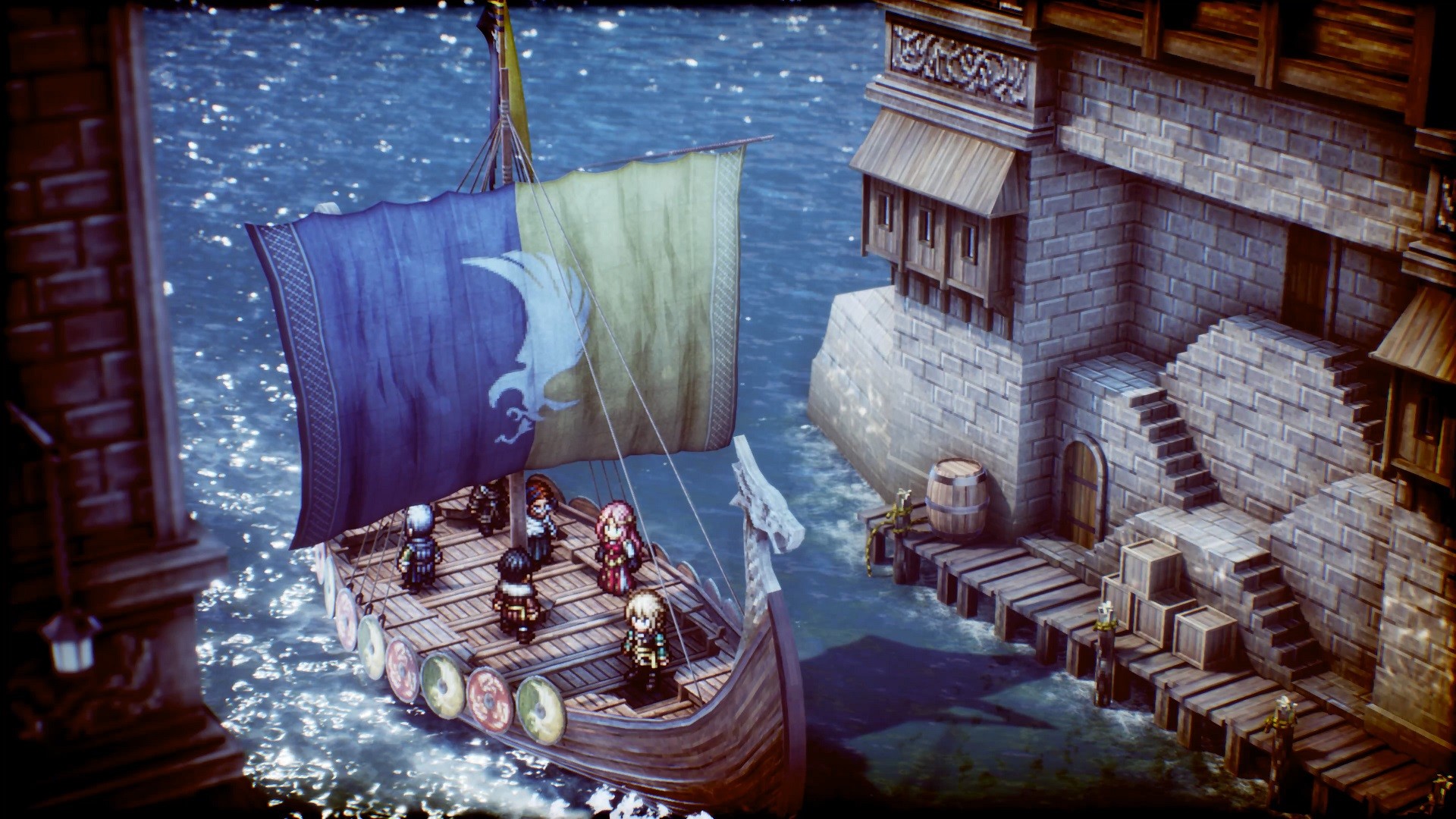
The battles are turn-based but do not divide play into a single allied phase followed by an enemy phase. Units act in a sequence influenced by their speed, and the order is shown so the player can anticipate what will happen before choosing a move. A character’s turn usually combines movement and one action, such as attacking, using a skill or item, or changing position to support another unit. Facing and elevation influence attacks, while placing an enemy between two allies can trigger a follow-up strike. Units have distinct abilities rather than interchangeable jobs: Serenoa fights with a sword and counters, while other recruited characters contribute specialized actions. Spellcasters and items can change battlefield surfaces, so setting up an attack may require manipulating the ground before a lightning strike or positioning units to exploit a flank. Skills consume Tactical Points (TP); characters begin with a reserve of Tactical Points and regain a point at the start of their turn, so expensive techniques must be budgeted across an encounter. The battlefield therefore combines turn forecasting, unit-specific tools, terrain, facing, formation and resource timing. An aggressive move can put a unit within range of an enemy’s next turn, so the visible action order affects whether a character should attack, defend a position or wait for an ally to create an opening. When an approach fails, the player can reconsider deployment or the order of actions on a later attempt rather than relying on a single universal attack pattern.
Outside the main story encounters, the Encampment functions as a place to speak with allies, prepare equipment and strengthen the army. Shops supply goods, while the Sundry Shop and Smithy let the player improve characters and weapons. These services make the Encampment a practical staging point: the player can speak with companions, prepare the roster, then enter an optional battle with a specific tactical objective. Mental Mock Battles at the Tavern provide optional tactical scenarios with their own victory conditions, giving players a space to test formations and earn experience before returning to story battles. Character development remains tied to each unit’s own abilities and traits; the battle roster is built around selecting which distinctive characters to deploy, rather than freely changing every character’s class. House Wolffort’s forces can grow as the campaign’s convictions and story decisions influence which allies join. New recruits add distinct weapons, movement profiles and skills to the deployment choices, so a change in party composition can alter which terrain and objectives are practical in a later battle. That means preparation has both a tactical and narrative dimension: a new recruit can change the tools available on the battlefield, and a choice about policy can affect the composition of the army. Promotions, weapon upgrades and recruitment conditions add further detail to this loop of conversations, shops, strengthening, mock battles and story-linked allies.
The game presents Norzelia in HD-2D, combining pixel-art characters with three-dimensional scenery and effects. Its visual style supports the contrast between small exploration spaces and elevated tactical maps, where ladders, ledges and environmental surfaces give the terrain a visible role. Across the campaign, deployments, weapon upgrades and promotions give the player several ways to prepare a roster for a battle’s terrain and victory condition. The Steam edition includes the tactics RPG, while its Digital Deluxe Edition adds a digital mini-artbook. The prologue demo covers the opening chapters; the campaign continues through further political decisions and tactical encounters. Because allies have fixed roles, preparation involves comparing their movement, range and abilities against the map rather than applying one upgrade path to everyone. A roster built for height and ranged attacks can approach a different situation from one centered on close combat and support.
- Developer
- ARTDINK and Square Enix Asano team (publisher listing); Meta Quest version separately lists FRIMA and Square Enix Asano team
- Genre
- Tactical role-playing game