
About Trek to Yomi
Trek to Yomi follows samurai Hiroki from a village under attack into a journey shaped by duty, loss and the boundary between life and death. Explore cinematic environments, search side paths for supplies and new techniques, and fight with a katana through timing-based sword encounters.
Hiroki's story begins with a promise. As a young swordsman training under his master, he is told to protect the town and the people he loves. When violence reaches the village, the vow becomes the frame for a tale of duty, failure and the consequences of trying to keep others safe. The journey later carries Hiroki beyond ordinary life and death, where the supernatural becomes part of the world he must face. The story is presented through brief exchanges and visual scenes, with the action continuing between narrative moments. Its central question is not simply whether Hiroki can defeat an enemy, but what kind of path he will follow after tragedy changes the meaning of the promise he made. That structure lets the game connect sword encounters to character development: advancing through the levels means physically moving deeper into danger while the story confronts Hiroki with the limits of his earlier understanding of duty. The premise is grounded in a feudal Japanese setting, then broadens into a mythic journey without losing the personal vow at its center.
The game alternates between exploration and combat, and the camera helps define which kind of play is taking place. While moving through a village, forest or other environment, Hiroki can shift across the available depth of a space as the fixed camera arranges people and scenery into carefully framed views. When an encounter begins, the action moves onto a side-on plane. This change narrows the immediate problem to the opponent in front of Hiroki, while the explored setting remains visible as a backdrop. Paths can continue forward or branch toward a side area, so it is useful to examine the edges of a scene before leaving it. Those detours may hold a pickup, a new combat combination or an upgrade to health, stamina or ammunition. This makes exploration feed into the next encounter: searching a less obvious route can improve the resources available when the path returns to combat. The camera's fixed framing also makes environment traversal feel distinct from the deliberate spacing of a duel, even though both occur within the same continuous journey.
Hiroki fights primarily with a katana, using light and heavy attacks, blocking, parrying and evasive movement. Ranged tools such as a bow and shuriken provide alternatives to closing the distance, but their ammunition is limited, so they are not a replacement for swordplay. Timing matters because the opponent's attack must be read before choosing a response. A successful parry creates an opening to counter, while attacking without regard for the enemy's motion can leave Hiroki exposed. The game's official promotional material describes patience and timing as central to its combat, with the goal of using an opponent's force to unbalance them and land a decisive blow. In practice, the central exchange is about defense and response: watch for the start of an attack, hold position or evade as appropriate, then use the opening to strike. This rhythm gives each encounter a clear relation between observation and action. The player is not simply repeating attacks; stamina limits how long Hiroki can block or swing, and a depleted gauge can leave him vulnerable until he recovers.
The combat vocabulary expands through combinations that can be discovered during the journey. Some are learned from progression, while others are found by exploring the margins of a level. Directional inputs modify attacks, allowing the player to choose among moves with different speed, strength or effects. New combinations matter because enemies do not all present the same problem: armor can demand stronger attacks, while a foe approaching from behind makes a backward strike useful. Some sequences can stun an enemy, setting up a finishing move that both ends that threat and restores health. A well-timed parry also restores a small amount of health, and reaching a checkpoint shrine replenishes health and stamina. These connections make defense, attack and resource management part of one loop. A parry can keep Hiroki alive while opening a counter; a finishing move can turn a stun into recovery; and a shrine resets his condition before the next stretch. Ranged ammunition, health and stamina can also be increased through pickups away from the main path, so optional searching directly supports the fighting system rather than serving only as scenery.
Enemy encounters vary through their weapons and position. Swordsmen, spearmen, archers and riflemen create different distances and pressures: a spear keeps Hiroki from attacking freely at close range, while an archer or rifleman can force him to advance under threat. Later sections also include supernatural beings, extending the conflict beyond human violence. Combat can involve more than one opponent, so the direction of an attack matters as much as its timing. Some unlocked combinations cover a strike behind Hiroki, while ranged weapons can help answer enemies who are not yet within sword reach. Stamina makes movement choices consequential. Running in combat spends energy, and blocking or attacking repeatedly can leave the gauge empty; when that happens, Hiroki is temporarily unable to respond effectively. Managing that resource means choosing when to press forward, when to hold position, and when to stop long enough for him to recover. Checkpoint shrines punctuate the journey, and exploration for upgrades can prepare the player for later encounters. The game therefore ties combat readiness to both immediate decisions and attention paid to the path between fights.
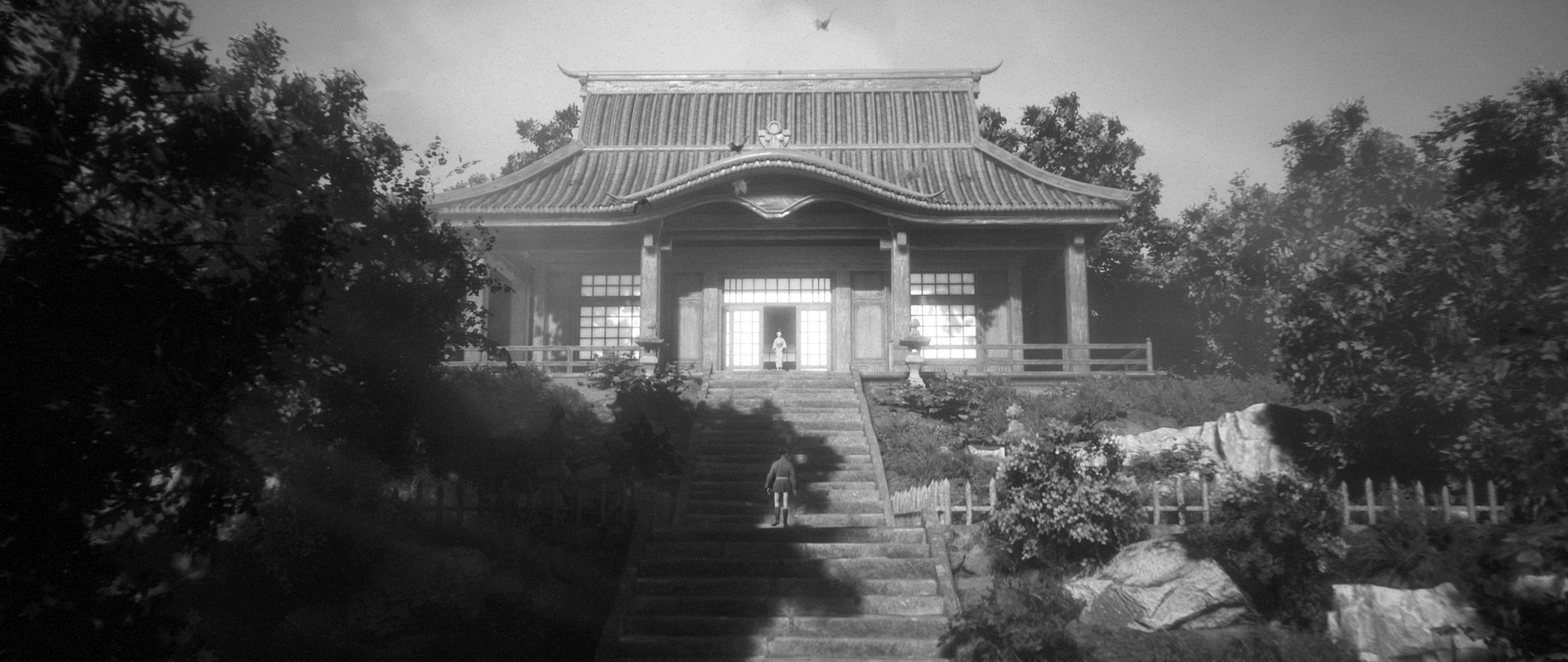
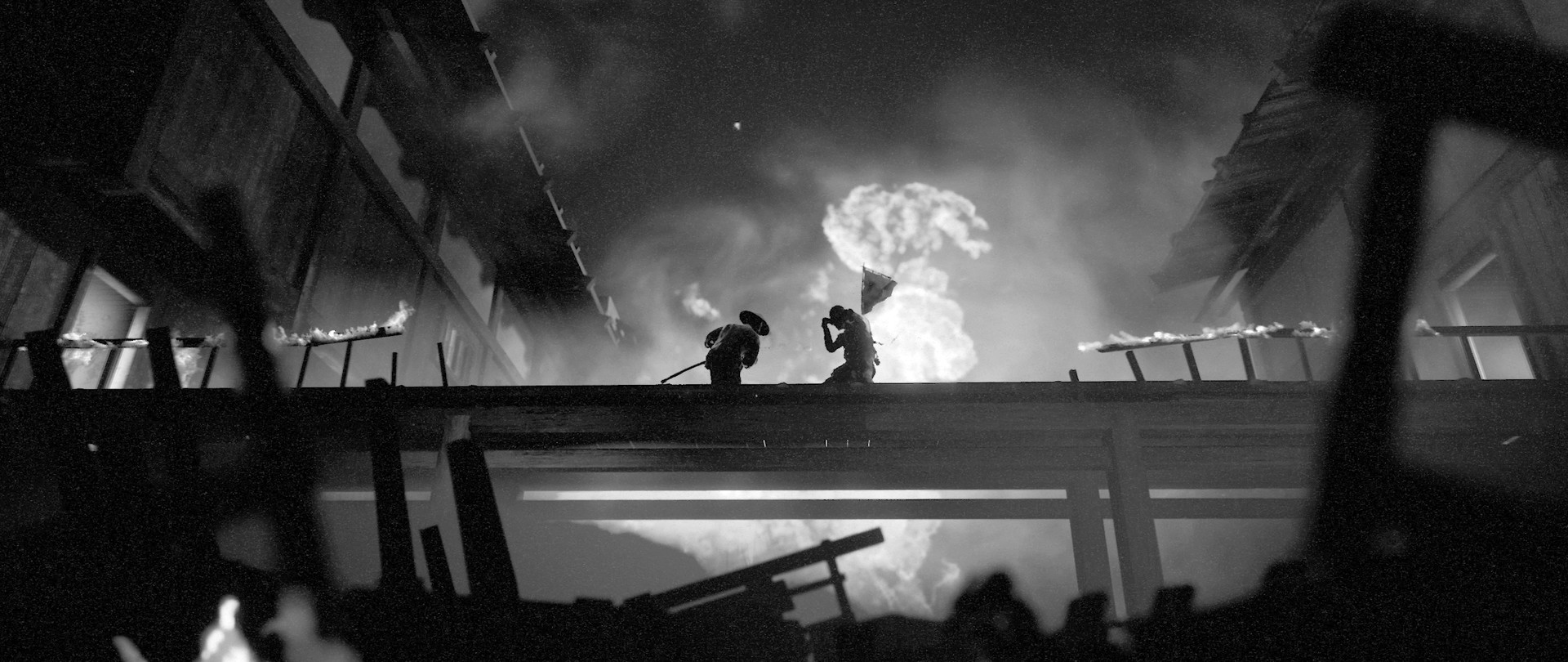
The visual design treats each scene like a composed image. Trek to Yomi uses a black-and-white presentation with strong contrasts, shadows, mist, rain, wind and fire. These elements give movement to otherwise static compositions and distinguish silhouettes against the scenery. The camera can frame a close passage through village stalls, then pull back to reveal fields or distant mountains; during combat it settles into the side view that supports the game's two-dimensional duels. Transitions between those perspectives make the journey feel cinematic while keeping the player's mode of movement legible. The soundtrack accompanies the action and quieter story passages, with Japanese voice acting on the Steam listing. Rather than depend on color changes to signal mood, the game uses light, texture and environmental motion to shape scenes. The result is a consistent presentation language across ordinary exploration and the mythic spaces beyond the human world. That style is not a separate mode: the same framing that establishes a location also stages the movement and fights that carry Hiroki through it.
Several environmental interactions can alter an encounter before Hiroki draws the katana. In one camp, a rope can be cut so a suspended load of logs tumbles into the bandits below; elsewhere, opening a dam sends rushing water through a group of enemies. These hazards turn nearby objects into a tactical choice: the player can act on the scene to remove opponents or avoid a fight, rather than treat every group as a mandatory duel. Their use depends on noticing the setup within a fixed-camera environment and understanding how the object will move through it. The game also places a symbol puzzle among its traversal sections. The player examines three kanji characters in the surroundings and lines them up in the required order, then meets this kind of recognition problem again later. It briefly changes the pace from swordplay to visual inspection, asking the player to compare marks and sequence them. These moments give the scenery direct consequences, whether it becomes a trap against a hostile group or a set of signs to interpret. They make the environment a source of action and information as Hiroki passes through it.
- Developer
- Leonard Menchiari and Flying Wild Hog
- Genre
- Action-adventure