
About Transistor
In Cloudbank, singer Red is left voiceless after a violent encounter and takes up the Transistor, a weapon that speaks with a man’s voice. As the Process spreads through the city, she pursues its former owners, using the weapon’s Functions to fight and to piece together the people and systems caught up in the crisis.
Transistor begins in Cloudbank with Red, a singer, beside a dead man and a strange, oversized weapon. The weapon, also called the Transistor, absorbs the man’s voice; Red has lost her own, so their exchange becomes a central part of the journey. The city is under attack from the Process, hostile manifestations that are changing or erasing the places they reach. Red takes the Transistor with her and moves through Cloudbank while the voice answers her actions and the pair pursue the people connected to the weapon. The opening gives the player a concrete threat and relationship while leaving the larger cause of the crisis to emerge gradually.
Red’s route through Cloudbank becomes a pursuit of the Camerata, a clandestine organization working behind the scenes for its own purposes. That group gives the crisis a human dimension alongside the Process. Red follows the people connected to what has happened while moving through areas occupied by hostile constructs. She pursues the Transistor’s former owners as the voice inside the weapon comments on her actions. Questions about what the Process is, what happened to Cloudbank’s residents and why the Camerata is involved unfold through the journey, while the city continues to change around Red.
The Transistor functions as a channel for abilities called Functions rather than as a conventional collection of separate weapons. Red can move and fight in real time, striking with Functions while watching enemy positions and responding to incoming attacks. The Process includes opponents with distinct ways of disrupting her plans: some can obscure the battlefield, while others can interrupt a Turn. That means combat has a direct-action layer as well as a deliberate planning tool. The player can use movement and attacks as events unfold, then decide when to pause the immediate pressure and arrange a coordinated sequence against one or several targets.
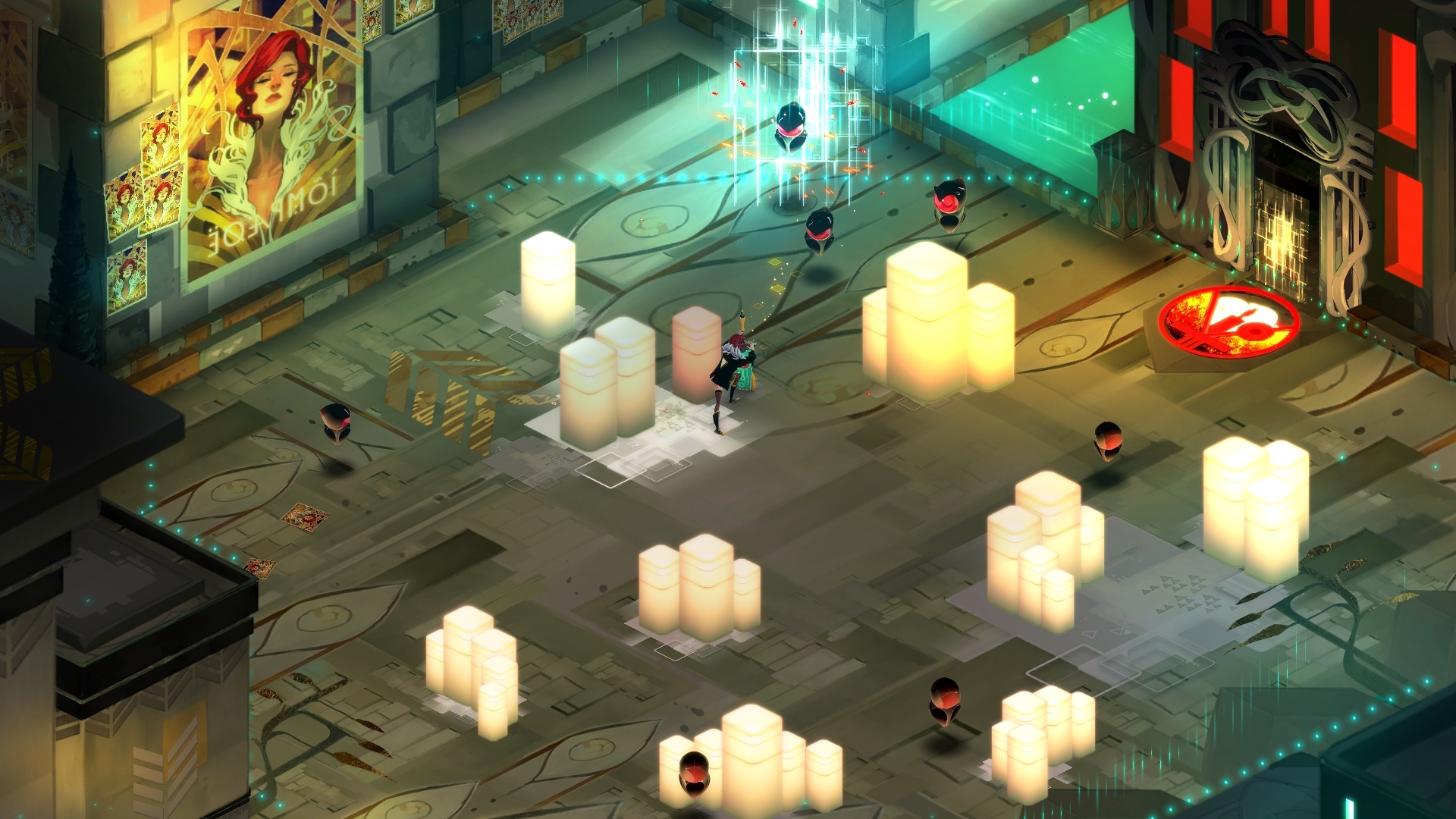
Turn() freezes the action so Red can queue movement and Functions against the current battlefield. Each planned move and ability uses part of the available planning bar, and the player can revise the sequence before committing it. When Turn() ends, Red executes the plan rapidly; the Process can still shift position during that execution, so a predicted hit is not always guaranteed. The bar then needs to recover before another full plan can be made, leaving a real-time interval in which positioning, movement and available abilities matter. Choosing what to include in a Turn and when to return to live combat is a central part of managing a fight.
Functions are the system’s attacks, movement tools and other effects, and most are connected to traces of Cloudbank residents. The same Function can fill three different roles in the Transistor: an active slot makes it a command Red can use directly, an upgrade slot modifies another active Function, and a passive slot gives Red an effect that operates under its own conditions. Crash() can open a target to a combo, allowing a follow-up Function to deal more damage; Jaunt() gives Red a way to reposition, and as a passive it can shorten Turn() recovery. Cull() as an upgrade to Tap() adds its launching impact to Tap’s nearby health-draining attack. These examples show how the slot chosen can change the role of an ability rather than adding only another button.
Loadout decisions also use the Transistor’s memory capacity. Functions have memory costs, and Red must fit the chosen active abilities, upgrades and passive effects within the capacity available at an Access Point. As she gains levels, she unlocks more abilities and additional configuration options, making the question of what to equip more involved over time. The four active commands, their attached upgrades and the passive effects all draw from the same pool, so a powerful combination can require tradeoffs elsewhere. Access Points let the player rearrange the setup, test different pairings and shape Red’s toolkit around the mix of attacks, mobility and support effects that suits an upcoming encounter.

The game makes that experimentation matter during difficult encounters. When Red’s health is depleted, her highest-memory-cost active Function can overload and become unavailable, making it necessary to continue with a reduced configuration. It is restored only after Red reaches two new Access Points, so its absence can shape more than the current exchange. A plan built around one expensive attack can therefore become fragile if that Function is lost. Optional Limiters add further conditions that strengthen or otherwise alter the Process while increasing experience rewards. They let the player choose extra pressure in exchange for faster progression, while the overload system asks the player to maintain a workable combination when a favored ability drops out.
Functions also connect combat choices to Cloudbank’s people. Their files reveal information about the residents whose traces are associated with them, and using Functions in active, upgrade and passive roles reveals further parts of those profiles. Trying a different configuration can therefore add context about the city as well as change how Red fights. The campaign’s reactive voiceover continues to respond to events, while the soundtrack changes with the action. After the main story, Recursion opens procedural battles for another round of encounters with the accumulated Function system.
- Developer
- Supergiant Games
- Genre
- Science-fiction action RPG