
About Tomb Raider: Underworld
Lara Croft follows a trail of Norse artifacts from the Mediterranean to hidden ruins around the world as she searches for answers about her mother. Climbing, underwater exploration and large mechanical puzzles carry the adventure, while the grapple gun and Thor’s relics open new ways through each site.
Tomb Raider: Underworld continues the story thread begun in Legend, returning Lara Croft to the mystery of her mother, Amelia. A search connected to her father’s unfinished work leads Lara toward Norse legends and a set of artifacts associated with Thor. She travels with her tech ally Zip in contact over her headset, while her PDA records observations and personal notes. The journey moves between historical sites, submerged ruins and places connected to Norse mythology, with the story asking what lies behind the legends and how they relate to Amelia’s disappearance. Lara’s investigation provides the reason to explore each site, but the player still has to read its architecture, solve its mechanisms and find a safe route through it.
The expedition ranges from the Mediterranean Sea to Coastal Thailand, Southern Mexico and Jan Mayen Island. Each location connects a real landscape with a ruin built around its own visual language and hazards. Lara begins underwater among the Mediterranean ruins, then moves through the overgrown Bhogavati temple complex in Thailand and the buried city of Xibalba in Mexico. The Thailand ruins also use interactive foliage among the overgrown paths. Later, the route reaches Valhalla beneath Jan Mayen and continues toward the Arctic Sea. Those settings change the kind of space she must cross: open water gives way to narrow chambers, jungle-covered walls and deep underground structures. The Norse artifacts also create a progression trail. Lara finds Thor’s Gauntlets, then the Belt that empowers them, before pursuing Mjolnir, which can only be wielded with both pieces of equipment.
Traversal is built around using Lara’s whole moveset to read a space. She jumps and grabs ledges, climbs marked handholds, balances across beams, swings from poles and can wall-jump between opposing surfaces. The game also lets her use the grapple gun to rappel down a line, extend a swing, or pull objects that are too heavy to shift by hand. Portable poles become tools: Lara can lift one from its holder, carry it to a socket in a wall and use it as a handhold or a step toward another route. These actions turn ledges, rings and poles into parts of the puzzle itself. A route may require a climb to a grapple ring, a controlled drop on the line and a jump from the wall to reach a platform behind the starting point.
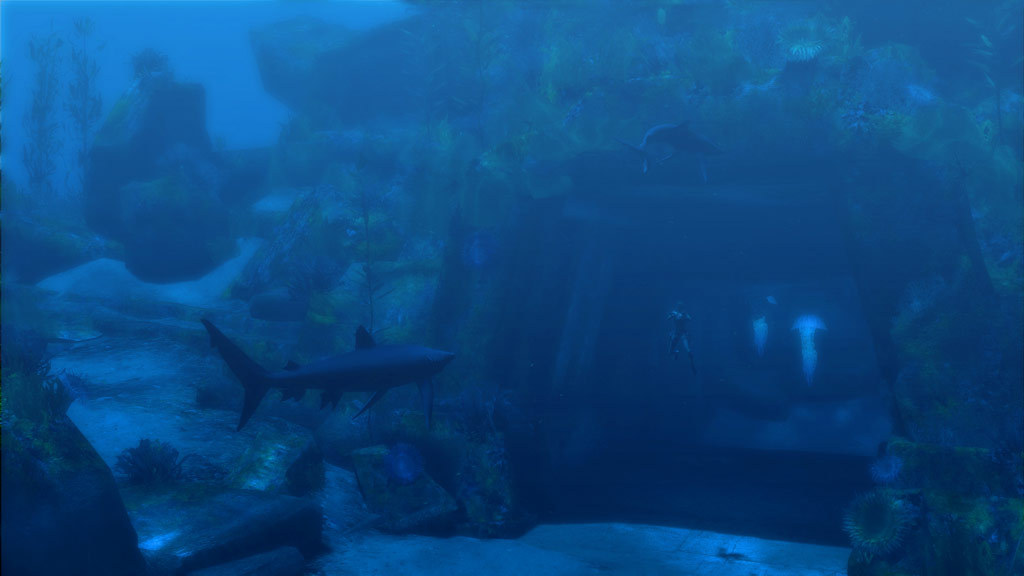
The grapple line also gives the environment a physical role in solving puzzles. Lara can attach it to a ring, walk along a wall while suspended, lower herself over an edge or pull a marked object into a new position. Moving an object or mechanism may expose a ledge or open a passage elsewhere in the chamber. Other puzzles ask her to carry portable poles, turn ancient devices or retrieve objects from one section and use them at another. Since these larger puzzles can send Lara across more than one area, an opened route may lead back through a room she has already crossed. Water is another traversal space rather than just scenery: Lara can swim through submerged corridors, search for an exit and surface where the next part of the ruin begins.
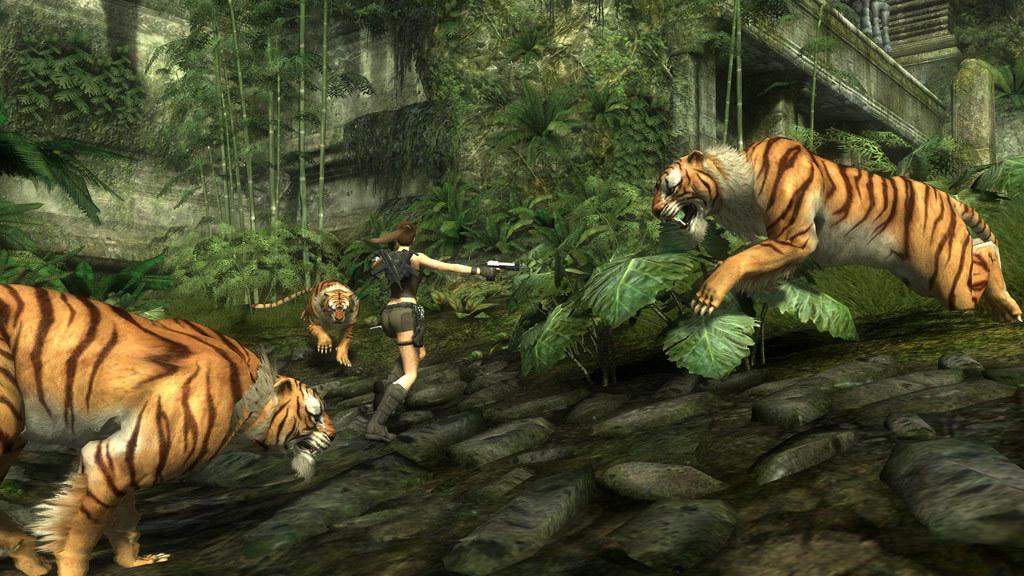
Combat stays in the background of the exploration but gives Lara several ways to handle threats. Her dual pistols have unlimited ammunition, while other weapons use limited ammunition and can be selected for each level through the PDA. Sticky grenades adhere to a target or surface, and Lara can kick enemies that get too close. As she damages enemies, the Adrenaline meter fills. With enough charge she can trigger an Adrenaline Headshot at close range, or spend the meter to slow time and line up more damaging shots. The choice is situational: use a close-range finish when an enemy is within reach, or keep distance and use the slower aiming window. This system replaces the earlier games’ quick-time prompts with player-controlled reactions during ordinary combat.
Lara’s PDA ties navigation, investigation and post-game replay together. During the adventure, it stores her journal entries and provides two levels of hints when the next step in a puzzle is unclear. Its map presents a wireframe view of the current area, useful for checking the surrounding shape while moving through large underground spaces. The Personal Light Source can illuminate dark passages, and the field camera gives Lara a way to inspect what she finds. After the main story is finished, Treasure Hunt mode lets players revisit completed levels to search for missed treasures and relics, with most enemies removed. It is available from the main menu, and Lara can use the PDA to travel between locations she has already visited. That mode turns the same environments into a quieter collection run, while the main campaign remains focused on reaching the next artifact and uncovering what the Norse trail has to do with Amelia.
- Developer
- Crystal Dynamics
- Genre
- Action-adventure