
About Tomb Raider I-III Remastered Starring Lara Croft
Tomb Raider I-III Remastered brings together Lara Croft’s first three adventures and their expansions. Across ancient ruins, cities, wilderness and underground complexes, Lara searches for the Scion, the Dagger of Xian and meteorite artifacts, using precise movement, environmental puzzles and a growing arsenal to cross traps and hostile ground.
This collection follows Lara Croft through three separate expeditions, each built around a different artifact and threat. In Tomb Raider, Jacqueline Natla hires Lara to recover the pieces of the Scion, sending her toward the lost city of Vilcabamba and older Atlantean ruins. Tomb Raider II takes Lara after the Dagger of Xian, a blade associated with the power of a dragon; the pursuit brings her into conflict with Marco Bartoli and the Fiamma Nera cult. Tomb Raider III begins with the search for the Infada Stone and expands into a hunt for meteorite artifacts tied to Dr. Willard and RX-Tech. The settings move from ancient tombs to Venice, Tibet, islands, industrial sites and London, so the trilogy’s travel is also a shift in the kind of danger Lara faces.
The shared core is a third-person action-adventure built around deliberate movement through spaces that function like physical puzzles. Lara runs, walks, jumps, swims, climbs, hangs from ledges, pulls switches and pushes blocks; a missed handhold or mistimed jump can be as dangerous as an enemy. Rooms often connect through keys, levers, movable objects and routes that loop back to earlier spaces. There are no objective markers to identify every solution, so the player reads the architecture, notices a reachable ledge or a differently shaped doorway, then tests how the route fits together. Hidden pickups and secrets reward looking away from the obvious path, while traps such as blades, collapsing floors and rolling hazards make observation part of traversal. The remasters retain this measured, spatial rhythm while offering both the original tank-style scheme and a modern control option.
Combat is an extension of Lara’s movement rather than a separate arena system. She automatically aims her equipped weapons at nearby threats and can keep firing while moving or jumping, then uses jumps and rolls to create distance from charging animals, guards and other opponents. Her dual pistols provide a dependable weapon, while shotguns, magnums, rifles and other finds draw on ammunition picked up in the levels. Medipacks restore health; flares briefly light dark passages. Ammunition and puzzle objects are found in the levels and used at encounters or route barriers. Tomb Raider II adds several vehicle sequences, including the speedboat in Venice and the snowmobile in Tibet. These sections change the pace and handling, but the central loop remains to cross hazardous ground, find the item or mechanism that opens the next route, and carry enough supplies through the encounter ahead.
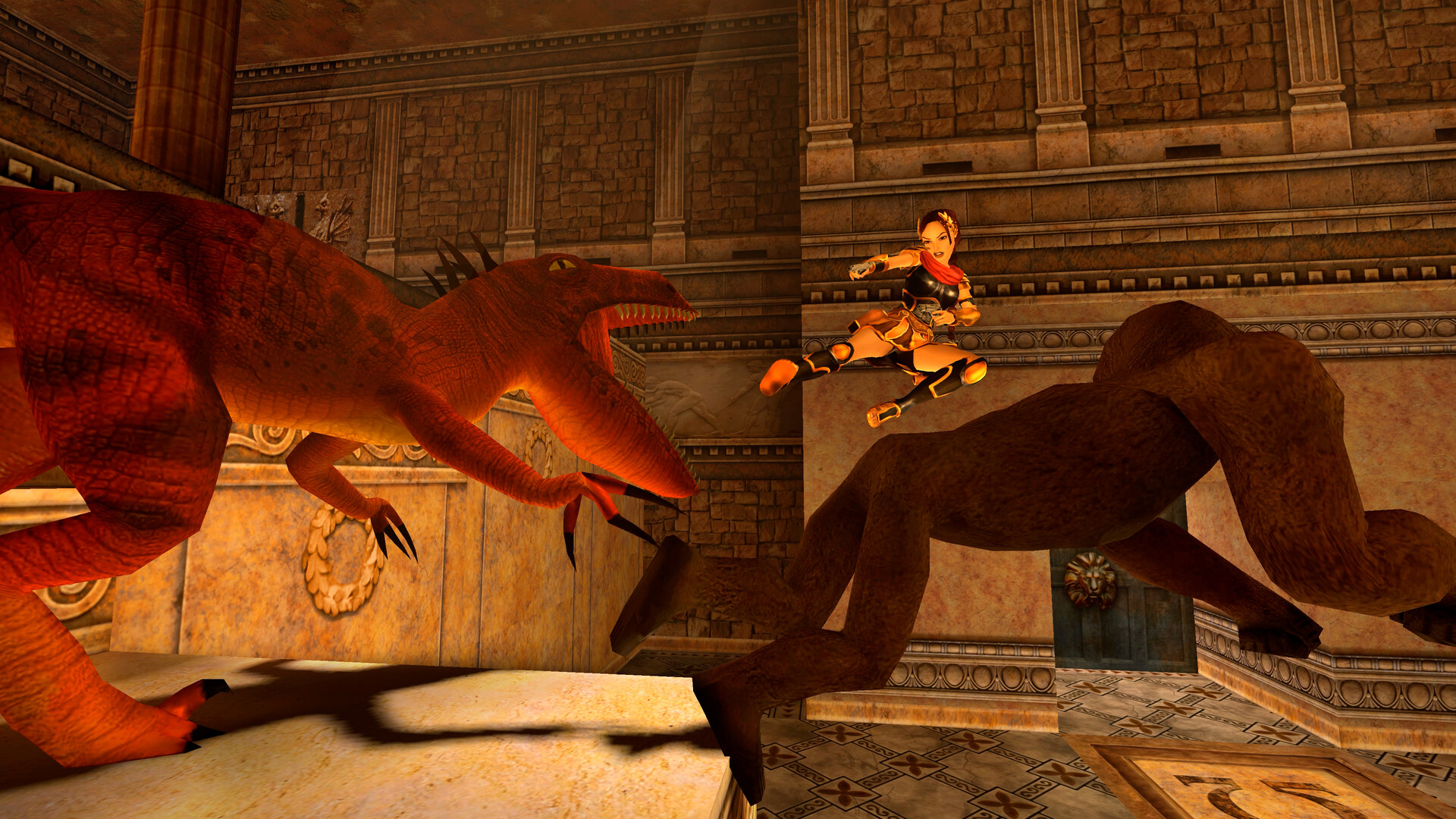
The first game is the most concentrated version of that loop. Lara’s pursuit of the Scion takes her through Peru, Greece, Egypt and the remains of Atlantis, with Jacqueline Natla’s mercenaries and fellow raider Pierre Dupont complicating the search. The levels combine animal encounters, ancient mechanisms and platforming, but the main problem is usually how to reach the next room or make a large structure work. Croft Manor serves as a movement tutorial before the expedition, and the campaign then builds on those actions through larger tombs and ruin complexes. The included Unfinished Business expansion adds four bonus levels in two chapters, returning to Atlantean spaces with a separate set of objectives.
Tomb Raider II broadens Lara’s route into a more varied globe-trotting chase. Venice’s canals and rooftops lead into the pursuit of the Dagger of Xian, while later areas include an offshore rig, a sunken ship and mountain terrain in Tibet. Bartoli’s followers use firearms and guard controlled spaces, making ammunition choices and movement through exposed corridors more important than in the first game. The speedboat and snowmobile let Lara cover ground in vehicle sections, while the levels also add more outdoor spaces and destructible scenery. The Golden Mask expansion is a separate five-level adventure set around a search for an ancient mask; it extends the second game’s exploration and combat without changing the main Dagger storyline. Across both parts, keys, switches and timed routes still determine progress, but the environments give those familiar tasks different visual and mechanical contexts.
Tomb Raider III makes the journey less uniform by letting players choose the order of several major regions after the opening section. Lara follows the meteorite trail through India, Nevada, the South Pacific and London before the expedition reaches Antarctica. The landscapes add more varied terrain, weather and lighting, and Lara gains additional moves as she deals with ledges, slopes, water and traps. Some passages offer alternate routes or require a different approach to a familiar obstacle, so the sequence of regions changes the feel of the campaign while still feeding the artifact search. The Lost Artifact expansion contributes six more levels, continuing Lara’s adventures after the main game.
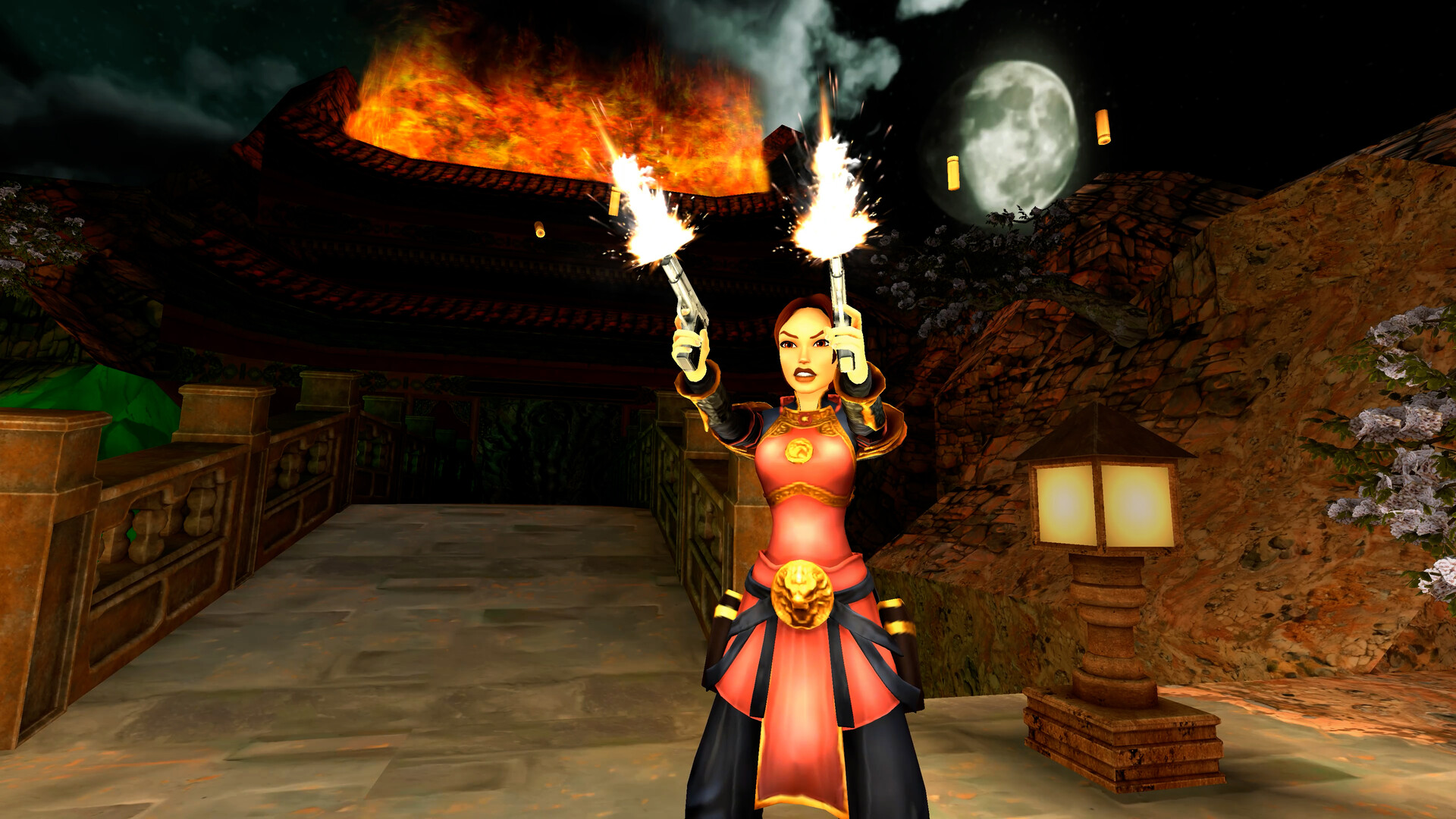
The remaster presents the three campaigns with upgraded graphics that can be switched to their original polygonal presentation at any time, and it includes the expansions and secret levels for all three games. Photo Mode lets the player pause a scene, pose Lara with available weapons and outfits, or inspect a level for hidden objects. A separate Challenge Mode adds level replay with adjustable conditions such as Lara’s health, equipment, enemy numbers and enemy strength; its modifiers change the challenge rating and rewards, and each replay begins with a fresh loadout unless equipment is selected. That mode gives completed levels a configurable return route, while the original campaigns keep their own progression and discoveries.
- Developer
- Aspyr, with Crystal Dynamics
- Genre
- Action-adventure