

About Tokyo Xanadu eX+
Ten years after an earthquake, student Kou Tokisaka discovers that Morimiya City’s hidden disasters connect to the Eclipse, a maze-like world inhabited by monsters called Greeds. As a Wielder, he and his allies balance ordinary school and city life with investigations and dungeon battles. This PC eX+ edition adds scenarios, characters, dungeons and modes to the original game.
Tokyo Xanadu eX+ is an action role-playing game set in Morimiya City, a rebuilt urban district on Tokyo’s outskirts. A decade earlier, a colossal earthquake devastated the capital; the calamity is tied to the Eclipse, a dangerous otherworld that overlaps with reality. High school student Kou Tokisaka first encounters this hidden threat while returning from a part-time job, when he finds student body president Asuka Hiiragi being harassed. Following her leads him to a monster and a sword-wielding girl in the Eclipse. The story follows Kou as he becomes involved with Wielders, people able to summon Soul Devices and enter the Eclipse. The danger reaches beyond individual encounters: the hidden world can be mistaken by ordinary residents for disappearances, natural disasters or urban legends, while organizations pursue competing ways to manage, use or seal it. The narrative moves between public life in a contemporary Japanese city and the maze-like spaces where Greeds gather, letting school relationships and local incidents sit alongside a larger supernatural conflict.
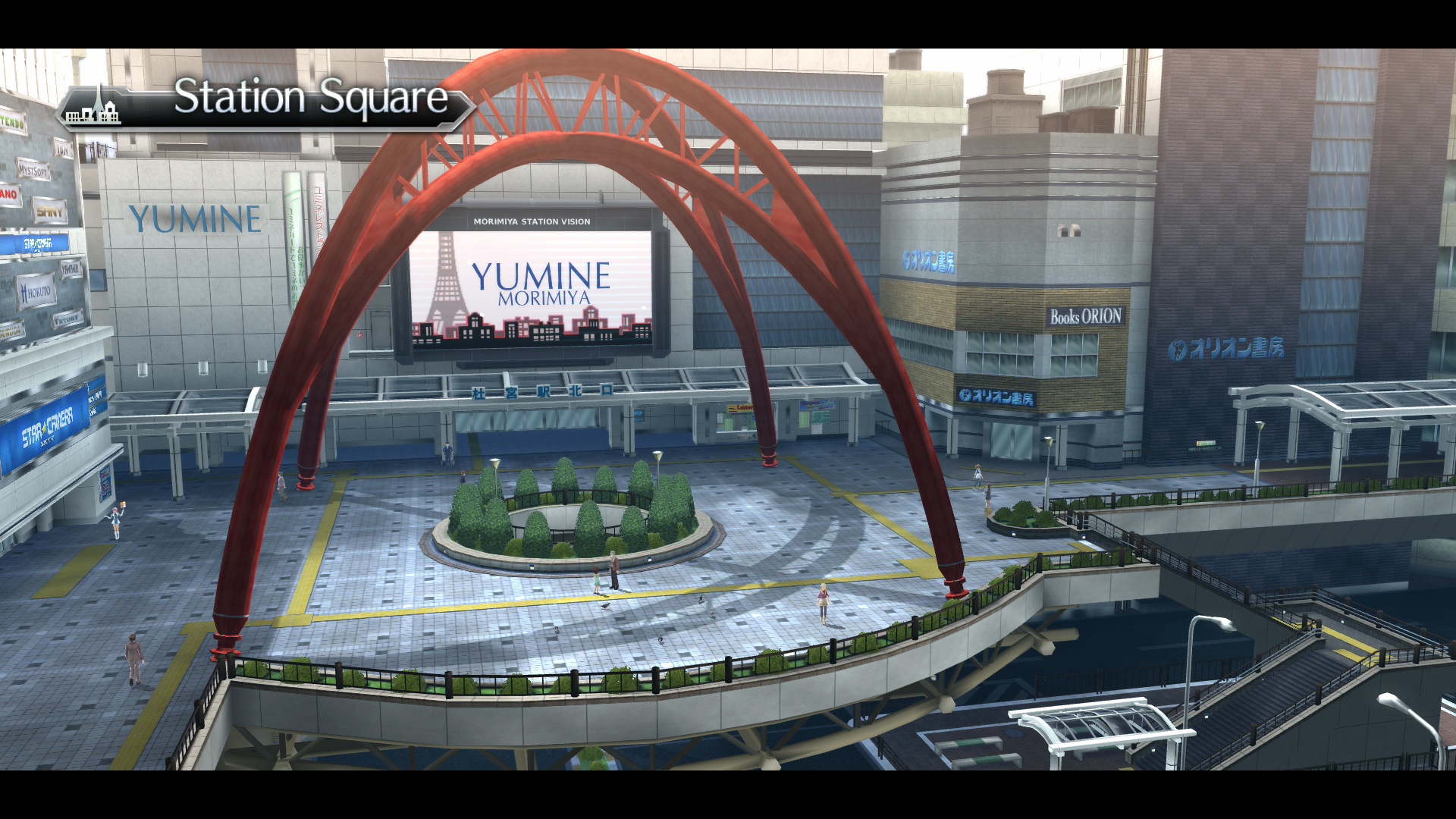
Morimiya is presented as a lived-in city with several distinct neighborhoods rather than a single school hub. Morimiya Academy is Kou’s co-ed high school, with classroom buildings, a library, club rooms, cafeteria and pool. Station Square connects the station to buses, subway and monorail services; nearby shops such as Star Camera and Books ORION make it a natural after-school gathering point. The old-fashioned Shopping Street links local businesses and familiar residents, while Brick Alley places cafés, boutiques and Kou’s part-time workplace in a more polished setting. Other locations include Kokonoe Shrine, associated with Kou’s grandfather Sousuke and his granddaughter Towa; Acros Tower, a commercial and cultural landmark; and Morimiya Memorial Park, whose lakeside paths and skate park contrast with Houraichou’s nighttime entertainment district. Moving among these places gives context to the people and routines that the Eclipse threatens. The city’s ordinary geography also makes the otherworld’s dungeon spaces a sharp change of scale and atmosphere.
Kou’s circle widens as the Eclipse enters school and city life. Asuka Hiiragi is the student body president whose return to Morimiya and connection to the Eclipse intersect with Kou’s first encounter. The ensemble also draws on people with different roles in the city, including shrine attendant Towa, childhood friend Shiori and Kou’s friend Ryouta, whose family runs Ibuki Grocery. SPiKA, a popular idol group that includes Rion, connects the school-age cast to Morimiya’s entertainment and media life. Around them are groups with opposing relationships to the Eclipse: Nemesis is an organization that says it manages the phenomenon and operates through society’s underbelly, while Zodiac is a union of powerful firms that seeks to use it. The Church of the Holy Spirit secretly operates the Kronos Orden, knights who aim to seal the Eclipse. These are not simply monster factions; their different stances make the Eclipse a social and political problem as well as a source of dungeon threats. Their activities provide the wider setting for the student group’s investigations without requiring the city’s residents to understand what is happening.
The Xiphone, a widely used personal terminal, ties daily routines and case information together through the NiAR app. NiAR includes a Main page for the story outline and next objective, a Quest record for main and accepted side quests, and a Friend section for party members, school friends, acquaintances and allies. Its Battle page keeps encounter history and enemy information, while Recipe and Book pages track food creations and reading material. Recipes can be used to create food items when the required recipe and ingredients are available; the result can vary with the cook and their experience. This device is both a setting detail and a practical organizer: it keeps objectives, relationships and discoveries accessible while Kou moves between school, work and investigations. Menus also provide equipment, character status and Soul Device customization. Equipment is changed by choosing a character and slot, then selecting a replacement item. These systems connect the story’s everyday communication technology to party management and dungeon preparation without turning the city sections into a separate game.
When an incident leads into the Eclipse, the Wielders explore dungeon stages populated by Greeds, the name given to the otherworld’s monsters. The Eclipse takes the form of a maze produced where reality and another world overlap; the event that opens a gate can be connected to occurrences in the real world. Combat offers several attack forms, including basic, ranged, power and flying skills, and show a stage structure that ends when its boss is defeated. Exploration includes combat encounters and breakable objects: destroying these can produce items and orbs, including Life Orbs that restore health. Breaking many objects also contributes to the stage rating. S-rank victories over Greeds can cause Gift Cubes to appear, which can be attacked for rare items. Golden relics restore HP, and the Camp Menu can be opened at one to save; green relics provide the same save function without restoring health. These details make the dungeon route a cycle of fighting, watching resources and interacting with the environment, rather than a sequence of boss arenas alone.
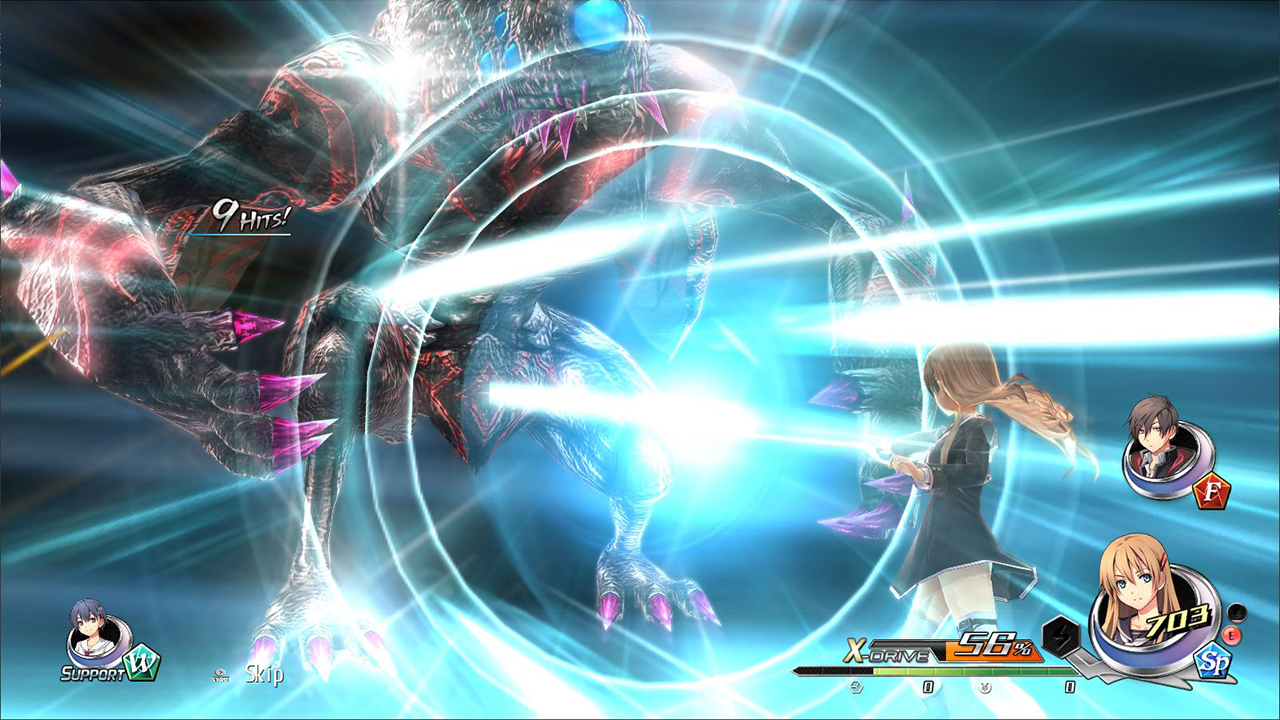
Combat is real-time, with basic attacks and skills used against monsters as the player moves through a stage. Each character has an attribute, and five attributes apply to characters’ weapons and enemies, creating opportunities to match attacks to weaknesses. Skill use depends on a Skill Gauge, while damage, experience, HP, physical and magical defenses, and different skill categories are tracked in character status. Successful play can build resources for two major team abilities. Strike Points rise through basic attacks and more quickly through skill attacks, kill bonuses and combo milestones; spending one point activates the character’s unique X-Strike. At Soul Level 3, a partner or support character can join a Strike Chain follow-up through a prompted command. Damage also produces Drive Orbs, with breakable objects as another source. These fill the D-Gauge, and at 100 percent the player can trigger X-Drive. It allows continuous skill use, gradually restores HP, makes attacks use an effective attribute and can provide further benefits such as resistance to status ailments and faster movement. The choice of active character and partner matters because their attributes determine X-Drive’s Drive Ability, with matching attributes strengthening its effect.
Longer-term growth connects story and relationships to combat setup. Characters gain experience and levels, while Soul Points earned through story progress and Friendship Episodes raise an individual Soul Level. Reaching new levels unlocks Soul Abilities; Soul Level 3 enables Strike Chain and level 4 improves X-Drive’s effects. The Soul Device adds another layer: it has a Base with grids, Free grids that accept Elements, attribute-restricted grids that require a matching Element, and a Master Core that can be changed later in the story. Equipment and Elements can therefore be adjusted alongside character statistics rather than relying on levels alone. Between stages, the city offers quests, conversations, relationship-building, mini-games, equipment upgrades and dungeon training. The PC eX+ product is the enhanced version of Tokyo Xanadu and is identified by Falcom as the Steam release; it runs at 60 FPS and includes additional scenarios, playable characters, monsters, dungeons, bosses and Time Attack and Boss Rush modes. It also adds Wielder stories and an extra quest available after completing the game. These additions belong to eX+; Aksys’s later Switch release is separately described as including all additional content and a revamped localization, so that platform-specific localization statement does not define this PC edition.
- Developer
- Nihon Falcom
- Genre
- Action role-playing game