
About TimeShift
After Dr. Aiden Krone alters history, an unnamed scientist follows him in the experimental Beta Suit and becomes trapped in an authoritarian version of 1939. As the Alpha District’s rebellion fights Krone’s regime, the suit’s ability to slow, stop and rewind time shapes firefights, movement and environmental obstacles.
TimeShift opens in a near-future research facility where a project called N.E.X.T.2 has produced two time-travel devices: the Alpha Suit and the more advanced Beta Suit. Dr. Aiden Krone, the programme’s director, takes the Alpha Suit and jumps into the past, leaving the facility in danger. The player follows as the unnamed Beta Suiter, a scientist whose earlier motives are revealed only in fragments. The jump leads to an alternate version of 1939, where Krone has used his knowledge of the future to build a military regime. The immediate goal is to survive this new timeline, find a route back and help undo the damage caused by Krone’s intervention.
The campaign’s main setting is Alpha District, a rain-soaked city under siege. Krone’s forces control the streets with soldiers, vehicles and heavy machinery, while the Occupant Rebellion fights to regain ground under Commander Mason Cooke. The regime’s authority reaches into civilian life, and the district’s ruined buildings and barricaded roads show a population living under occupation. Rather than placing the player in command of a large force, the story follows one combatant moving through this conflict. Brief flashback scenes return to the near-future research group and introduce Dr. Marissa Foster and Dr. Nathan Tucker, connecting the rebellion’s struggle to the experiment that created the crisis.
The Beta Suit makes the passage of time a direct combat resource. Its three powers slow events, stop them or rewind them, while the suited player and their weapon continue moving normally. These effects consume a limited energy supply; after it runs low, the suit gradually recharges. Slowing a fight can create a short opening to cross a dangerous line or aim at enemies, while stopping time lets the player act as the battlefield remains suspended. Rewind provides another way to manipulate a situation as it unfolds. The suit’s onboard system, S.S.A.M., helps select a context-appropriate time effect through a single control, so the mechanic is designed to be used while aiming, firing and moving rather than through a separate puzzle interface.
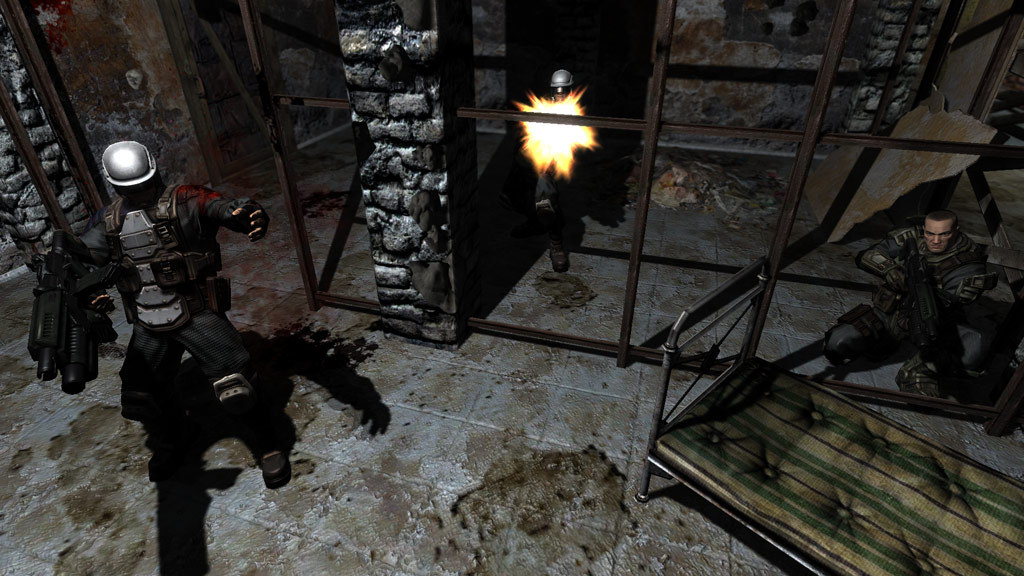
Time control also changes how the player handles ordinary obstacles. Since the Beta Suiter is not affected in the same way as the surrounding world, slowing, stopping or reversing time can make hazards and moving objects into temporary routes through an encounter. The game applies the same idea to environmental puzzles as to firefights: the player reads what is moving or blocking the path, uses the appropriate time effect, and acts during the opening it creates. Each activation draws on suit energy, so using a power at every opportunity can leave less available for the next encounter. This resource loop encourages the player to switch between ordinary shooting and time manipulation, then allow the suit to recover when the immediate pressure eases.
Firearms remain the other half of the campaign’s combat loop. The player can carry up to three guns, collecting them from weapon crates, armouries and fallen opponents, or taking a weapon from a living enemy while time is slowed or stopped. The named arsenal includes the KM-33 and KM 2103 Karbine, the close-range ShatterGun, the Echo Rifle, Thunderbolt, E.M.F. Cannon, Bloodhound, Hell-Fire and SurgeGun. Their different roles make range and enemy position relevant alongside the time abilities: the player can select a weapon for the current fight, then create a safer moment to change position or attack. Grenades, mines and deployable turrets add further tools to the combat space, with options such as Clutch and Swarm Grenades, Spring Mines, Laser Trip Mines and defensive turrets.
The route through Alpha District mixes infantry encounters with changes in scale and pace. Vehicles and machines include the Prowler, Quad, troop transporter and the imposing Sentinel, while cranes, aircraft and other industrial equipment contribute to the occupied city’s military infrastructure. The Sentinel is also tied to the conflict’s larger stakes: it is a walking fortress fielded by Krone’s forces, not just another foot soldier. Across the campaign’s 24 combat missions, the player advances through changing battle conditions and follows the rebellion’s effort to push back the regime. The story’s near-future flashbacks provide context between these missions without shifting the playable action away from the alternate Alpha District.
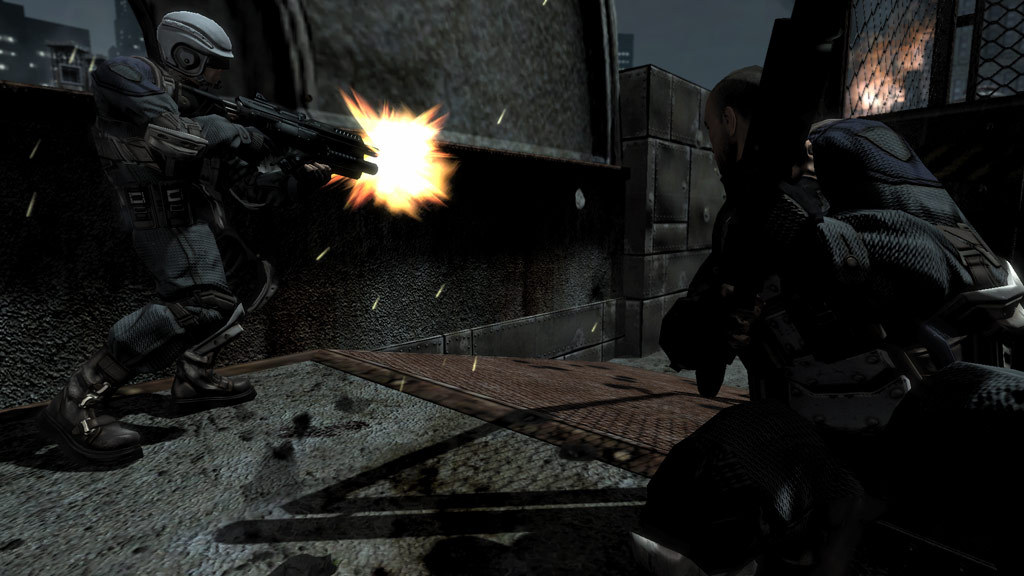
The original multiplayer design gives time control a separate match setting. It supports matches of up to 16 players across 14 maps, with time grenades that let players slow, stop or reverse time. More than 40 customization features let players tailor multiplayer. These mechanics carry the central time-shift concept into competitive rounds: instead of activating the Beta Suit directly as in the campaign, a player uses a grenade to alter the flow of a match. Opponents can respond from their own perspective, making a grenade a tactical interruption shared across the arena. Maps and configurable match rules provide the structure around those encounters, which have their own competitive objectives and pacing.
- Developer
- Saber Interactive
- Genre
- First-person shooter