
About Timberborn
After humanity’s disappearance, beaver societies attempt to establish lasting settlements in a drought-struck, polluted world. Timberborn is a city-building simulation about managing water, food, housing and power through changing seasons. Choose between the Folktails and Iron Teeth, reshape rivers and terrain, and expand a settlement through vertical construction and increasingly complex production.
Timberborn takes place long after humanity has vanished, leaving a damaged landscape for intelligent beavers to inhabit. The player establishes and manages a settlement rather than following a human protagonist or a fixed campaign narrative. Beavers need water, food and places to live, while the settlement depends on workers, materials and power to grow. Droughts and toxic waste make survival a problem of planning across changing conditions: a colony must develop enough infrastructure and stores to withstand difficult seasons while making productive use of the land. Human structures and remnants can still be found, but the focus is on how the beavers adapt their society and engineering to an environment that no longer supports human life.
Players choose between the Folktails and Iron Teeth, whose buildings and production chains give each settlement a different character. Folktails rely on renewable power from water, wind, beaver muscle and geothermal energy, and can use Beehives to speed crop growth. Their food choices include raw carrots and sunflower seeds, grilled potatoes and Spadderdock, or wheat milled into flour and baked into bread. Iron Teeth emphasize mechanical industry: Steam Engines use logs and water for power, their Breeding Pods produce kits, and their diets include crops such as kohlrabi, soybeans, mushrooms and cassavas. They can produce food rations from corn, eggplants or algae. Their bots use a Control Tower signal to work efficiently, while Folktails’ machine beavers run on crop-derived biofuel. These faction-specific systems affect how players plan population, power and production.
Water engineering is a central city-building system. Water has three-dimensional flow: it can spill over terrain, form waterfalls, build pressure, irrigate soil and move through raised aqueducts. The player shapes its course with dams, levees, floodgates and valves; pumps can draw it into tanks or reservoirs, while water wheels convert flow into power. Speed and pressure influence where a wheel is useful, and water can be redirected away from one area toward fields or storage elsewhere. Badwater is a separate fluid that can contaminate land, so routing decisions also matter for safety. Water and badwater sources, seep objects and aquifers give maps different starting conditions for irrigation and settlement design.
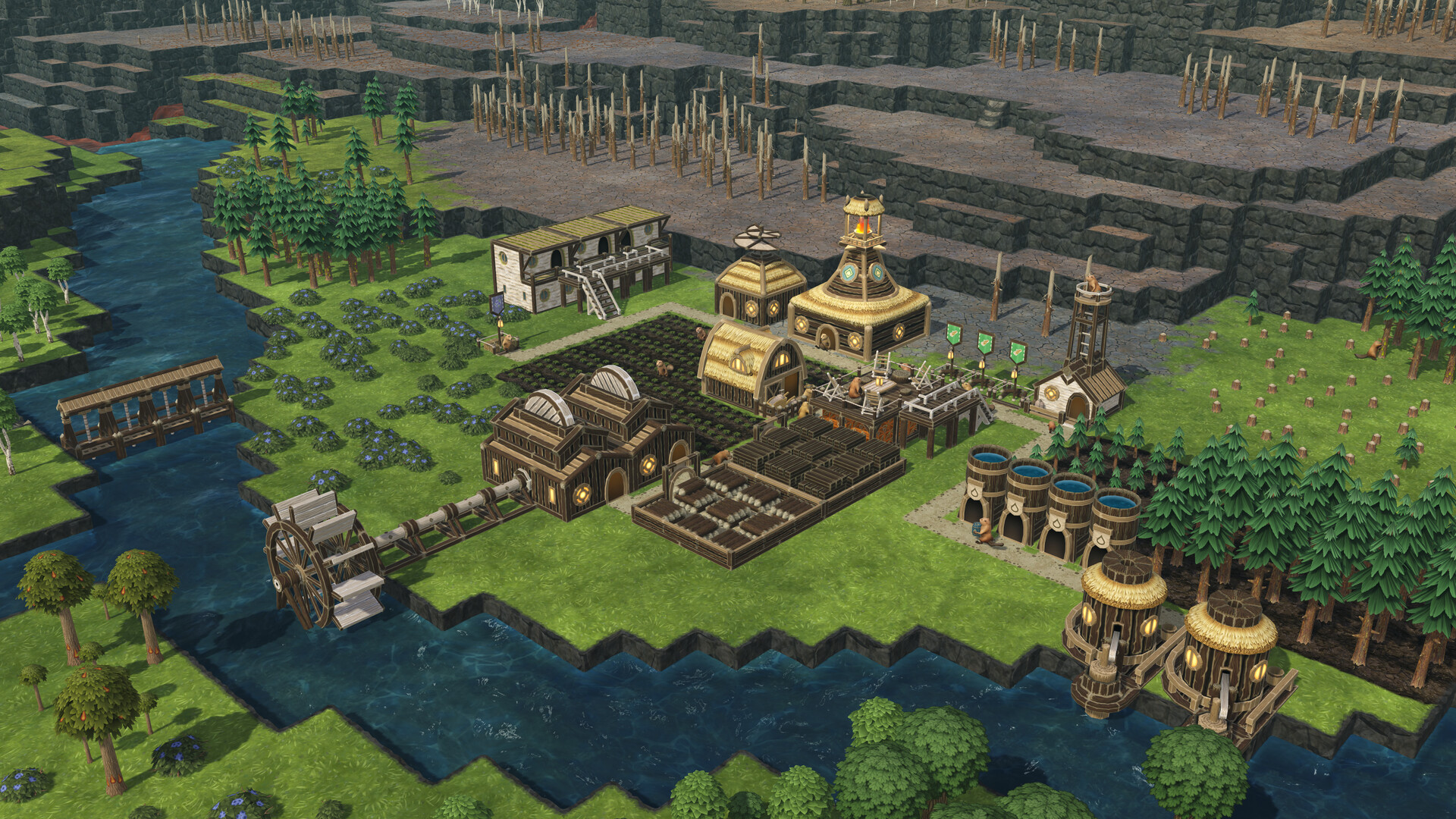
The environmental cycle forces the colony to prepare for scarcity and contamination. Droughts threaten water supplies, while badtides bring dangerous badwater into the landscape; stored food and reserves help the settlement endure disruptions. Some map objects add hazards or opportunities that require a different response. An Unstable Core can activate after a warning, and beavers cannot switch it off, so they must mitigate its effects. Thorns obstruct access and take time to remove, creating a choice between clearing a route and working elsewhere. Geothermal Fields can power a Geothermal Engine, while relics left by earlier inhabitants provide Science Points. These objects turn the wasteland itself into a source of risks, resources and obstacles rather than an empty surface for construction.
Settlement layouts use height as well as land area. Lodges, workshops, platforms, bridges and other structures can be stacked or connected across levels, allowing buildings and paths to fit into constrained terrain. A power network must reach the machinery that depends on it, and buildings need workable routes for both workers and materials. Each faction has a mass-transit option for extending those routes: Folktails connect Zipline Stations with pylons and beams, while Iron Teeth use sealed Tubeways that can climb vertically and pass through water or badwater. The transportation choice complements each faction’s architecture and changes how players link distant work areas within a growing colony.
A settlement’s economy develops through gathering and processing. Beavers harvest resources, carry them to workplaces and turn them into construction materials, food or other goods; those outputs then support further buildings and production. The player balances workers among extraction, farming, workshops, services and infrastructure as the colony expands. The settlement must provide food and housing to sustain its workers, and leisure buildings add further needs to plan for. Leisure and comfort buildings also form part of settlement life, with Folktails able to build Campfires, Dance Halls or Carousels and Iron Teeth using facilities such as Swimming Pools and Exercise Plazas. The colony’s development therefore includes social needs alongside material supply.
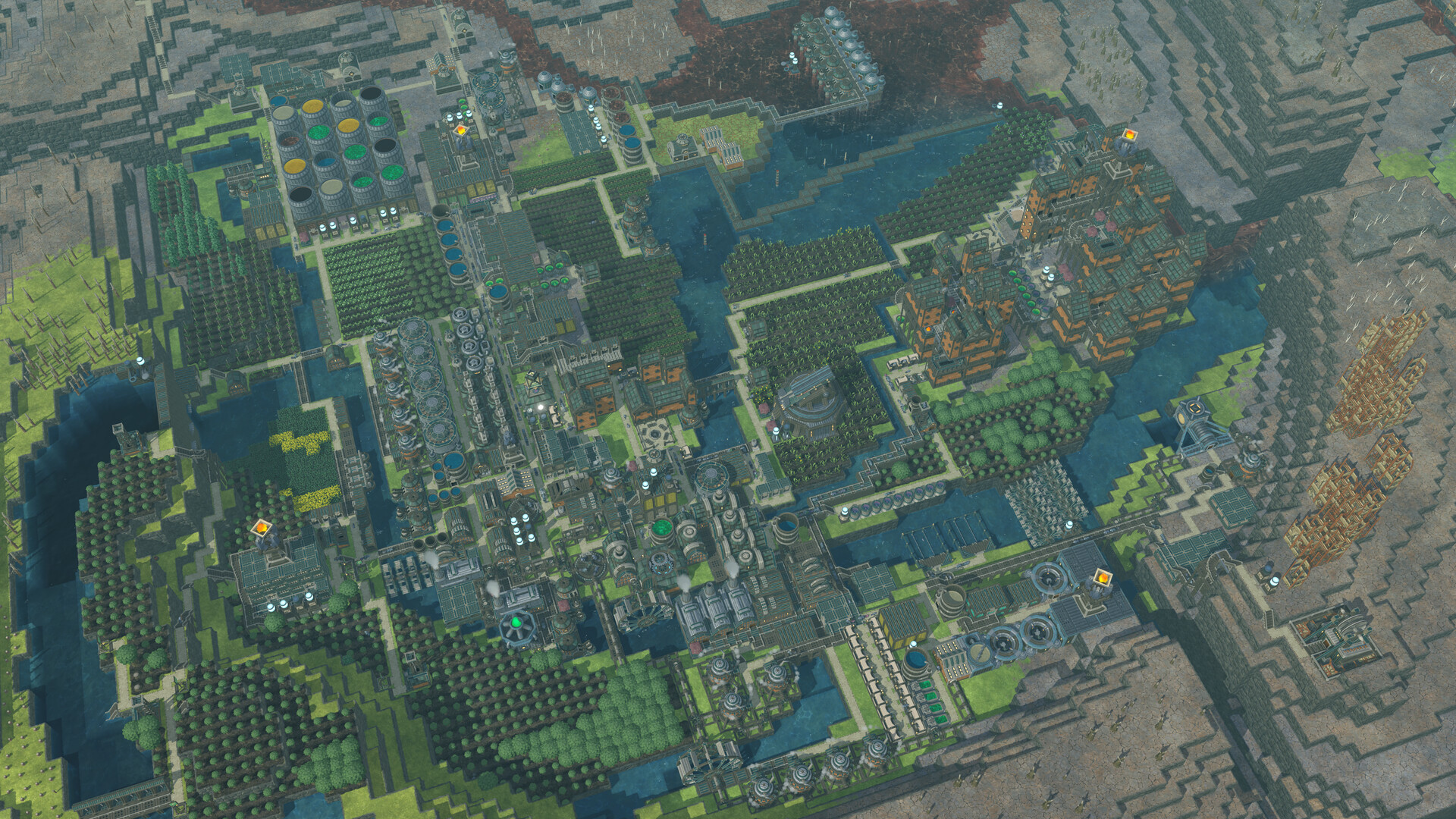
Long-term goals and control tools round out the sandbox. Each faction has a wonder tied to its approach: the Folktails’ Earth Recultivator distributes tree and crop seeds, while the Iron Teeth’s Earth Repopulator sends beavers toward remote areas. In 1.0, more than twenty control buildings, including Sensors, Relays and Timers, let players set up operations that respond to signals or schedules. The full release also provides built-in maps and a map editor for creating or revising layouts, including the addition of interactive objects that change local challenges. These tools let a settlement’s endgame reflect both the chosen faction and the landscape it has been built to manage.
- Developer
- Mechanistry
- Genre
- Single-player city-building simulation and strategy