
About Thimbleweed Park
In 1987, two federal agents investigate a body beneath a bridge in the declining town of Thimbleweed Park. Their case draws in a ghost, a foul-mouthed clown and a would-be game designer. Switching among five characters, the player explores the town, joins clues across their stories and solves puzzles in Casual or Hard mode.
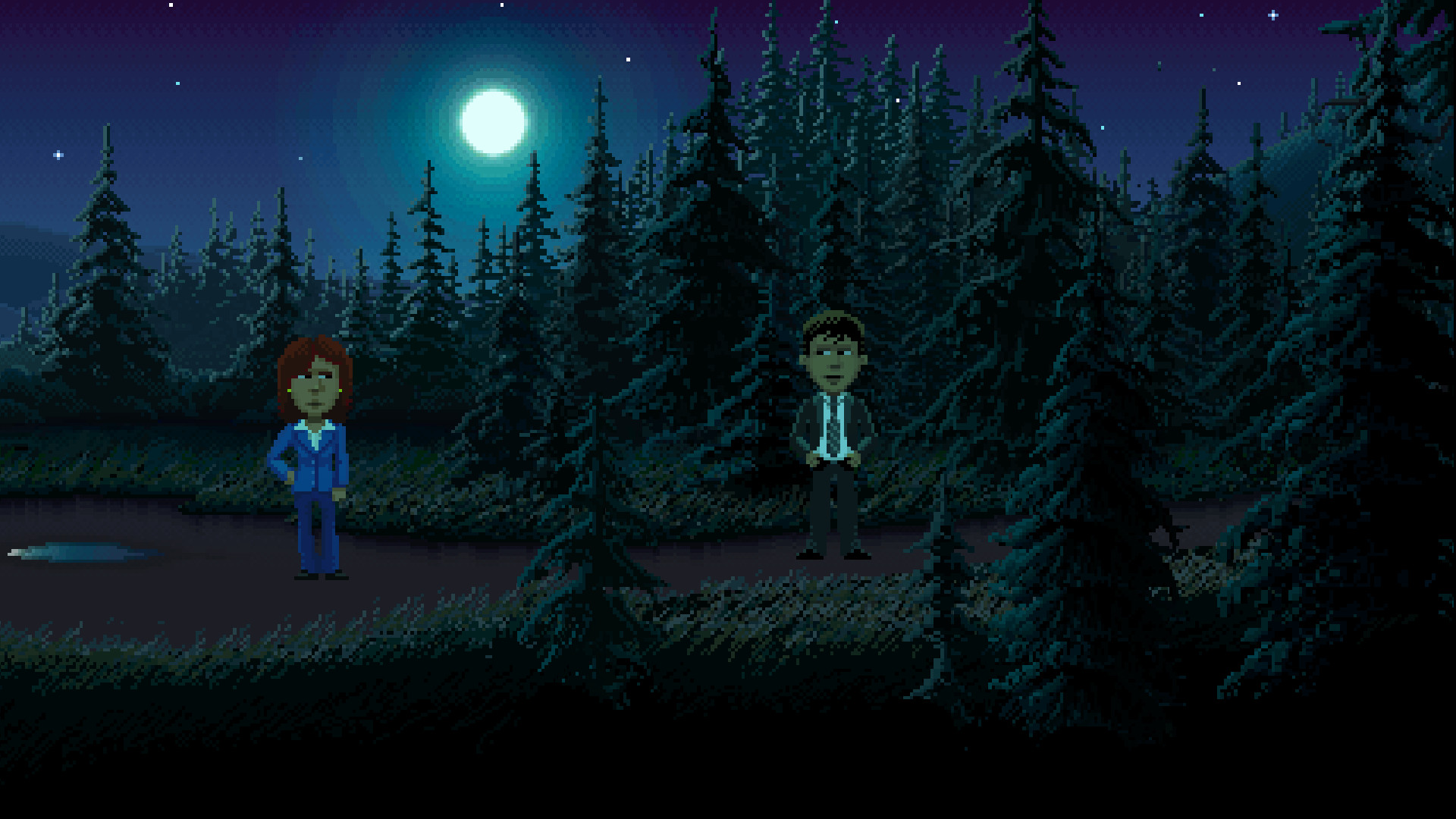
The investigation begins with a body discovered beneath a bridge outside Thimbleweed Park, a small town whose empty streets and fading businesses sit alongside stranger sights: a haunted hotel, an abandoned circus, a pillow factory burned out years earlier and a bathroom fitted with vacuum-tube toilets. The story is set in 1987, when federal agent Ray and Junior Agent Reyes arrive to determine what happened. The apparent murder is only an entry point into a mystery tied to the town and its residents. Each visitor and local seems to have a separate concern, and the agents’ questions gradually connect those concerns to events that predate their arrival. The game uses a classic point-and-click adventure structure: the player directs a character around illustrated locations, examines objects, speaks with people and works out how an action in one place can open a path somewhere else. Thimbleweed Park is presented as a contained community rather than a large continuous map. Familiar buildings recur as the case expands, and the contrast between the everyday town and its inexplicable features supplies both the investigation’s atmosphere and its comic tone.
Ray and Reyes are only two of the five playable characters. As the investigation develops, the player also follows Delores, who wants to make video games despite family expectations; Ransome, the insulting clown whose public persona has become a burden; and Franklin, a ghost whose unfinished connection to his daughter shapes his part of the story. Their personal situations are introduced through short flashbacks, after which the player can switch among them. The cast is not a menu of alternative heroes: all five contribute to the same larger account, though the optional portions of their individual stories can vary with how much the player pursues. This structure gives the town several points of view. A locked door, a conversation or a newly accessible room may matter to one character while another has a separate lead to follow. Ray and Reyes approach the place as investigators, while Delores, Ransome and Franklin bring their own histories and relationships into its spaces. The game’s central activity is therefore divided between discovering what the body has to do with the town and understanding why these five people are there at all.
Progress is built around switching characters and carrying information between their separate threads. The main mystery is divided into acts, and the character stories are interwoven with it rather than arranged as five complete episodes played one after another. Some character chapters feed directly into the shared investigation, while later personal material can be left for after the main story. A clue or obstacle that one character cannot handle may be addressed by another, so the player must keep track of who can reach a location, what each person knows and which object belongs in whose inventory. Character switching is available directly during play, and scenes can be revisited as fresh leads arrive. The design encourages the player to treat the whole cast as a connected set of investigators: a conversation in one thread can give context to a puzzle in another, and an item found on one character can become useful after changing control. The primary progression comes from making discoveries, completing interdependent character tasks and opening the next part of the case, while leaving some portions of each person’s background optional.
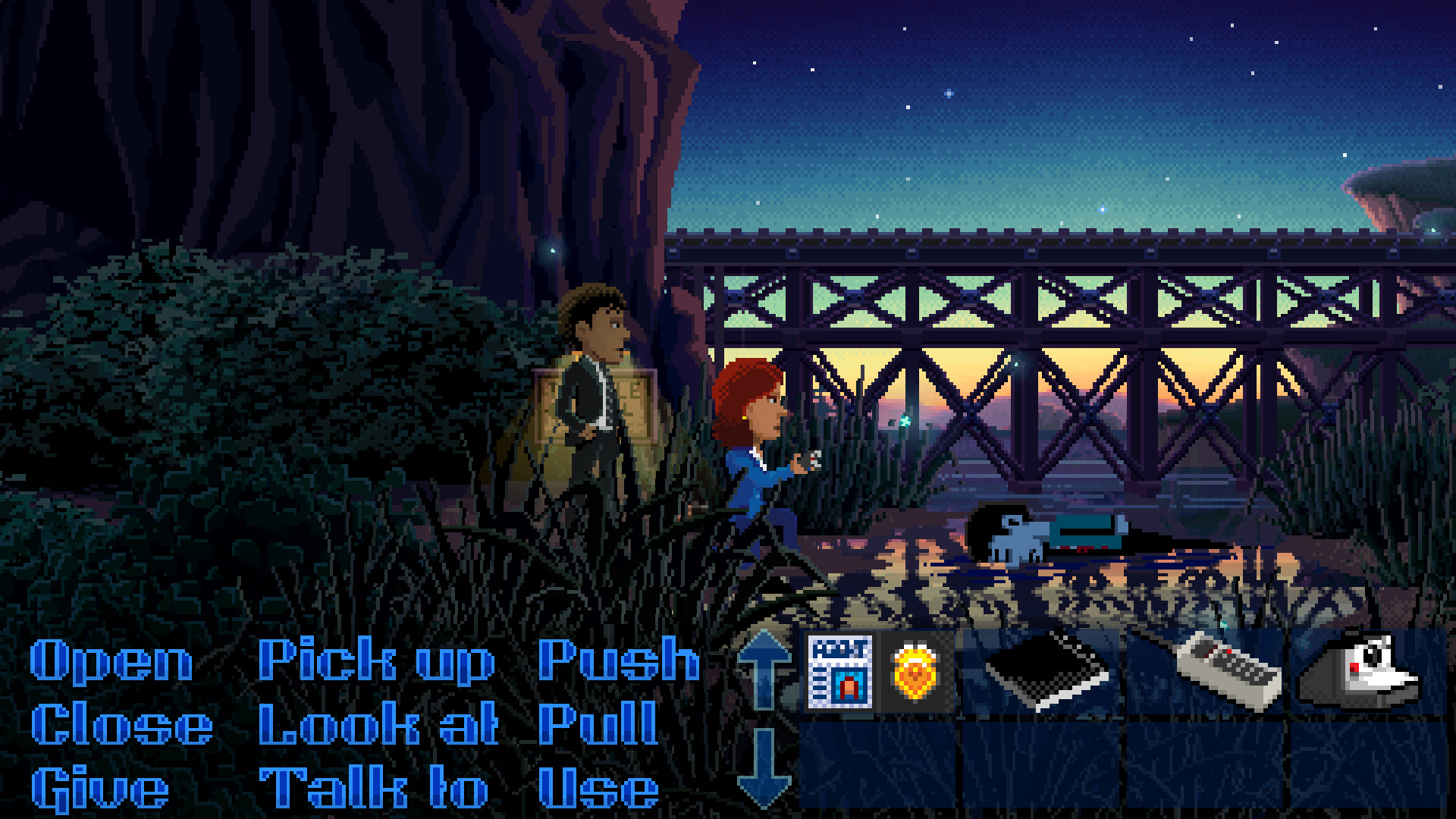
The puzzles use an inventory and a verb-based point-and-click interface. Characters can inspect people and objects, talk, pick things up and apply held items to elements of a scene or to other inventory objects. The interface makes the possible kinds of action explicit, while the challenge lies in identifying which action fits the situation and connecting clues found across rooms. A tool or scrap of information may have no obvious use when first discovered; later dialogue or an altered scene can give it meaning. The player’s task is to read the environment, exhaust useful conversations and test plausible item combinations without losing track of which character currently holds an object. This is not a game about reflexes, combat or character statistics. Movement is point-and-click navigation through fixed, hand-composed scenes, and the main obstacles are logical or contextual. Since the five stories overlap, puzzle progress can mean changing perspective as much as finding a new object. When a character seems to have reached a dead end, another’s inventory, access or knowledge may supply the missing link. That shared problem-solving loop gives the ensemble structure mechanical purpose: the cast’s personal routes are also parts of the larger puzzle system.
The town’s locations turn the mystery into a sequence of revisits and newly opened routes. The hotel, circus, factory, diner and other public or private spaces each have people to question and objects that can be examined. Conversations are important because characters often reveal what they have seen, what they want or what they refuse to discuss; a seemingly comic exchange may also establish a practical clue. Different characters bring different reasons to enter a room, and scenes can read differently when approached from another point of view. The player uses the town as an investigation board, where a remembered detail links one location to another and an item or conversation can make an earlier scene newly relevant. The setting’s quiet decay is part of that logic. The residents have routines and grudges that continue while the agents search for evidence, so solving a puzzle often requires understanding the local relationships rather than treating every person as a dispenser of clues. The growing case and the residents’ private stories gradually make the town feel less like a set of disconnected joke locations.
Thimbleweed Park presents its world with pixel-art characters and backgrounds, animated scenes and a deliberately old-fashioned interface. Its small-town landscape is built from readable silhouettes and specific details: roadside spaces, interior rooms, the hotel and its odd fittings, the circus grounds and the industrial remains around the factory. This visual language supports a story that combines a murder investigation with surreal interruptions and dry humor. English voice acting and the cast’s performances distinguish the agents’ investigative exchanges from Ransome’s insults, Delores’s ambitions and Franklin’s ghostly predicament. The game also uses music and sound to establish shifts between ordinary locations and the uncanny events around them. Presentation is consistent with the adventure format: characters move through composed scenes, speak with whoever is present, and interact with highlighted objects through the verb-and-inventory system. Much of its character comes from the contrast between what can be seen in a room and what a person says about it, with visual jokes and recurring objects complementing the dialogue. The tone can shift from an absurd detail to a serious personal concern without abandoning the mystery structure.
The full game offers Casual and Hard modes with different difficulty levels. Both use the same central town and investigation, while the selected mode changes the challenge of the adventure. The PC listing identifies Terrible Toybox as developer and publisher and describes a single-player adventure; Nintendo’s Switch listing likewise identifies the five-character mystery and its two modes. The Switch version lists touch-screen support and the handheld, tabletop and TV play modes. Platform editions retain the point-and-click adventure, though controls and interface presentation vary with the device. This profile refers to the complete game rather than a demo or a specific platform build. Its scope is the spoiler-light setup and the systems that carry the investigation forward; it does not resolve the identity behind the murder or the later turns in the characters’ stories. As players move between Ray, Reyes, Delores, Ransome and Franklin, the same set of places accumulates new meanings. Their interlocking paths make both the town’s history and the act of solving its puzzles depend on looking at the case from more than one character’s position.
- Developer
- Terrible Toybox
- Genre
- Single-player point-and-click adventure / mystery