
About Thief II: The Metal Age
Garrett returns to the City for a new sequence of thefts amid the rise of the Mechanists, a technology-driven religious movement and growing civic corruption. Across fifteen non-linear missions, he studies patrols, shadows and sound, steals valuables and uses specialized tools to avoid detection or find another route.
Thief II: The Metal Age follows Garrett, a thief who makes his living among the City’s wealthy households, merchants and institutions. The setting has changed since the earlier campaign: a new Mechanist sect has grown from a split in the Hammerite faith, and its devotion to machinery is reshaping the city around it. New technology, civic corruption and the influence of rich nobility give Garrett's work a different backdrop. The story begins with another job and gradually draws him into the tensions surrounding this new religious and civic order. Garrett remains an independent operator rather than a soldier serving one faction; his immediate concerns are access, valuables and survival, even as his assignments connect to the larger conflict. The game presents this setting through mission briefings, environmental details and conversations that can be overheard while moving through guarded spaces.
The campaign is organized as fifteen large, non-linear missions. Each assignment sets objectives and sends Garrett into a location where several routes may lead toward the target. A map and compass help orient the player, and the map can be marked with notes; the objectives screen records which requirements have been met. Jobs may involve entering a private residence, crossing a public or industrial complex, retrieving particular property or reaching a protected area. The route through a building is part of the problem: a locked door can call for a key or lockpicks, while a balcony, service passage or upper level may provide another way around a guard. Loot contributes to the mission's requirements, and harder difficulty settings can add minimum amounts, specific tasks or restrictions. The same level therefore asks the player to interpret the brief, learn its layout and manage exposure instead of simply moving toward a visible marker.
Stealth depends on light, sound and the way Garrett moves through the environment. The Visibility Gem gives an ongoing indication of how exposed he is: the dark helps conceal him, while entering a bright area raises the risk of being seen. Guards also respond to noises, and different floor materials make different amounts of sound underfoot. Walking slowly, crouching, waiting for a patrol to pass or using a softer route can reduce the chance of drawing attention. Sound carries useful information in the other direction too: footsteps help the player estimate where a guard is and how close the patrol has come. If a guard notices something, he can investigate and alert others, so a small mistake can turn a quiet room into a search. Studying a route before crossing it gives time to account for doors, light sources, hard floors and places to hide rather than relying on speed once suspicion has started.
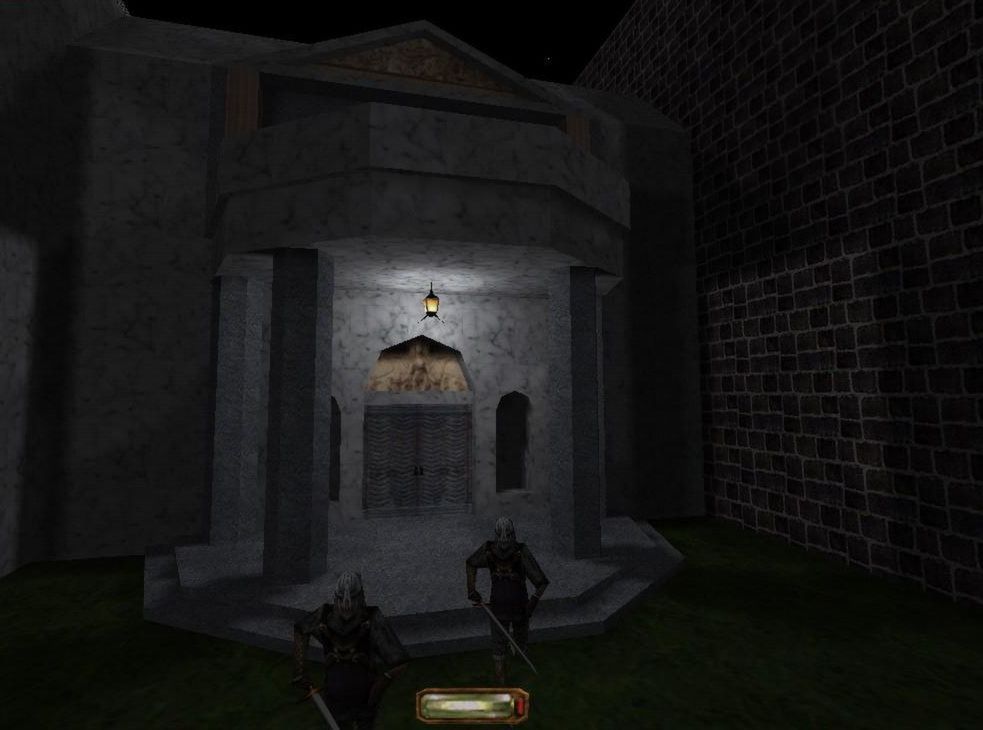
Garrett’s equipment supports several ways to influence a guarded space. His blackjack can knock out an unaware human guard, while his sword and broadhead arrows make open combat possible but risky. Water arrows extinguish torches and gas lamps, though electric lighting resists them; moss arrows cover a normally loud surface so it can be crossed quietly. Rope arrows attach to suitable surfaces and provide a climbable line, while the sequel also has vine arrows that can anchor to additional materials such as metal grating. Noisemaker arrows bounce and sound at their resting place, drawing attention away from Garrett long enough to pass. Special arrows and throwables are carried in limited quantities, and using one can solve a local obstacle at the cost of that resource. A player can choose to wait for a guard to move, quiet the floor, darken a torch-lit path, or use a distraction, with each option suited to a different arrangement of light, patrols and architecture.
The sequel adds tools that let Garrett gather information before committing to a route. His mechanical eye can zoom in on distant surroundings, making it easier to inspect a space from cover. A scouting orb can be thrown into an area; once it stops, the player's view shifts to the orb so the room can be surveyed without immediately alerting its occupants. The orb must be recovered before it can be used again unless Garrett has another. Maps and notes complement this remote view: together, they help the player plan an approach and remember which doors, passages or hazards have been found. The city’s technological theme also appears in mechanical security. Watchers can detect intruders and trigger alarms, while robots and turrets create threats that behave differently from human patrols. Their presence makes it useful to distinguish an ordinary guard problem from a device that can call other defenses into action.
Before each mission, Garrett reviews its objectives and loadout, then can spend available cash on equipment for that job. Starting gear varies by assignment, and purchased supplies are selected from a priced list; money and tools do not carry over as a permanent inventory between missions. Difficulty is also chosen mission by mission, and cannot be changed once the assignment is underway. Normal, Hard and Expert alter the objective set and challenge: higher levels can require more loot, add tasks, lock doors, remove supplies or increase enemy numbers and strength. Expert often requires the player to avoid killing human characters. At the end of a job, the results lead into the next briefing and another round of planning. This structure makes resource decisions specific to the level ahead. Choosing water arrows, moss arrows, flash bombs or scouting gear depends on the mission's spaces and objectives, and the player has to decide when avoiding a problem is more valuable than spending equipment to remove it.
- Developer
- Looking Glass Studios
- Genre
- Stealth action / simulation