
About Thief
In Thief, Garrett returns to the fog-bound City, where Baron Northcrest’s Watch tightens its grip as a mysterious sickness spreads. Work through guarded homes and larger heists in first person, reading light and sound, opening locks, lifting valuables, and choosing when to slip past a patrol or use the tools in your bow.
Garrett is a professional thief who has made the City’s rooftops and alleys his workplace. The 2014 game opens with him returning to a place already under pressure: Baron Northcrest promises an age of industry, but his Watch enforces order through violence, while the Gloom sickness spreads among the population. A threat of uprising hangs over streets built from old stone and newer machinery. Garrett’s established contact is Basso, a fence who finds work and turns stolen goods into money. The story follows Garrett through this unstable City as he takes jobs, searches for answers, and moves among people with different stakes in the unrest. Its first-person view keeps the player close to doors, windows, pockets, and the guards who stand between Garrett and the next way through.
The City is explored from Garrett’s perspective, with routes crossing cramped streets, interiors, elevated walkways, and rooftops. Movement is built around contextual climbing and traversal: Garrett can scale ladders, ropes, pipes, and walls, slip through windows, and use the Swoop to dart quickly across a short exposed stretch. A route that looks blocked from street level may have a climbable ledge or an opening above it. The game asks the player to inspect the space around a target rather than follow only the obvious entrance. Inside a house, drawers and cabinets can conceal valuables; outside, balconies and roof paths connect areas that guards patrol below. The Journal tracks objectives and collected documents, while the map helps orient movement through the City and its connected districts.
Staying unseen depends on the light and noise Garrett creates. The Light Gem gives a quick indication of whether he is hidden in shadow; dimmer places make him less likely to be spotted, but they do not remove the need to watch patrol routes and distance. Garrett can crouch, move slowly, pause behind cover, or enter hiding places while a guard passes. Light sources can be changed from a distance, opening darker paths through a room. Footsteps and hurried movement matter too, so the player must consider the surface underfoot and avoid crossing an exposed area at the wrong moment. These cues make stealth a sequence of small choices: wait for a guard to turn, cross when the route is clear, and keep a retreat path in mind if someone becomes alert.
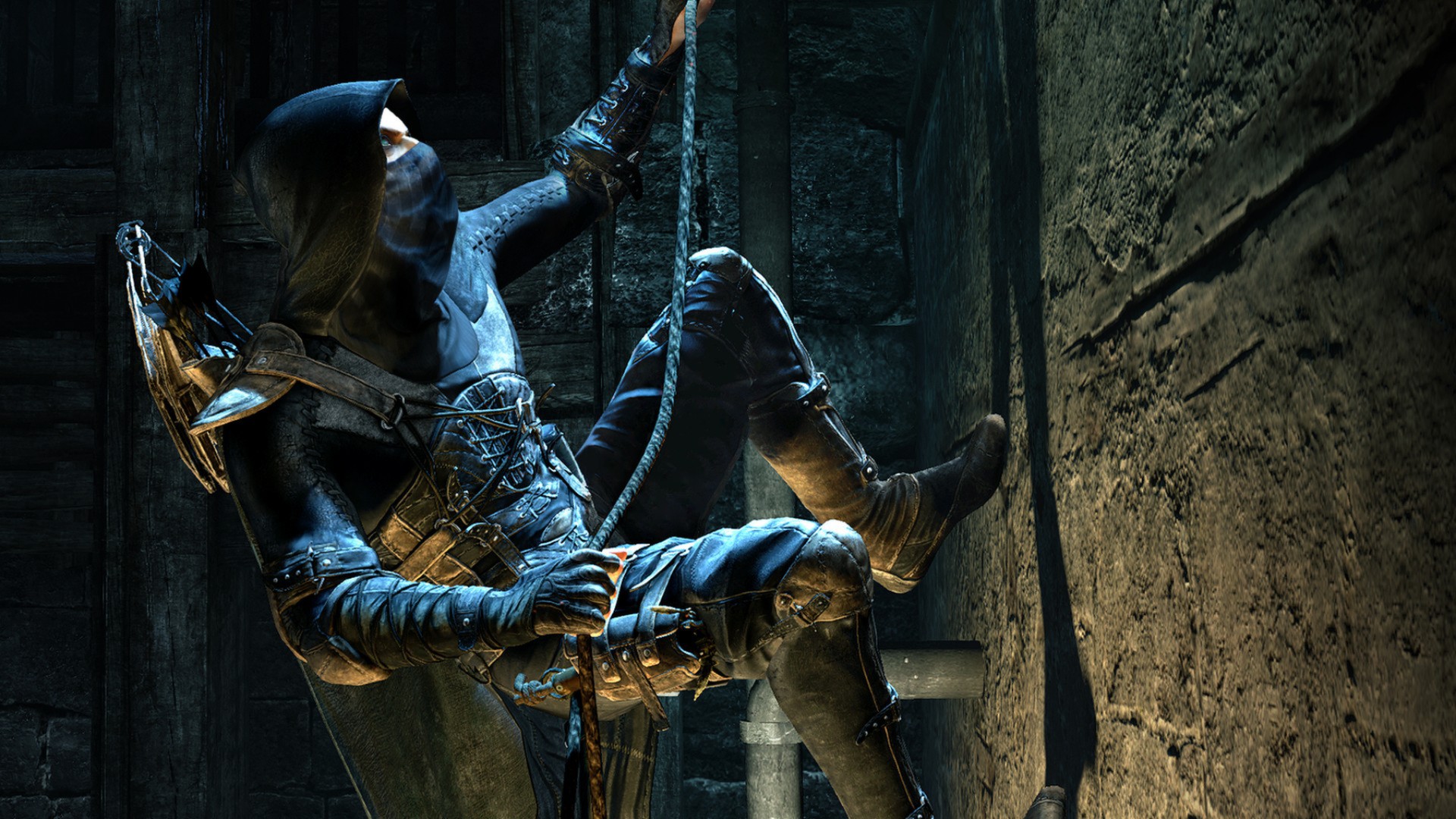
Garrett’s bow is a tool for changing a room as much as for fighting. Water Arrows can extinguish flames, while Blunt Arrows can strike distant objects such as vases or switches. Choke Arrows release a gas that can incapacitate a patrol, Rope Arrows attach to suitable points and create a climbable line, and a Flash Bomb can interrupt enemies when a quiet escape is needed. Broadhead and Sawtooth Arrows are lethal options, but using them risks drawing attention and changes the character of an encounter. Ammo is limited and each arrow has a particular use, so the player chooses whether to spend one to create darkness, distract a guard, reach a higher ledge, or deal with a threat directly. The game also gives Garrett a blackjack for close-range takedowns.
Breaking into a property involves more than reaching the door. Garrett can peer through keyholes, pick pockets, open containers, and work through locks by searching for each pin’s sweet spot. Some objects need a separate tool: a wrench opens certain panels, while other devices and routes become accessible as Garrett acquires equipment. The bow can interact with distant mechanisms, and Focus can make details or actions easier to pick out in the moment. Focus uses a limited meter that can be restored with Poppy Flowers, so activating it is a resource choice rather than a constant view mode. These interactions reward checking corners and surfaces for handles, vents, loose panels, and valuables instead of treating every room as a straight passage toward the marked objective.
Main chapters are connected by returns to the City, where Basso offers optional jobs alongside the central story. Those jobs send Garrett into smaller spaces with a specific item to steal, giving him more reasons to revisit districts and use their side routes. Scattered loot and valuables contribute to the money available for supplies, weapons, tools, and upgrades. The Clock Tower functions as Garrett’s base between excursions, while merchants provide gear that can open new traversal options or improve existing equipment. Focus can also be developed through upgrades, and the Journal records progression, collected documents, objectives, and statistics. The result is a loop of taking a job, choosing a route through occupied spaces, gathering what can be carried, and returning to prepare for the next break-in.
The difficulty settings change how much pressure surrounds that loop. Rogue reduces enemy awareness and makes resources more plentiful; the standard Thief setting keeps opponents more alert and supplies available at a middle level. Master makes guards more dangerous, raises the cost of resources and upgrades, and restricts civilian kills or knockouts. A Custom setting lets players adjust several rules themselves. The main menu also includes a separate Challenge Mode and leaderboards. On a mission, the Journal exposes objectives and collected material, and players can return to the City after a chapter. These options let the same burglary-focused systems sit inside different rulesets, while leaving the core actions—watching, moving, opening, stealing, and escaping—in the player’s hands.
- Developer
- Eidos-Montréal
- Genre
- First-person stealth action-adventure