
About The Witness
Alone on a quiet island with no memory of arriving, you explore linked landscapes and solve more than 500 line puzzles. Their rules emerge through symbols, repetition and observation, while hidden patterns, recordings and environmental clues deepen the island’s mystery. Different regions can be approached in varying orders, letting discovery guide progression.
The Witness begins in a dark passage and opens onto an island whose paths wind among gardens, forests, ruins, workshops, shorelines and mountain slopes. The player character has no spoken introduction or named companions; the immediate premise is simply that you have awakened alone without remembering who you are or how you arrived. Exploring is the first action: walk toward structures, follow paths and cables, inspect panels, and notice how doors, gates, lifts and other devices connect to the landscape. The island feels both natural and arranged, with water, trees and stone formations beside buildings and equipment whose former purpose is left unclear. Its history is suggested through these layers rather than explained in a conventional sequence of scenes. There is no quest log organising these discoveries into a prescribed itinerary, so landmarks, visible structures and the lines of cables become practical orientation cues as well as parts of the fiction.
Most encounters centre on a panel presenting a maze-like grid. You trace a continuous line from its marked start to an exit, and a successful route may open a door, move a mechanism or activate a larger installation. Early boards establish the basic act of drawing a path, but each region introduces a distinct rule set that has to be inferred from examples. Some boards ask the line to pass through dots; others use colored squares, triangle marks, paired symbols or shapes whose grouping and area matter. Later panels combine familiar marks or alter the conditions, so recognising a symbol is only the beginning: its rule has to be read alongside the other marks and the shape of the grid. There is no combat loop or inventory management; attention, hypothesis and correction drive these interactions. A failed attempt gives immediate feedback, encouraging comparison between a changed line and the marks it now includes or separates.
An important progression loop is to learn a region’s rule across a sequence of panels, then apply that knowledge to a connected device or a more complex board. Wires and cables often make these relationships visible, carrying power between panels, doors, switches and structures. Solving a panel can change the world permanently by opening a route or activating a laser, while movable platforms and lifts can be used repeatedly. The lasers provide a broad goal visible from distant parts of the island: their beams converge on the mountain and signal progress toward a deeper area. That structure gives the exploration direction without imposing a strict route through every district. Several puzzle groups can be pursued in different orders, and getting stuck in one place can send the player elsewhere to learn a new visual language. Progress is therefore measured through changed access and newly understood rules, not a conventional character build.
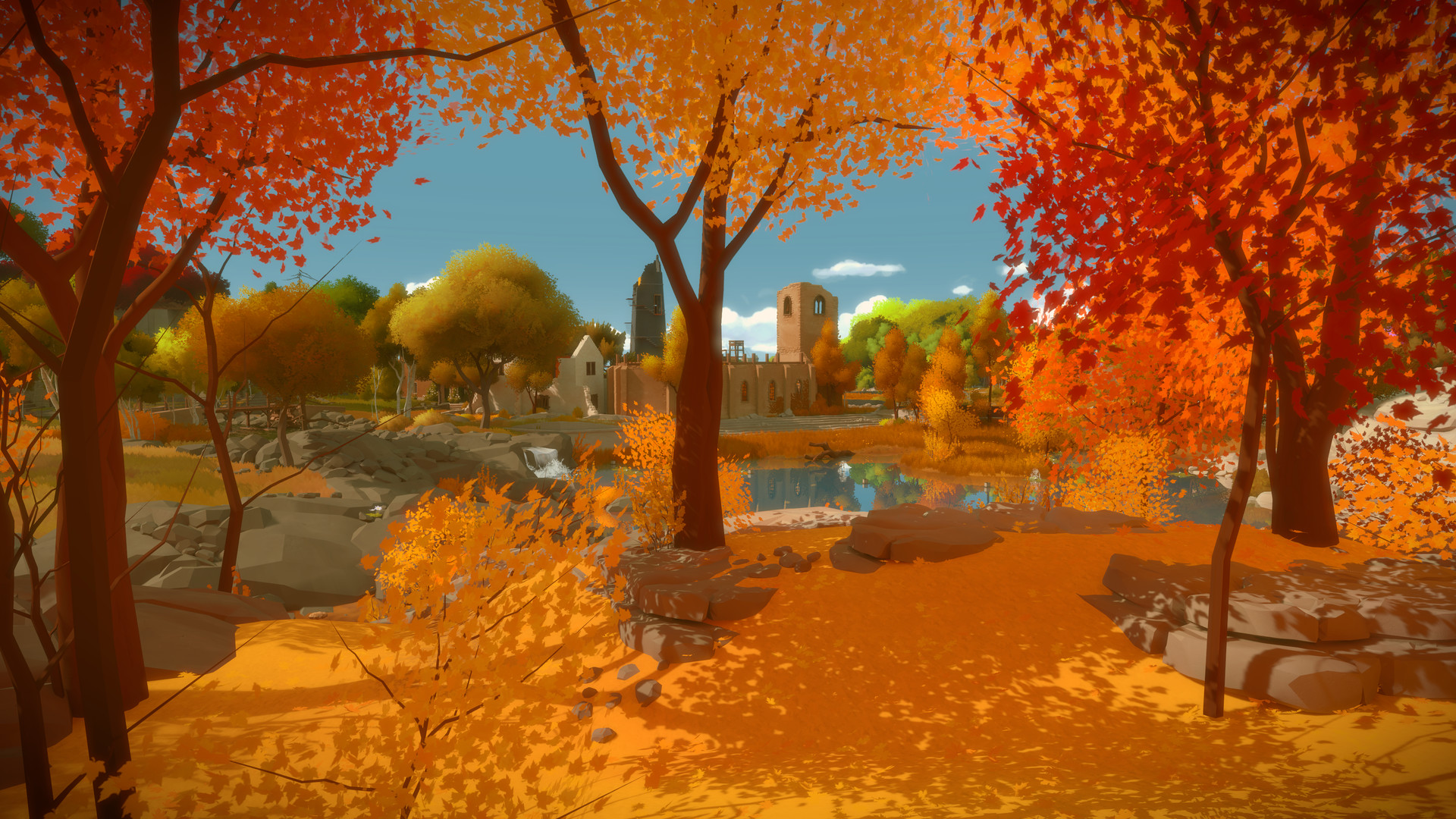
The island itself also functions as a field of clues. A panel’s grid may be only part of the problem: its frame, transparency, position or nearby objects can matter, and the intended line may become apparent only when viewed from a different angle. In environmental puzzles, paths or symbols seem to emerge from the alignment of branches, rocks, walls, shadows or other shapes in the world. These discoveries ask the player to move, look back and compare forms rather than interact with a conventional interface. The same habit of observation helps connect isolated spaces: architecture, cables, sightlines and repeated motifs make distant areas feel related. The island’s varied biomes—from orchards and enclosed gardens to marsh, desert, forest and volcanic terrain—change what can be seen and how a clue is framed. Sometimes the clue is legible only when the geometry of the scene resolves into a single path.
Sound creates another family of clues, especially in the jungle. There, short sequences of tones must be distinguished from ambient noise and translated into the relative heights or sizes marked on a panel. Some puzzles include competing calls or other sounds, making selective listening part of the rule rather than background decoration. Separate from these interactive sound sequences are scattered audio recordings. They offer spoken reflections and fragments from different voices and sources, adding ideas and possible interpretations without functioning as a linear character dialogue track. Neither the recordings nor every optional environmental puzzle is required to understand the basic panel loop. They reward attention to the island’s details, while leaving room for the player to decide how much of its wider context to pursue. The audio logs can be found in different parts of the island, so their fragments need not arrive in a fixed order.
The island's buildings also reward a kind of investigation separate from drawing lines. A windmill, quarry, glassworks, dam and abandoned ship suggest that different people used the same ground for different purposes. Stone, timber and metal appear in structures that seem to have been altered and reused, so an area can look like the remains of more than one period of habitation. None of this requires the player to assemble a formal history before solving a panel. It gives the silent setting texture while encouraging the same habit that puzzles demand: look closely, compare details, and revisit a familiar place from another angle. The mountain's converging beams provide a visible long-range objective, but the island still holds optional boards, hidden alignments and recordings beyond the path to its central endpoint.
- Developer
- Thekla, Inc.
- Genre
- First-person open-world adventure and puzzle game