
About The Wild at Heart
Two children slip into the Deep Woods and find a hidden world that needs their help. The Wild at Heart combines exploration, creature-led puzzles, gathering and crafting. Wake and Kirby guide a growing band of Spritelings through tangled routes, dangerous encounters and a day-night cycle that changes how safely they can travel.
The Wild at Heart begins with a departure from an ordinary childhood world into a place that seems to have been waiting just beyond it. Wake, a young inventor from Willowvale, enters the woods with his neighbour Kirby and discovers the Deep Woods, a realm of odd inhabitants, forgotten structures and a protective order called the Greenshields. There is the immediate business of finding a way through the next thicket, crossing a gap or helping someone encountered along the path; behind it sits a larger mystery about what the Greenshields protect and why the threat called the Never matters. The game presents that world through a storybook look rather than through a realistic forest. Its figures, objects and terrain read like illustrated pieces arranged into living scenes, making exploration feel like turning pages while still asking the player to notice useful details in each area.
Spritelings are the small creatures that turn this setting into a game of cooperation. Wake and Kirby do not simply attack every obstacle themselves. They gather a group, direct its members toward tasks and use the right creatures for the situation. Spritelings can haul objects, clear barriers, help create routes and take part in fights, so the question at a blocked passage is often what the group needs to do rather than which button opens a door. Bringing them back together after a job is part of managing the journey, especially when several little figures have been sent in different directions. The result is a form of exploration in which the forest is both a landscape to traverse and a sequence of practical problems to solve with a mobile team.
Wake brings another tool to the expedition: the Gustbuster, a vacuum-like invention that works alongside the Spritelings. It can be used in encounters and environmental situations, broadening the player's choices beyond directing the swarm. A place that looks impassable may call for clearing debris, moving something into position or finding a better approach from an adjoining route. An enemy, meanwhile, asks for attention to the creature group rather than blind forward movement. The Steam description also makes clear that the world is interconnected. That matters because a newly discovered route can change how earlier ground is understood; an unfamiliar corner may become relevant once the right means of reaching it has been found. Progress is about learning the shape and workings of the Deep Woods as much as following the story forward.
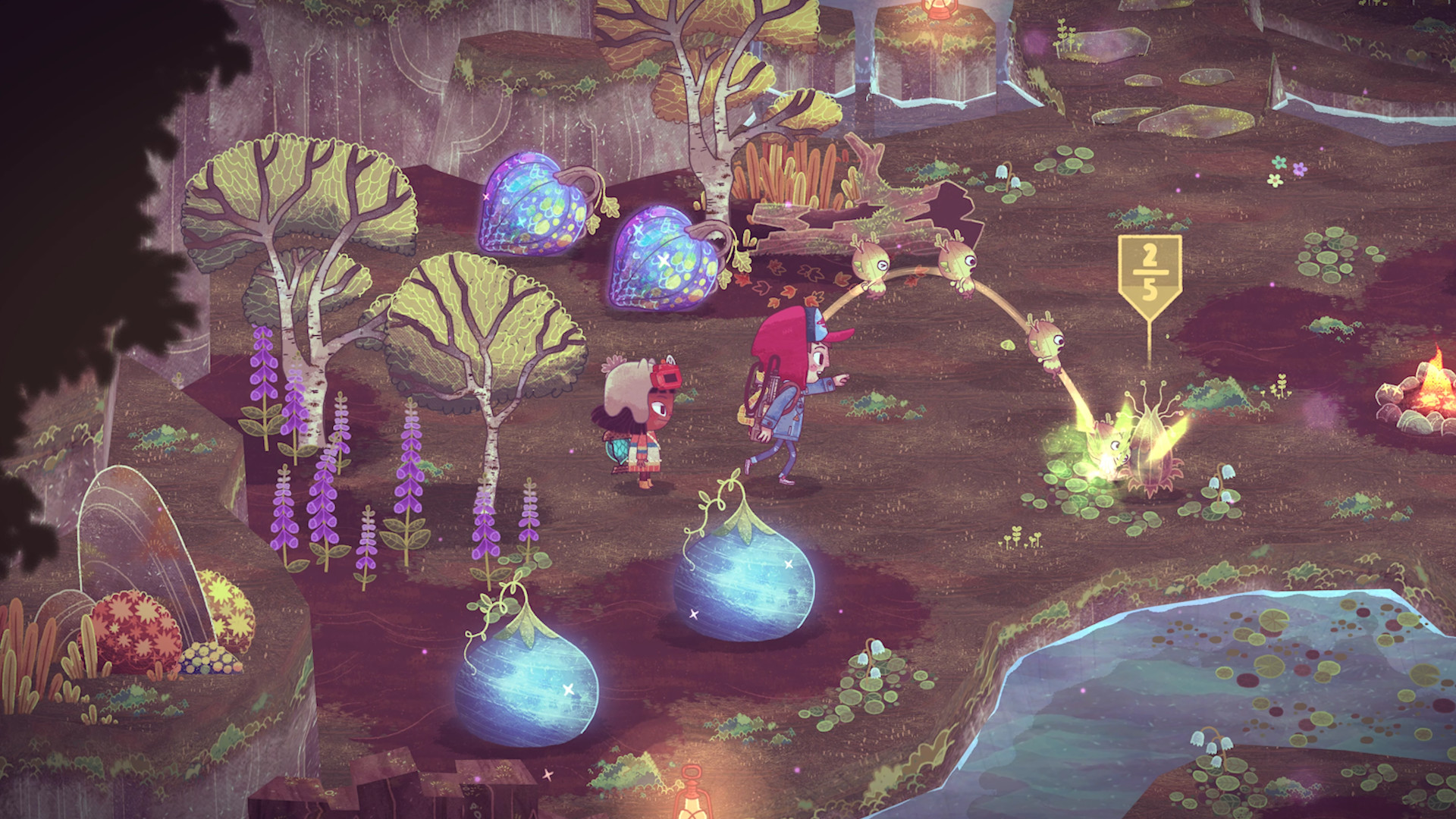
Gathering and crafting feed directly into that movement through the forest. The woods hold materials such as crystals, scrap and electrical components, which can be put toward structures, useful items and upgrades. The act of collecting therefore has a purpose beyond filling a list: it supports the next stretch of exploration and the ability to deal with a more demanding obstacle. Camps and storage offer points where that roaming activity can be gathered into a plan. The developer's account of camp design describes them as safe places and collection points, giving Wake and Kirby somewhere to regroup with their resources. This creates a practical loop: venture into an area, identify what it contains, bring back what the party can use, and return with a better idea of what needs to be built or solved.
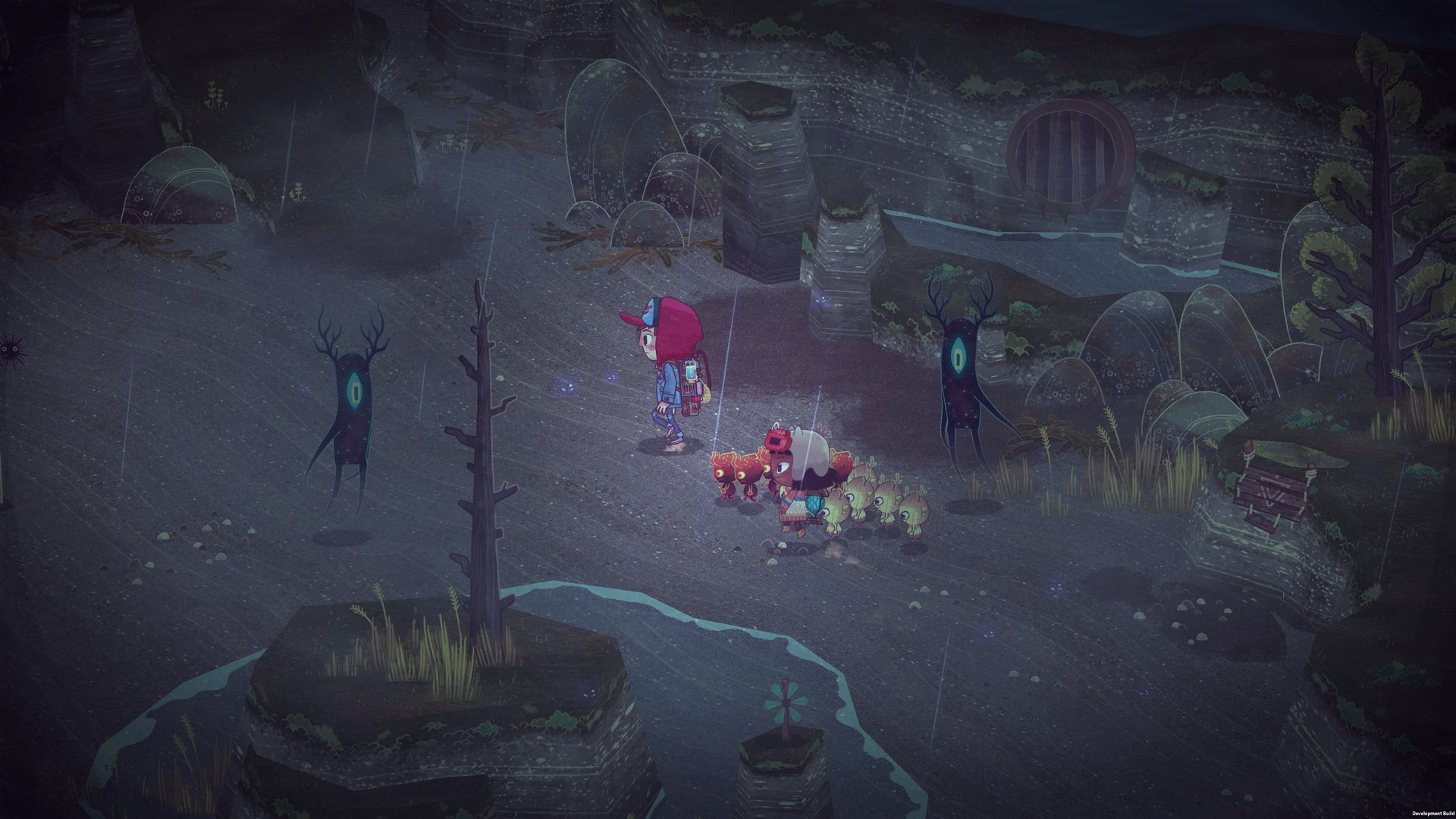
Time changes the meaning of that same environment. The developer describes daylight as the safer period for planning and exploration, while night carries greater danger from the Never's minions. Some resources and tasks, however, are associated with the dark, so night is not merely a cue to stop playing. A campfire offers a safer option: return, rest and take another route when daylight comes, or make a deliberate trip into the riskier hours. This gives each excursion a modest tension even when the scene is visually gentle. The woods become a place with its own schedule, where the same path may invite a different decision depending on when it is taken.
The people and creatures met along the way prevent the Deep Woods from feeling like a series of anonymous resource sites. The Greenshields have a history and responsibilities of their own, while the children's arrival places them inside a conflict much older than their visit. Wake's interest in making things and the appearance of his improvised tool fit the practical tasks asked of the player; Kirby helps make the expedition a shared story rather than a solitary tour. The details that emerge from conversations, shelters and strange locations are part of understanding this world, but the broad premise does not require revealing the later turns of its mystery. What makes the setting inviting is that its fable-like surface and its working systems support each other. A creature is not just decorative if it can help carry a burden, and a ruined route is not just scenery if the group can learn how to reconnect it.
The Field Guide update added a useful choice for anyone deciding how to approach that mixture. Wanderer emphasises exploration and story, while Adventurer gives combat and crafting more weight; the developer says the choice can be changed. That means the broad structure of the journey remains recognizable while its pressure can be adjusted to suit the kind of attention a player wants to give it. The Wild at Heart is best understood as an exploration adventure built from relationships between things: two children and an unfamiliar order, a growing creature group and the jobs it can perform, collected materials and the routes they help reopen, daylight and the dangers that follow it. Its appeal lies in seeing how those connections make an illustrated forest gradually legible. Each cleared obstacle reveals another piece of the place, while the story gives a reason to care about what lies deeper among the trees.
- Developer
- Moonlight Kids
- Genre
- Story-rich exploration and creature-led puzzle adventure