
About The Wandering Village
In a world overtaken by toxic spore-producing plants, a displaced community builds a settlement on Onbu, a giant wandering creature. Guide the villagers’ growth, explore changing biomes for resources, and balance their survival with the health and cooperation of the host carrying them.
The Wandering Village begins after mysterious plants spread across the world, releasing toxic spores and driving a small group of people from their home. They find shelter on Onbu, a colossal, six-legged creature that continues to roam through the damaged landscape. The settlement’s survival is therefore bound to a living host: villagers need room, food, water and protection, while Onbu has its own needs and can be affected by the choices made on its back. The story-led campaign frames this shared journey around the search for a place where the community might settle and the effort to understand what happened to the world. Rather than sending the player across a conventional map as an individual adventurer, the game makes the moving creature itself the community’s home and route through the setting. The terrain below changes as Onbu travels, while the village remains built on its back. This premise gives ordinary city-building decisions a second consequence. Taking materials from Onbu or using buildings that exploit the creature may help the settlement, but can harm the relationship on which the journey also depends. The central question is how to keep both sides alive while their fates remain connected.
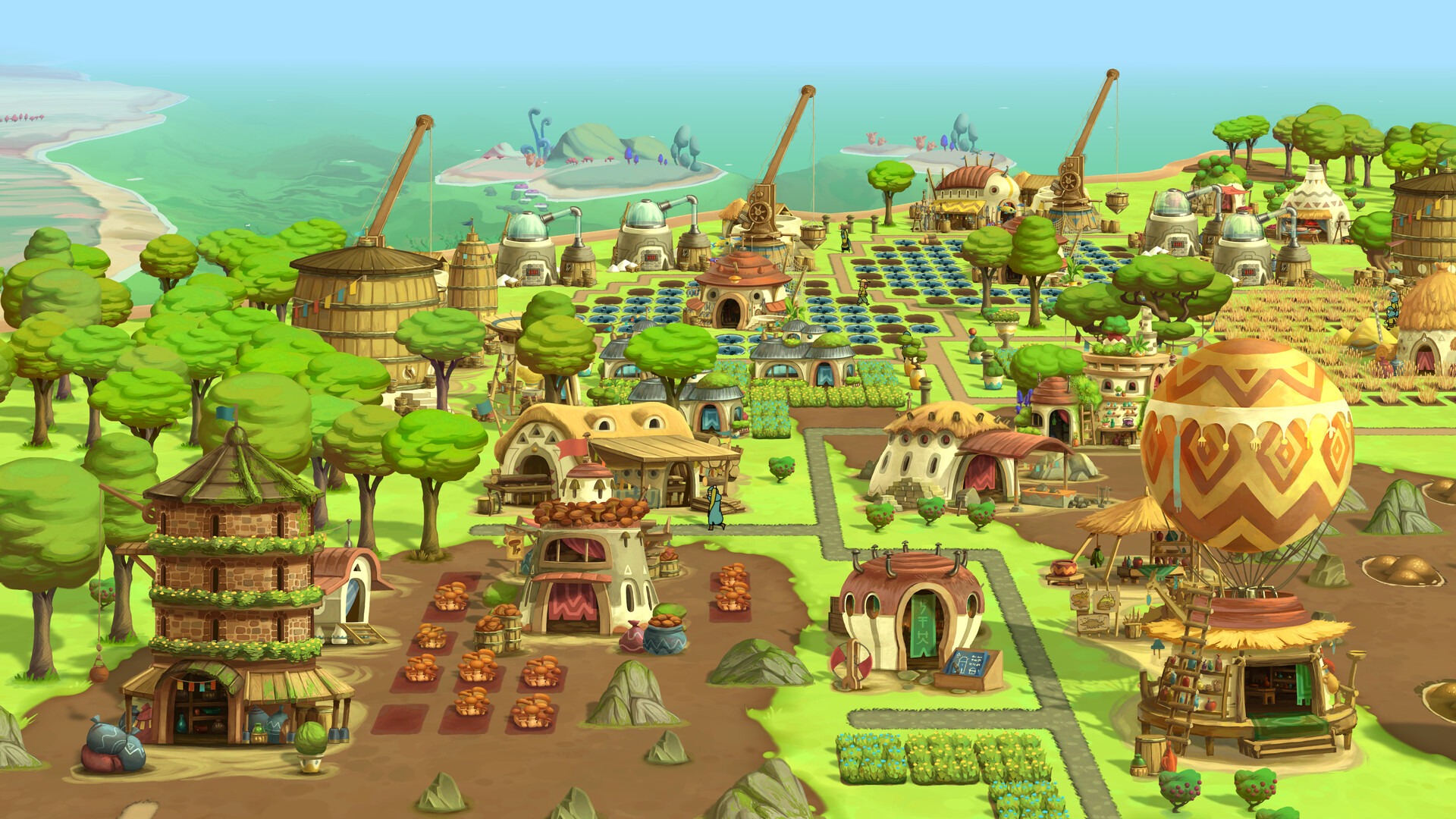
The player directs the village as a compact production system spread across Onbu’s limited back. Buildings need workers and materials, and the settlement must provide essentials such as food, housing and water as its population grows. Farms turn plots into crops for meals; gathering and processing buildings convert raw materials into supplies or construction goods. Each structure occupies space that cannot be expanded indefinitely, so placement and production planning matter together. Villagers have to be assigned across the buildings that keep the colony running, and those assignments compete with construction, harvesting, scouting and research. New arrivals can increase the workforce, but also raise the demands on food and shelter. A farm needs usable plots and staff, while workshops and other production buildings need both employees and inputs. Placing related facilities close enough to work efficiently can reduce the movement burden on workers, but the village still has to reserve room for housing and future needs. Expansion brings more capacity, yet each new workplace adds another claim on the population and the stockpile. The player must decide which shortages deserve attention first and whether to divert villagers from existing duties to build or operate a new part of the production chain. These choices make the limited plateau a planning constraint: the settlement grows by coordinating space, labor and supplies rather than by spreading across an open plain.
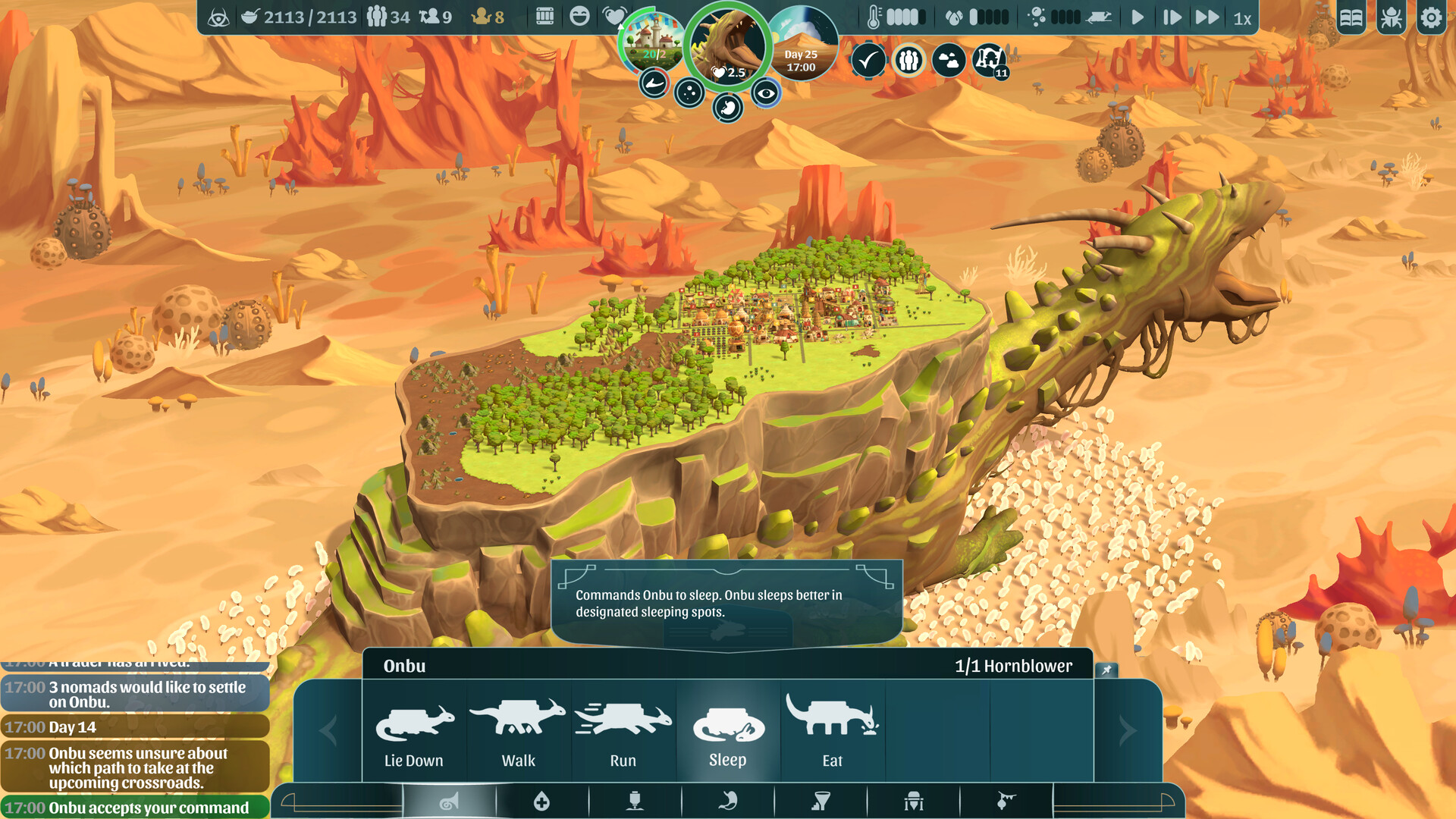
Onbu is both the ground beneath the village and a creature whose condition shapes the settlement’s prospects. Its health, hunger and exposure to poison require attention alongside the villagers’ needs. The game gives the player ways to care for the host, including gathering food that can be launched to it, and research can open additional forms of interaction. A horn lets the settlement issue movement commands, but cooperation is tied to the relationship the villagers have built with Onbu; the creature is not merely a vehicle that obeys every instruction automatically. Its route can bring the village toward opportunities or through dangerous conditions, and its own behavior includes resting and seeking food. Villagers can also harvest resources from Onbu’s body, creating a direct trade-off between materials for the settlement and the host’s well-being. That tension makes the two economies inseparable: actions that support the village may weaken the creature, while neglecting Onbu can put the people at risk. Players can pursue a more mutual relationship or take a more extractive approach, and the game presents this as a strategic choice rather than a separate morality system. The creature’s movement also changes the frame of settlement management, since the ground and conditions around the village keep shifting as the journey continues.
Travel exposes the village to a sequence of different biomes, each with its own climate, opportunities and threats. Scouting lets villagers survey nearby surroundings, while foraging missions bring back resources and remnants from the old world. These expeditions connect exploration to the settlement’s economy: a discovered material or artifact can expand what the community can make or research, but sending people out also draws on the limited workforce needed at home. Biomes matter to more than scenery. Their conditions affect which resources are available and what risks the community faces, so the player must read the environment and adapt production as Onbu moves. A destination can offer a useful supply opportunity while also exposing the travelling community to harmful weather or poisonous conditions. The wider view of the route helps identify nearby events and possible destinations; when trust and the relevant tools permit, Onbu can be guided toward or away from some of what lies ahead. Scouting and foraging thus serve different purposes: one gives information about the surroundings, while the other sends villagers to collect what the village may need. Both tasks draw on workers who could otherwise tend farms or production buildings. Choosing when to explore becomes part of the labor plan, and the changing terrain means that a settlement prepared for one biome may need to reorganize as Onbu continues onward.
Research turns discoveries and gathered materials into new buildings, technologies and ways to manage the community. Villagers investigate remnants of the old world, and the resulting knowledge can improve production or provide tools for dealing with Onbu and the surrounding hazards. Progress is not detached from the survival loop: research uses people and resources that could be assigned elsewhere, while new technologies may depend on materials the village has yet to secure. As the available options grow, the player must decide which capabilities address current shortages and which prepare the village for future conditions. The story campaign gives this development a narrative direction, with the community seeking answers about the ruined world and contact with others along the way. Challenge and Sandbox modes offer alternate ways to approach the village beyond the story campaign.
The village and its host are drawn at two different scales: hand-drawn, hand-animated villagers and buildings occupy the back of a three-dimensional Onbu, with the wider landscape presented around them. Zooming close makes individual workers and everyday activity visible; pulling back reveals the creature’s movement and the biome ahead. This visual arrangement keeps the settlement readable as a busy place while showing that it is travelling through a larger environment. The composition changes with the player’s task, from examining building placement to observing Onbu against the terrain. Challenge Mode offers a collection of modifiers that can make a run more punishing or forgiving. Sandbox Mode supports an open-ended building run and lets players switch off some Onbu and villager debuffs, reducing the survival pressure around construction. The two modes therefore change how much attention a settlement needs to devote to threats while using the same core village-building systems. The story campaign also uses illustrated sequences alongside text-based exchanges to carry the community’s encounters and discoveries. Its central radio tower receives transmissions from beyond the village, giving the elders a reason to investigate the collapse of civilization and make contact with other settlements. The signals create a thread through the campaign, connecting the village’s search for its past with the communities it meets along the route.
- Developer
- Stray Fawn Studio
- Genre
- City-building simulation and strategy