

About The Unfinished Swan
The Unfinished Swan follows Monroe, a ten-year-old boy, into a storybook kingdom after a swan escapes from his mother's painting. Beginning in a blank white space, he throws paint to reveal the path ahead. Each chapter changes how the world is explored as the story draws him toward its eccentric king.
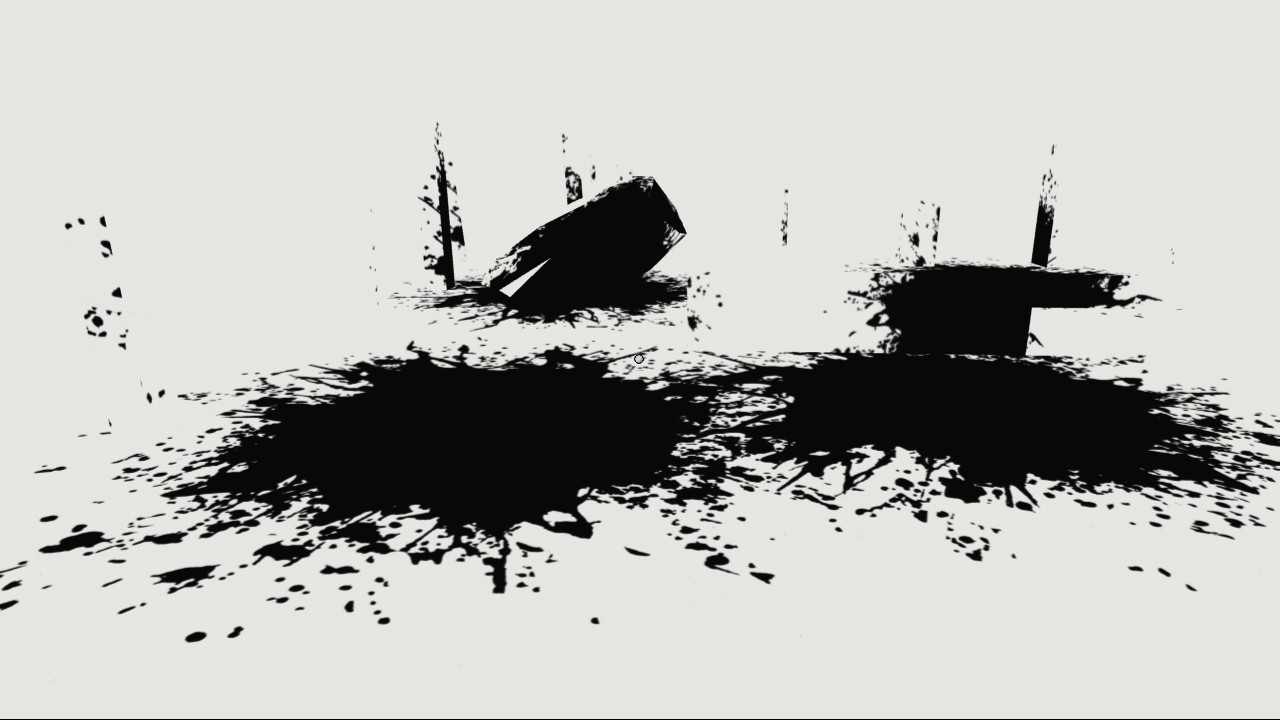
The Unfinished Swan begins with a simple absence: Monroe's mother has died, and the ten-year-old boy has kept one of her unfinished paintings. When its swan disappears from the canvas, he follows it into a kingdom that looks as though much of it has yet to be drawn. The first-person view gives him no map of the opening space. White ground, white walls and white objects merge until a thrown black paintball lands on something solid and exposes its shape. A doorway is no longer merely a dark suggestion; a stair or corner becomes visible through the marks Monroe makes. This is the game's first and most memorable rule, and it makes ordinary movement an act of discovery. The swan's footprints offer a reason to move on, while the setting withholds the information that a conventional adventure would display from the start. The question is not where an objective marker is pointing but what stands within reach of the next splash. Giant Sparrow built the game around that sense of entering the unknown rather than around a conventional combat or collection loop.
The opening does not ask the player to paint a complete picture. A few well-placed splashes can define the edge of a platform or the turn in a corridor, and too much paint can turn the scene into another difficult mass of black. The player has to read negative space as carefully as the markings left behind. This changes the usual relationship between scenery and navigation: an unpainted surface may be safe ground, a drop, or the side of a structure, and the only way to know is to test it. Following the swan requires walking, looking, throwing and then reinterpreting the room from the new evidence. The limited visual information can make a short crossing feel larger than it is, because every few steps revise the player's understanding of the place. The early white landscape also establishes Monroe's scale. He is a child finding his way through a world created by someone else, and the player's uncertainty mirrors his. Paint is a practical tool, but its splatters also leave a visible record of where the search has already taken him. The opening pond is a contained lesson in that idea. Monroe can cross it with only a handful of throws once he understands the ground, and the game even recognises a particularly sparse route. The throw itself is gently adjusted toward an object the player points at, so the interest is in deciding what to expose rather than in mastering a projectile arc. Those small choices matter: a painted corner can make a safe passage obvious, while a broad scatter of marks may obscure the clean shape that was just discovered. Returning to a previously marked stretch is easier because the surfaces still carry the trace of the earlier search.
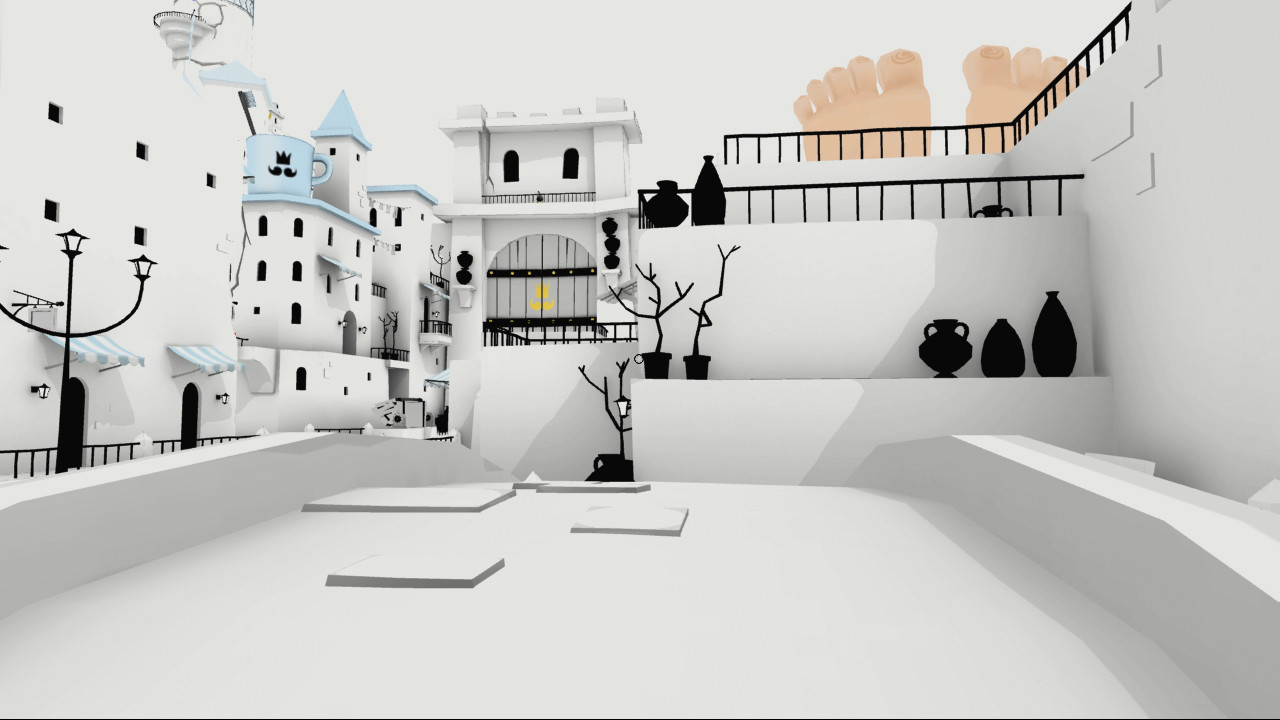
The kingdom soon refuses to stay a black-and-white painting experiment. Giant Sparrow's creative director Ian Dallas explained before release that the blank white opening is only the beginning; subsequent chapters bring different spaces and ways of interacting with them. Buildings and streets acquire more recognisable form, and the journey takes Monroe through places that feel like successive pages of a strange children's book. A later mechanic involves throwing water so that vines grow across surfaces, making routes that the paint alone could not produce. That change matters because it shifts the player's task from revealing a path to helping create one. Other stretches rely on light and the layout of the world rather than on covering everything in black marks. The adventure therefore has a chapter-by-chapter rhythm: learn what the current environment hides, find the action that makes it legible, and use that understanding to travel onward. It remains an exploration and puzzle adventure, with the challenge arising from perception and movement rather than from an equipment build or a string of fights.
The storybook form gives the journey more than a visual identity. As Monroe follows the swan, he encounters traces of the eccentric king who built the kingdom and the creatures living within it. The king's presence turns each new space into evidence of a particular imagination: grand constructions and unfinished corners belong to a place shaped by someone's decisions, not to a random series of puzzle rooms. PlayStation's descriptions frame the game as a child's pursuit through a surreal realm, with new surprises and sometimes dangerous creatures from one chapter to the next. The tale has an unfolding narrative, but its central mystery is better approached through what Monroe sees and does than through a list of late-game revelations. A corridor painted into visibility, a climb made possible by growing vines, and a new area that changes the rules all tell the player something about this kingdom. The world feels incomplete by design, and uncovering it becomes a way of understanding the person who left it that way.
There is also a clear difference between looking at a finished illustration and moving through an unfinished one. In a picture book, the page tells the reader where its edges are; here, the player discovers those edges by throwing, walking and turning. The first-person camera keeps the act close to Monroe, so the sudden appearance of a bench, arch or wall comes from the player's own action. Sound and the contrast between sparse white space and later, more furnished scenes help distinguish the game's stages without requiring a permanent on-screen guide. The relatively simple controls keep attention on the changing meaning of the same surroundings. A staircase is a route only once its steps can be read, and a wall can become a surface for plant growth when the available tool changes. That makes the adventure's progression unusual: the player does not primarily become stronger, but gains new ways to understand and cross the world. Each chapter can surprise by changing what counts as useful information. There are four chapters rather than an endless series of variations on the first trick, and their visual styles change with their mechanics. Even the apparently pure white of the opening was designed as a warmer tone, preventing the kingdom from looking like an empty technical test. Its contrast is deliberate: the first black mark feels startling because the surrounding colour has so little definition, while a more furnished street gives the eye enough shape to notice what remains concealed. The game also lets a sustained walk gradually quicken Monroe’s pace. That quiet movement detail makes crossing a known area less laborious without turning exploration into a race. Together with the changing presentation, it keeps the search focused on the next discovery.
The Unfinished Swan was originally made by Giant Sparrow for PlayStation and later came to Windows through a version published by Annapurna Interactive. Its core premise is consistent across those releases: Monroe pursues the escaped bird, beginning in the all-white landscape and moving through a kingdom that opens up in stages. The Steam release presents it as a single-player adventure rather than a competitive or multiplayer experience. Players looking for a conventional action game should expect a different kind of pace here. There is space to follow the kingdom as a place with a history and a ruler, rather than treating every scene as a test of throwing accuracy. The puzzle is often a question of what the present space will allow Monroe to learn. At first a black splash answers it; later, a growing route or a newly lit surface may matter more. The interest lies in the act of finding a route, testing how an environment responds, and seeing a tale about a child and a king emerge from the places between those discoveries. The opening paint mechanic is striking enough to stand on its own, but the game's larger shape depends on leaving it behind at the right time. By the end of the early white spaces, the player has learned its guiding idea: in this kingdom, the world reveals itself through the attempt to explore it.
- Developer
- Giant Sparrow
- Genre
- First-person exploration and puzzle adventure