
About The Tartarus Key
Alex Young wakes in a locked mansion with no account of how she arrived. Cameras watch its rooms, a voice reaches her by radio, and other captives need help. The Tartarus Key is a first-person mystery built around contained escape-room puzzles: examine the environment, solve its traps, open new routes and learn why everyone was brought there.
Alex Young remembers being alone at home, then wakes in a room that appears arranged for her. The window offers no reassuring view outside; the door is secured by a puzzle; a camera suggests somebody expects to watch her response. A portable radio puts her in touch with another person somewhere in the mansion, giving the first isolation a human voice without explaining who placed either captive there. The Tartarus Key begins with those practical questions. How does this lock work? Which objects in the room are clues? Can Alex trust the voice helping her? The larger mystery grows from the answers she finds while moving through the house. She discovers that she is not the only person confined there and that some of the others are in immediate danger. The building is therefore more than a backdrop for an escape. Each locked chamber represents both an obstacle to the front door and a possible opportunity to reach someone before a trap determines their fate. The story keeps the purpose of the captivity in view without revealing its answer at the outset, using the cameras and carefully staged rooms to establish that the puzzles are part of a deliberate arrangement.
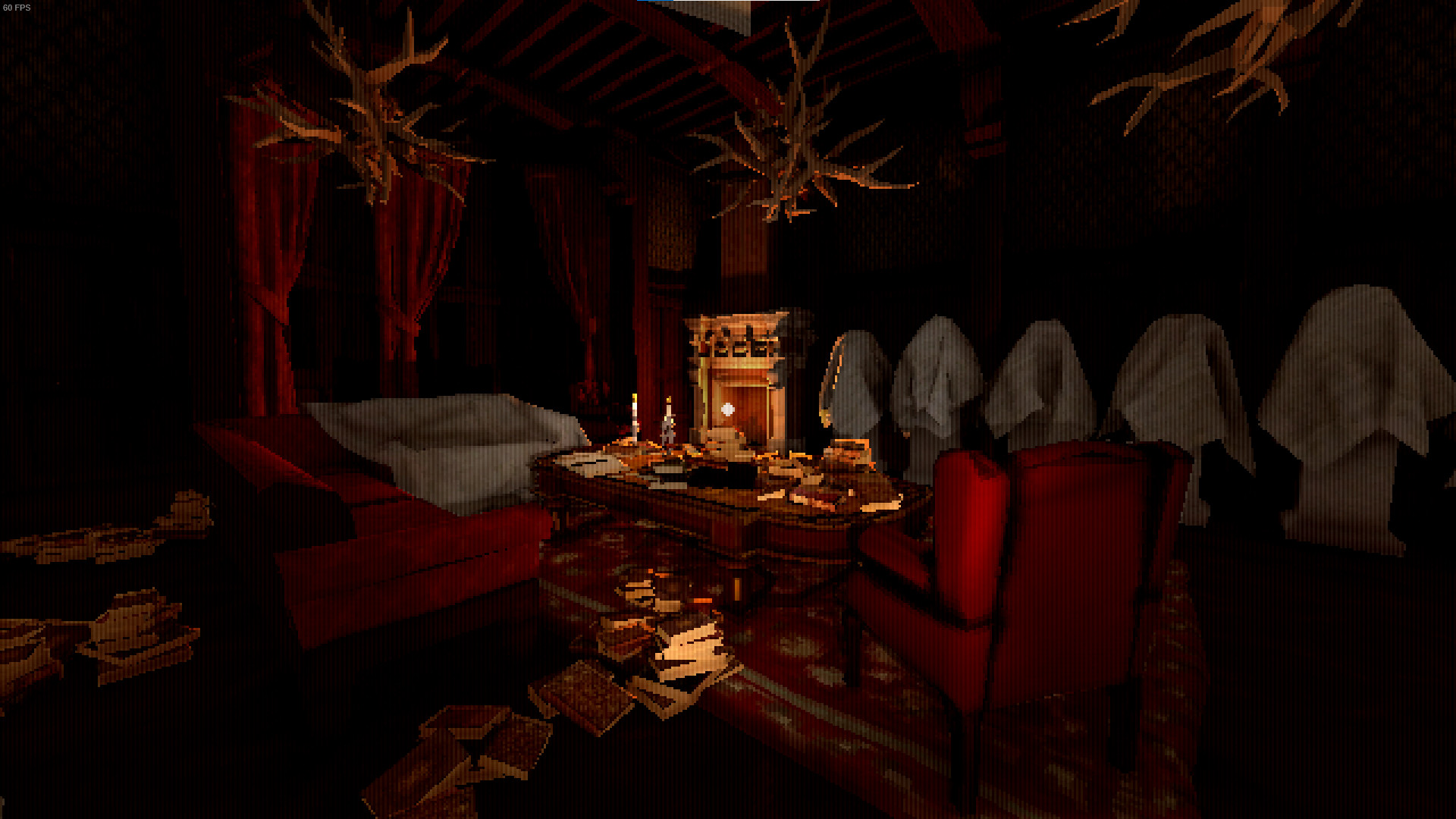
The mansion is explored from Alex's first-person perspective. She can move into a chamber, look closely at its furniture and walls, and test the objects that seem connected to the door. An early keypad asks the player to search for a combination, while another room uses bottles of coloured liquid and pedestals. Those examples establish the game's preferred scale: the information needed for a solution is generally in the room, or in a closely connected space, rather than hidden on the far side of the building. A desk may matter because of what is written on it, how an object has been placed, or what it lets Alex manipulate. Looking around is only the first step; the player must decide which observation bears on the particular lock ahead. This room-sized structure keeps the reasoning legible as the mansion expands. Solving one door may yield a key that gives access to another part of the house, and a new area brings its own materials and rules. The player revisits shared spaces as routes open, but the active puzzle usually asks for close attention to its immediate setting rather than a random search through every previously visited corridor.
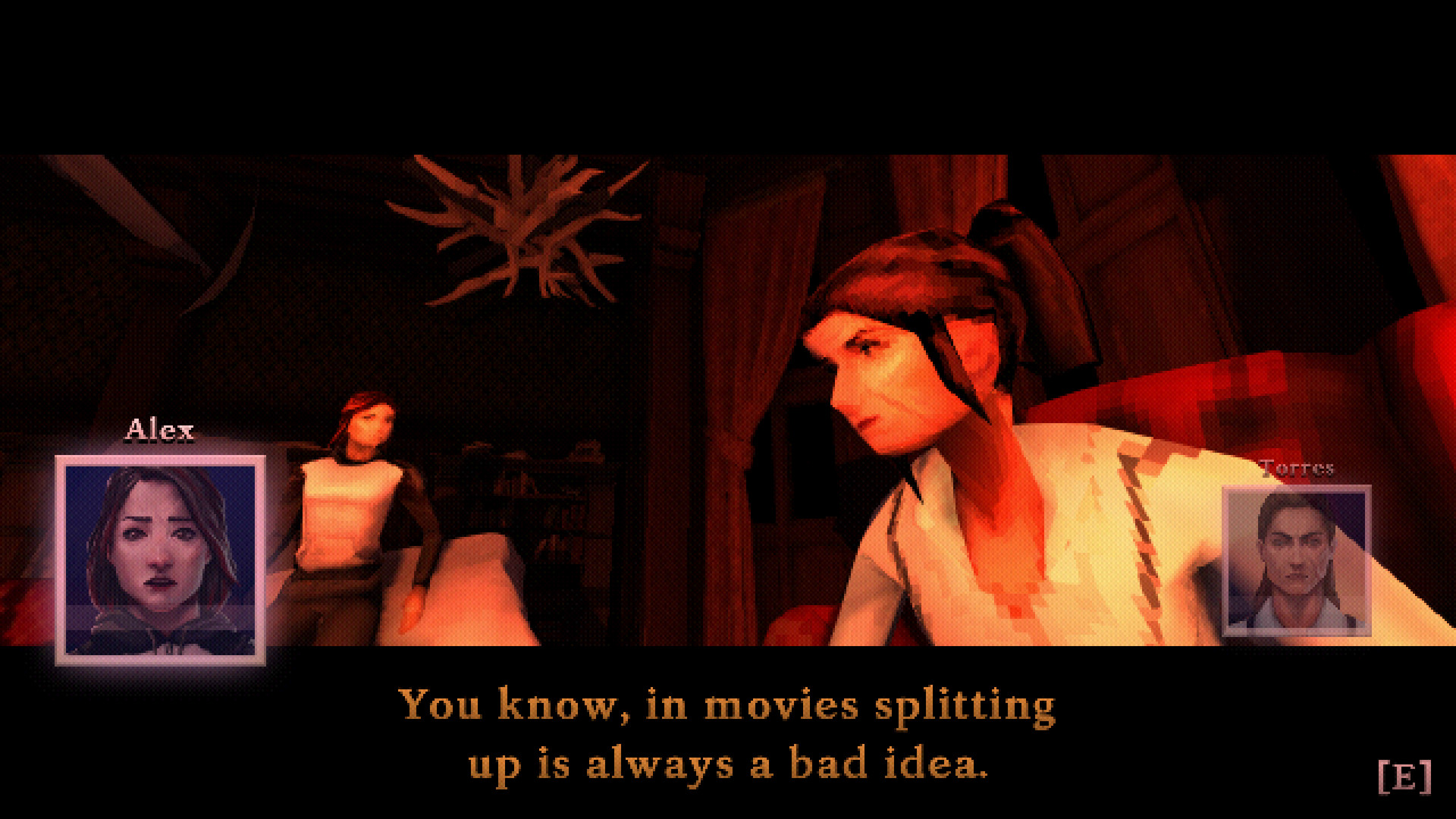
The radio also changes the meaning of those rooms. Torres, a private detective, is among the voices and captives Alex encounters, and the publisher describes others including a conspiracy theorist. Their contrasting responses to the abduction give Alex more than a series of anonymous rescue objectives. Conversations can offer context, reveal what someone noticed in another chamber, or make a newly opened safe space feel inhabited. After a rescue, the person is not simply an item collected from a trap; the survivors can meet and speak as the group tries to understand the mansion. That matters because the game's branching outcomes include whether fellow captives survive. The puzzle design is tied to those stakes: a door may stand between Alex and a person in trouble, and uncertainty about a solution can carry more weight than a locked exit used only to pace the story. The game advertises three endings, but it does not require knowledge of their precise conditions to understand the central choice. Alex is trying to get people out and identify who put them there. How the attempt goes depends on more than her own escape route.
There is no weapon system waiting behind the next door. Vertical Reach builds tension through observation, uncertainty and the risk attached to its puzzles instead of combat or pursuit. That distinction is useful for anyone expecting a conventional survival-horror loop. Alex does not need ammunition to clear a corridor, health items to survive a boss or a quick reflex to outrun an enemy. She needs to notice what the room communicates and make a defensible inference about how its parts fit together. An object picked up for a puzzle generally belongs to that local problem, so inventory work is less about carrying unrelated supplies for hours and more about testing an immediate idea. Some chambers involve a sequence of interactions rather than a single code: move or arrange objects, compare the result with a clue, and reconsider if the door remains closed. The setting still uses blood, shadows and apparently inexplicable movement to make those quiet moments uncomfortable. The player can be safe from a chase and still feel watched by a camera while spending time on a stubborn lock. Fear comes from the possibility that the room itself has been designed to mislead Alex.
The house opens in stages. Completing puzzles and freeing people can produce keys for further areas, bringing another set of chambers into the growing route through the mansion. This gives the adventure an episodic rhythm without turning each room into an unrelated minigame. New doors belong to the same building, and the question of who arranged its tests persists while the captive group changes. The player might return through an earlier common area after a rescue, hear another conversation and then choose which fresh route to investigate. Some puzzles have consequences for the person caught in them, so progression is measured in lives and information as well as access. The game does not present a sprawling equipment tree or repeated enemy encounters as a substitute for progress. Its development is mainly a change in what Alex knows: more of the floor plan, more people with accounts of the place, and more evidence about the intention behind its traps. Each cleared chamber makes the mansion easier to navigate physically, but it can complicate the explanation for what Alex has been seeing. The three endings give that accumulating knowledge and the survival of the captives a destination beyond simply unlocking the outermost door.
The Tartarus Key borrows the visual language of older 3D horror games, with angular character models, coarse textures and dim rooms. These are deliberate presentation choices, not signs that the puzzle spaces should be read as empty decoration. A low-poly surface can conceal a relevant object at a glance, asking the player to study the space rather than wait for a bright modern marker. Warping textures and unstable-looking figures add to the possibility that Alex has misread movement at the edge of her vision. The game also lets players adjust some of its retro visual effects in the graphics options, which is useful when a particular distortion makes the rooms harder to read. Its sound and music, credited to composer Josie Brechner, work alongside the visual uncertainty; a dark room can feel threatening even while the rules promise no chase sequence. Dialogue provides a contrasting pace, allowing Alex and the other captives to react to what has happened before the next locked chamber. This combination of conversational scenes and closely inspected 3D spaces sets the game apart from a pure sequence of abstract riddles. The same mansion has to function as a believable place of confinement, an eerie performance for its unseen observers and a series of solvable physical problems.
Vertical Reach developed The Tartarus Key, and Armor Games Studios published the full game in 2023. It is available on PC, PlayStation, Xbox and Nintendo Switch; Steam also offers a separate demo and an original soundtrack add-on, neither of which should be confused with an extra chapter of the main adventure. The full game carries Alex's search beyond the opening escape room into a network of captive stories and the central explanation for the mansion. Its structure suits deliberate examination. A player can focus on one chamber's rules, take stock of the people now gathered in the house, and then move into the next unresolved route. It is possible to enjoy the puzzle work without seeking an action challenge, but the fiction is never detached from the locks: the cameras, the unusual staging and the fate of the other prisoners make every test part of the same question. The house holds its answers until Alex can read its clues and decide what to do for the people trapped alongside her. That is the thread connecting a small object on a table to the wider mystery waiting beyond the next door.
- Developer
- Vertical Reach
- Genre
- First-person mystery thriller and escape-room puzzle adventure