
About The Talos Principle
The Talos Principle is a first-person puzzle game set in a world of classical ruins and advanced technology. Guided by the voice of Elohim, the player solves increasingly involved chambers, gathers sigils and explores a non-linear environment. Its physical logic puzzles sit alongside computer records that raise questions about identity, humanity and the purpose of the world.
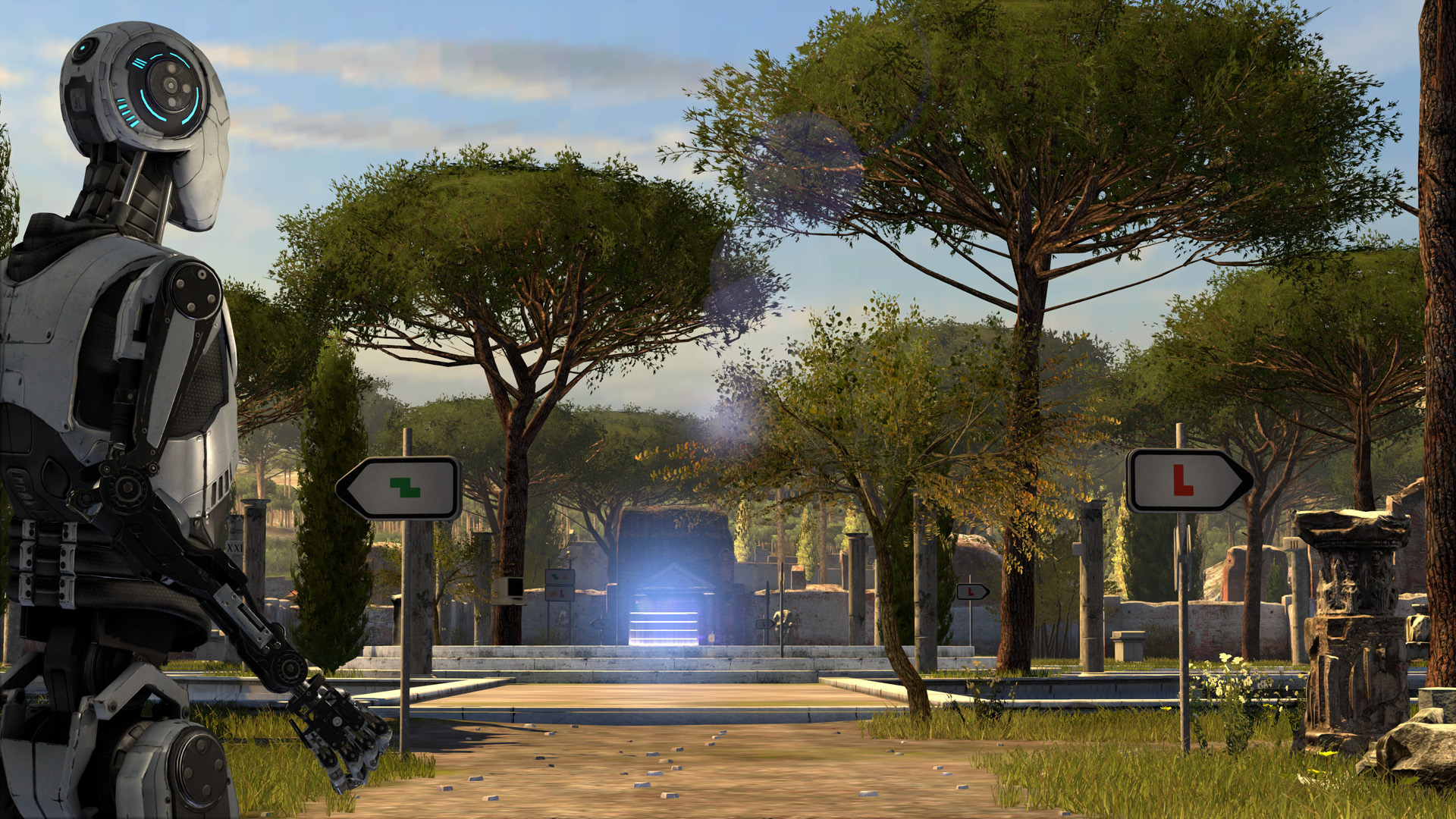
The Talos Principle opens in a world that combines ancient architecture with devices and structures that do not belong to an ordinary historical landscape. The player awakens in this contradictory setting and hears Elohim, an unseen voice that identifies itself as the creator and assigns a series of tests. The immediate task is concrete: enter puzzle chambers, understand the objects inside them and find a route to the exit. Beyond those rooms, the environment and scattered computer records introduce questions about the world and the player’s purpose. The game keeps the relationship between these activities open for interpretation, using its first-person exploration and philosophical science-fiction premise as complementary parts of the same journey.
Puzzle chambers are arranged through a non-linear world, so the player can move among available challenges rather than following one uninterrupted corridor of tests. Solving a chamber earns a shaped sigil, and groups of these pieces are fitted together at an arranging device to open further gates and areas. That structure makes each solution part of a broader progression system: a puzzle can unlock access to new rooms even when it does not directly connect to the next one. More than 120 puzzles are included in the base game, and the layout allows players to leave a difficult room and return later after trying other chambers.
The basic chambers teach the player to handle physical objects and reason about lines, barriers and access. A Jammer can disable a compatible plasma door, mine or other device, but it must be aimed from a usable position and may be needed elsewhere in the same room. Pressure plates respond to a player standing on them or to movable objects such as a cube placed on top, which lets one item hold a switch while the player moves away. These pieces transform a room into a sequence of spatial constraints: carry the right tool through the opening it creates, keep a route active, and work out which object must remain in place for the next step.
Energy puzzles use Connectors to link a generator with a receiver, routing a beam so that a matching receiver can power its target. The connector has a need for unobstructed sight lines, so an apparently simple line may need to bend through another connector or avoid walls that interrupt it. Redirection, compatible receiver colour and the placement of the device determine whether the circuit works. A laser receiver may open a barrier or activate another part of the chamber, while a pressure plate or Jammer handles a different constraint. The challenge comes from combining the devices without losing access to the equipment that must be moved next; an opened gate can change the whole geometry of the puzzle.
Other chambers introduce hazards and movement systems that make timing and safe positioning important. The game asks the player to divert drones, disable turrets and replicate time. A Time Recorder captures the player’s actions for a short interval and then plays them back as a duplicate, allowing two instances of the same character to perform separate tasks in sequence. For example, the recorded figure can keep a switch active while the present player carries out another action. This turns a puzzle into planning across a brief timeline: decide what the recording must do, make sure it is correctly positioned, then use the interval it creates to cross a barrier or reach an otherwise inaccessible switch.
Exploration between puzzle spaces carries environmental clues and a second kind of investigation. Terminals present logs, excerpts, e-mails and interactive text exchanges, some framed as records from a research facility and others concerned with philosophy, literature or intelligence. The player can browse these conversations to form theories about personhood and civilization, while the game also places clues in the surrounding architecture and areas that are not on the direct puzzle route. The records range from the team's daily work to philosophical writing, so moving between terminals changes the reading's subject as well as its role in the story. Elohim’s instructions offer one interpretation of the tests, but terminal conversations and environmental evidence add material that can complicate it. Reading is optional to basic chamber completion, though it is a central route into the narrative’s questions.
Alongside the sigils needed to open the main route, the original game marks a separate set of optional puzzles with red tetrominoes. These chambers put more demanding combinations of familiar tools in front of the player, adding a challenge tier that can be pursued without treating every puzzle as a mandatory gate. The non-linear layout gives room to defer a difficult test and return after learning how another device works elsewhere. That makes completion more than a single chain of exits: the player can balance access to new areas against optional rooms that ask for a stronger grasp of how Jammers, Connectors, blocks, beams and recorded actions interact.
- Developer
- Croteam
- Genre
- First-person philosophical puzzle game