
About The Talos Principle 2
Long after biological humanity has vanished, a society of sentient robots lives in New Jerusalem, carrying human culture into a carefully limited future. As 1k, its newest citizen, you join an expedition to a distant island and its vast megastructure, solving environmental puzzles while confronting questions about knowledge, progress and what this new humanity should become.
Biological humanity is gone, but its history and culture persist in the robot society of The Talos Principle 2. The city of New Jerusalem grew from the work of Athena, the first of these new humans, and its population has reached a deliberately set limit. You enter this community as 1k, its thousandth citizen, at a moment when people are already arguing over what the limit means. For some, it represents a promise to live in balance with the natural world; for others, holding the city at its current size risks turning a cautious plan into stagnation. The setting makes those arguments part of everyday life, from public conversations to records of the society’s earlier history.
That debate is interrupted by a strange signal associated with Prometheus and an energy reading from a remote island. 1k joins an expedition with Byron, Melville, Alcatraz and Yaqut to investigate. The island’s open landscapes contain remnants of earlier human activity, puzzle complexes and a monumental artificial structure whose purpose is not immediately clear. Rather than moving through one continuous corridor, the journey alternates between travelling around each region, entering self-contained puzzle chambers and returning to the expedition’s central objective. The team’s conversations give the discoveries a social context: they consider what the structure can do and what its existence could mean for a young civilisation deciding how much risk to accept.
Inside a chamber, the main task is to understand how its devices and barriers relate, then arrange the available tools so a route opens. Familiar elements include connectors that relay coloured laser beams between sources, receivers and powered devices, and jammers that suppress force fields or other obstacles. These tools depend on position and line of sight, so a beam that reaches the right receiver from one spot may fail when a wall, another beam or a barrier interrupts it. Pressure plates, movable blocks and fans add physical constraints: an object may need to hold a switch while a tool is carried elsewhere, or a lift may place equipment where its beam can reach a distant target. The challenge is usually about discovering the intended relationships between a small set of objects, not fighting enemies or managing a timer.
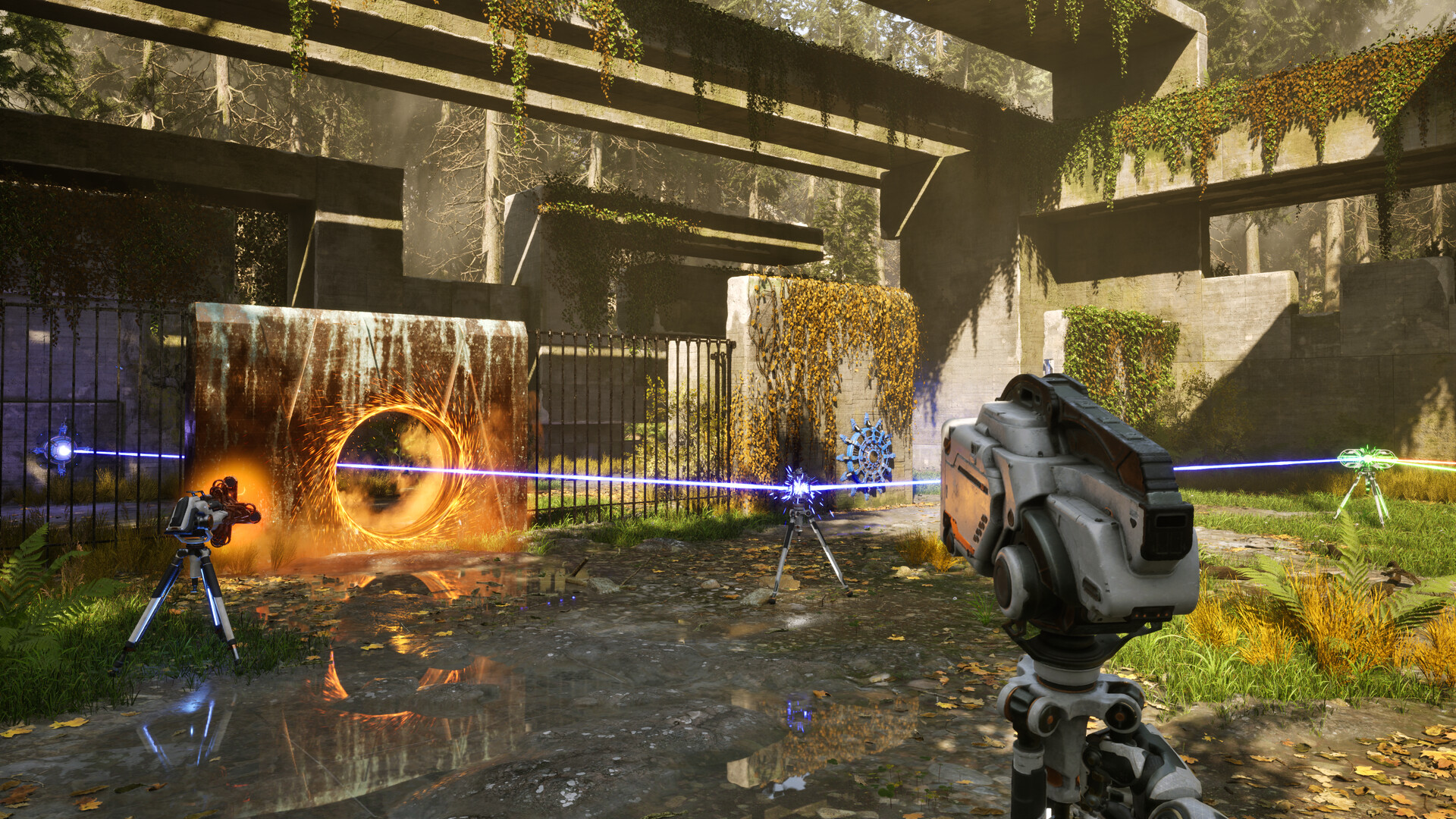
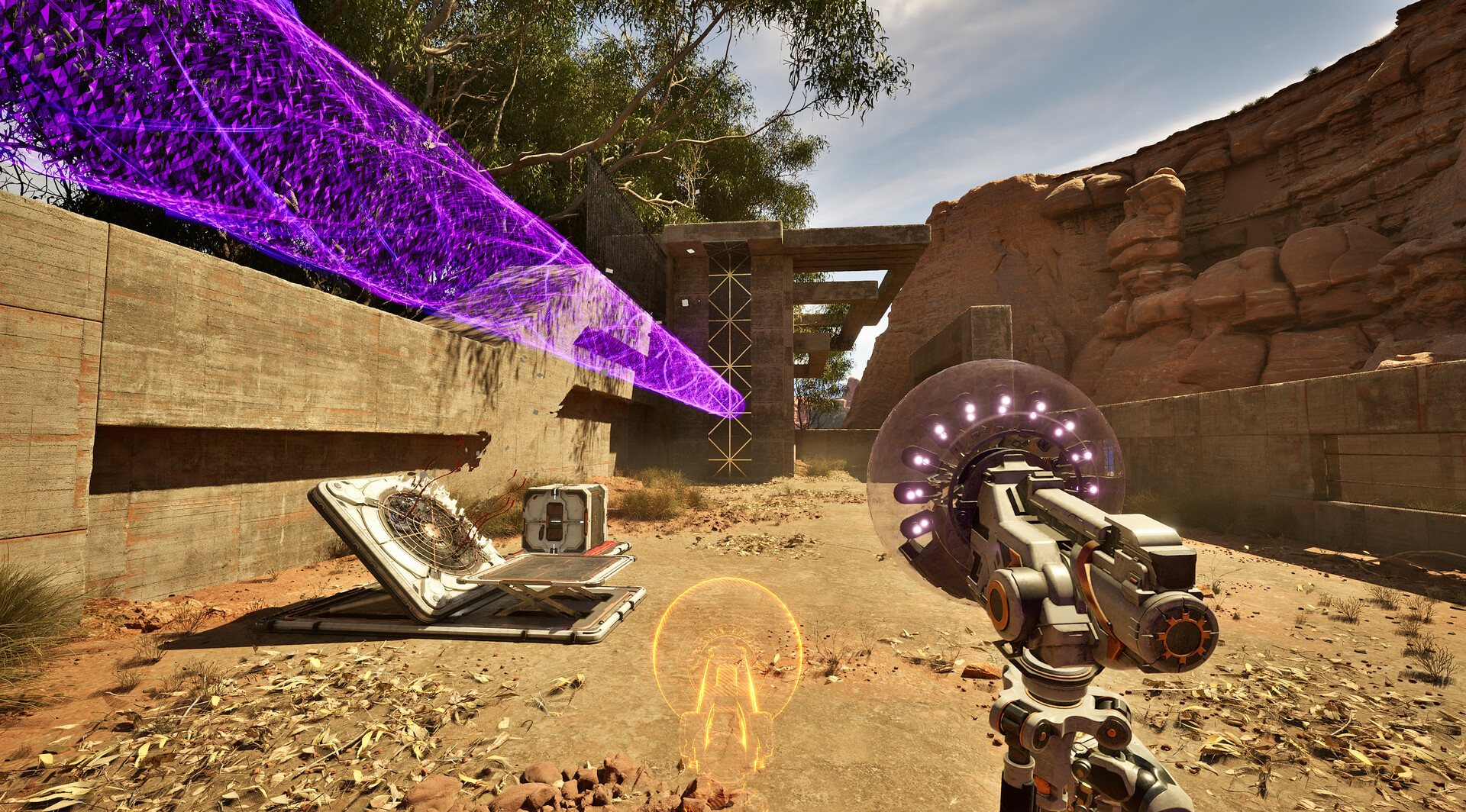
As the expedition reaches new areas, additional devices change the rules that familiar tools can follow. Gravity manipulation lets 1k and movable objects travel along surfaces that would otherwise be walls or ceilings, while mind transference shifts control between robot bodies positioned in different parts of a puzzle. Other machinery can make an opening in a suitable surface for objects or beams, exchange one item for another, or alter how light is stored and redirected. These systems have distinct uses: a connector carries a live beam through a valid path, while a device that stores light can preserve a colour for use somewhere else. Puzzles introduce equipment in focused combinations, then ask the player to consider placement, order and movement together. A chamber’s reset option provides a way to restore its arrangement when experimentation leaves the pieces in an unhelpful state.
Progress is organised around the island’s regions and towers. Each area offers a set of numbered chambers, with more puzzles available than the minimum needed to open the route onward; solving eight of ten standard puzzles is enough to enter a regional tower. That threshold makes the main journey flexible: a particularly difficult chamber can be left for later while other routes remain available. Returning to earlier places lets 1k finish optional challenges and look more closely at abandoned labs, terminals, environmental details and records. Larger metapuzzles connect discoveries beyond the boundary of a single chamber, asking the player to notice how separate pieces of information or mechanisms contribute to a broader task. The island therefore rewards attention between puzzle rooms as well as inside them.
Optional Lost puzzles and the more demanding Gold puzzles add another layer for players who want to investigate beyond the required route. Gold challenges build on the game’s established devices and combinations, while their completion can open further story material and affect the eventual resolution. They are not a requirement for reaching the central conclusion, and the standard puzzle threshold keeps the main expedition moving without demanding a perfect clear. Exploration can also uncover collectibles that provide hints, secret puzzle sites and records that fill in parts of the setting’s past. These additions support curiosity at different levels: a player can stay with the main chambers, pause for a side puzzle, or revisit an area with a new idea about how its objects might fit together.
Between the mechanical challenges, the expedition members and New Jerusalem’s residents give 1k’s discoveries competing interpretations. Conversations, written exchanges and archived material raise questions about consciousness, nature, freedom, mortality and the responsibilities of a society that has inherited human culture without being biologically human. The companions do not form a single, unified position: their different temperaments and priorities make the debate personal as well as political. Dialogue choices let 1k express a view, respond to a companion and influence how events develop, including the city’s leadership and later relationships within the expedition. Those decisions do not replace puzzle-solving; they shape the frame through which its results are understood. The story’s central tension is whether this new humanity should preserve a careful equilibrium or accept the uncertainty that comes with pursuing change and knowledge.
- Developer
- Croteam
- Genre
- First-person puzzle adventure