
About The Swapper
A scavenger explores an isolated research station in the remote reaches of space, where an expedition uncovered something unsettling. An experimental device lets the explorer create duplicates and transfer control between them. By coordinating those bodies through hazardous rooms, collecting access orbs and reading traces left by the missing crew, players encounter a mystery about identity and consciousness.
The Swapper is a single-player science-fiction puzzle platformer set aboard an isolated station at the edge of known space. The player controls a scavenger who arrives in a place shaped by a failed human expedition and an unusual discovery beyond its walls. The station is both a navigable structure and the evidence through which the story emerges: sealed compartments, damaged machinery, research spaces and records left behind make the crew’s absence tangible without turning the game into a combat-focused survival scenario. The central question is not simply how to escape a remote facility. The scavenger carries a device whose power makes ordinary ideas about one body belonging to one person feel unstable, and the station’s history gives that practical tool a disturbing human context. The broader setting includes a distant world and an alien presence investigated by the expedition, but the narrative introduces these elements gradually through exploration and recovered information. This keeps the player’s immediate task concrete—find a way through the next room—while letting each new piece of context change how the device and its duplicates are understood.
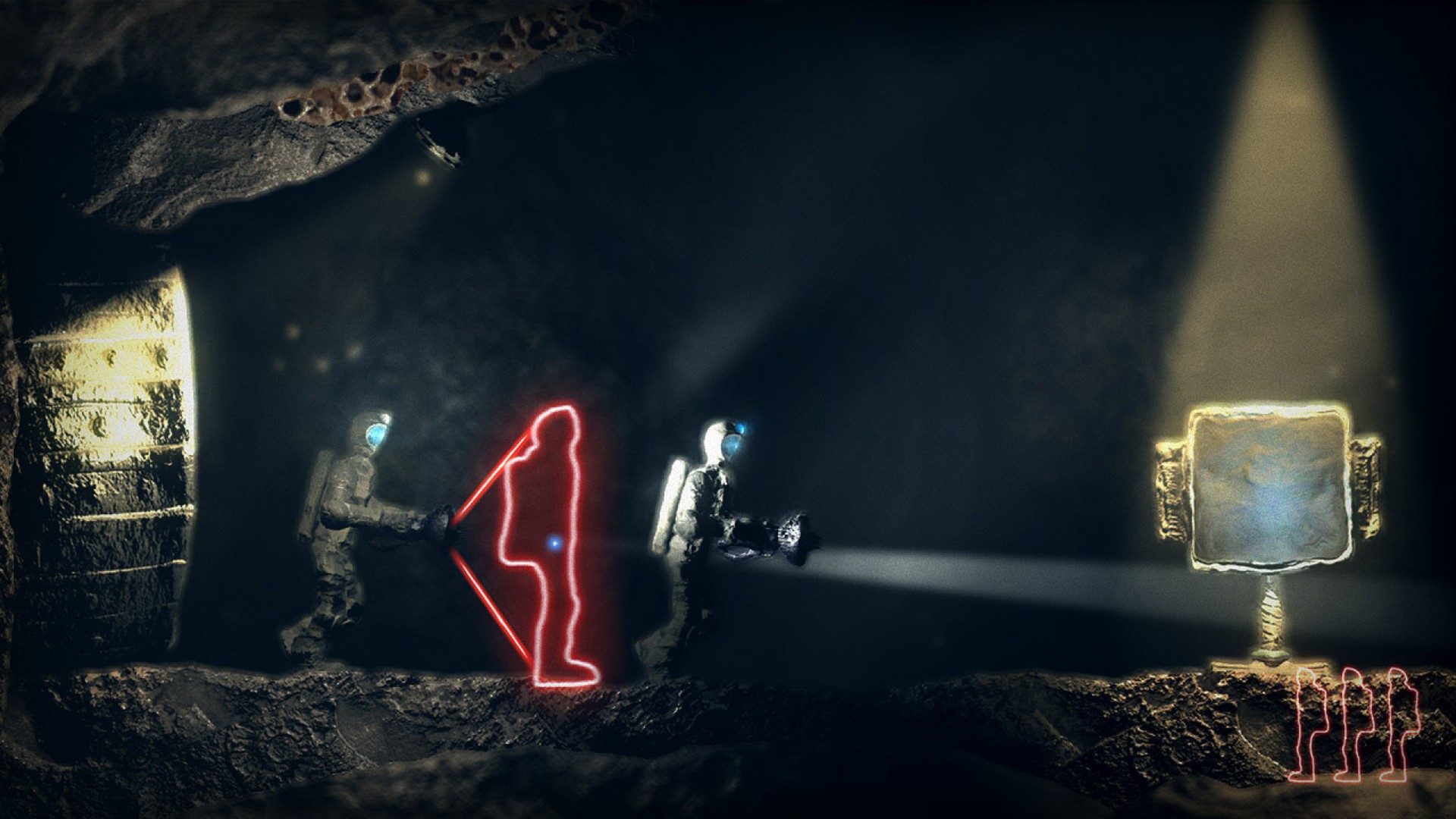
The Swapper device combines two actions: it can place a limited number of copies of the controlled character and transfer control from one visible body to another. Aiming determines where a new duplicate can be created, while line of sight governs which body can be selected for a transfer. The player can therefore use a clone as a destination, moving across a gap or reaching a ledge that the original body cannot access directly. The duplicates also provide extra bodies for pressure plates and switches. They are not independent companions with separate commands: when the active character moves, the other copies reproduce that movement, so the player has to account for the whole group at once. This shared motion is the rule that turns a seemingly generous power into a precise spatial problem. A clone placed on a button may open a door, but moving the controlled body afterward can pull every duplicate away from its position. A solution depends on where each body is standing, which one is active, and what movement the next action will cause. The device remains useful throughout the adventure; the challenge grows from understanding its interactions with rooms rather than building a combat loadout or collecting new weapons.
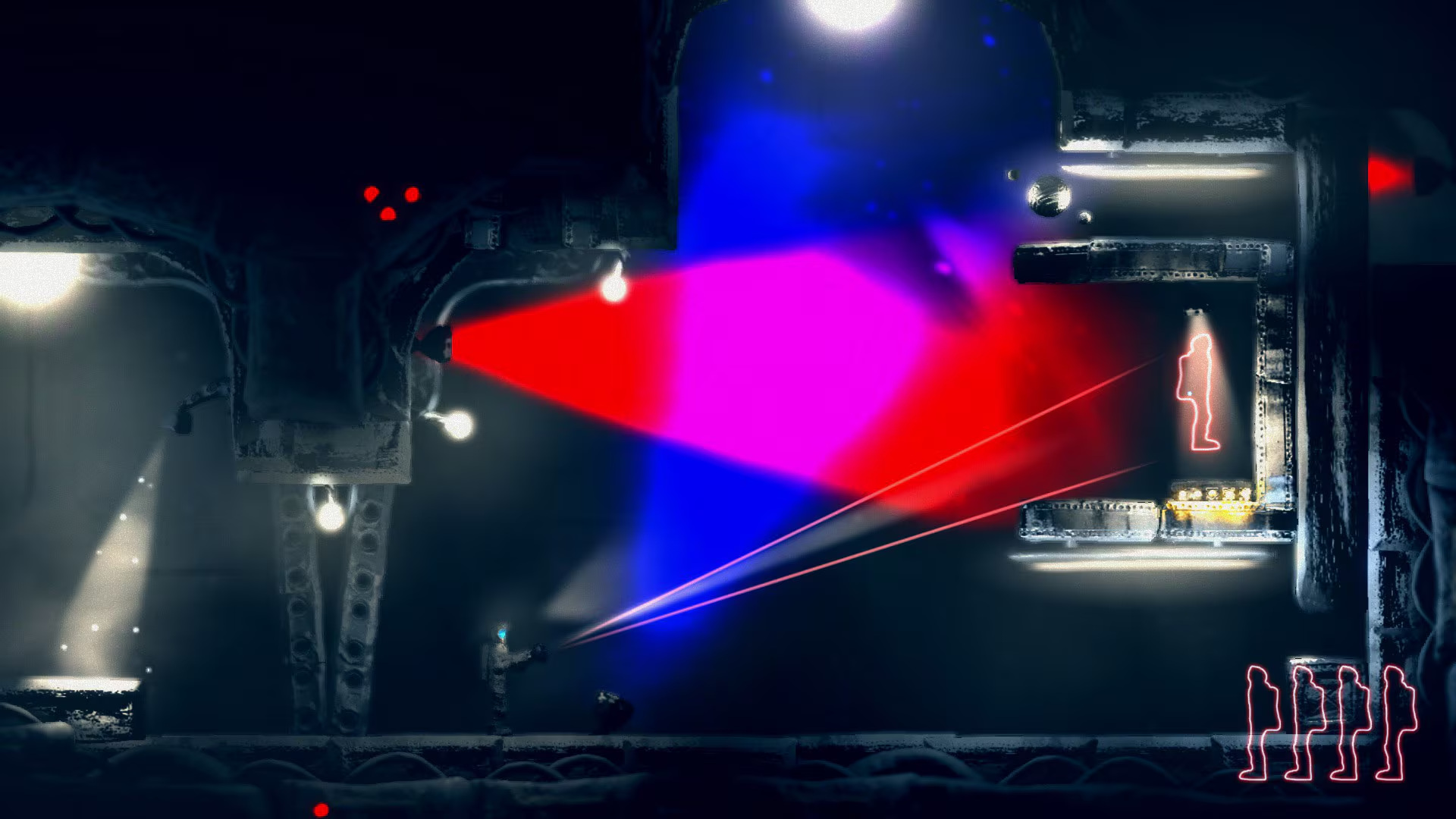
Rooms add restrictions that make the clone-and-transfer tool behave differently from one space to another. Coloured light fields block particular functions: blue light prevents creating a new clone in its area, red light prevents transferring control across it, and a field combining the two stops both actions. The restrictions are visible in the environment, so a room can be read as a spatial diagram before the player commits to a sequence. Switches can open routes or deactivate barriers, but reaching them may require placing a body on a platform, leaving another behind, and then changing which copy is controlled. Because the clones repeat the player’s movement, stepping toward a switch can undo an earlier arrangement unless the route and order are planned. The device’s aiming and transfer actions also depend on a clear line, so a usable destination may need to be positioned where it can be seen. This makes obstacles serve several purposes at once: a light field can block the shortest route, divide a room into safe and restricted zones, and make an apparently reachable switch irrelevant until the player repositions. The game teaches these rules through rooms that combine them, asking the player to treat light, sightlines, platforms and bodies as parts of one connected mechanism.
Progress comes from solving self-contained chambers and gathering energy orbs that unlock access to further parts of the station. The orbs are placed within puzzle spaces rather than functioning as ordinary currency or equipment upgrades; reaching one is the objective that validates a room’s arrangement. Some routes can be opened after collecting enough of them, which allows the player to make progress without clearing every challenge immediately. This structure gives exploration a practical loop: inspect an adjoining room, work out whether its prize or switch can be reached with the current layout, then use collected orbs to open a route deeper into the complex. The game does not rely on an expanding set of conventional abilities to solve earlier obstacles. Instead, it revisits the same core actions in combinations that demand more exact placement and sequencing. Later puzzles add gravity-changing surfaces, allowing bodies to walk on ceilings or approach the same apparatus from a changed orientation. Since gravity can vary between clones, a solution may involve arranging copies on different surfaces and preserving their positions while control shifts among them. The progression is therefore both geographic and conceptual: each opened sector extends the route through the station, while each new room tests a more involved reading of the same small toolkit.
Movement through the station links its puzzle rooms into a larger, partly explorable environment. Corridors and junctions connect to sealed chambers, and the map gradually fills in as the scavenger reaches new sectors. The layout invites the player to notice doors that remain closed and branches whose access requirements are not yet met, then return after collecting enough orbs. That light backtracking gives the station a coherent scale, while individual puzzle rooms keep their challenges legible and bounded. Teleporters between discovered parts of the facility reduce the amount of corridor traversal involved in revisiting an area. The scavenger’s movement is deliberately grounded in a side-view platforming frame: walking and jumping position the body in relation to ledges, gaps, switches and hazards, while the device extends that physical reach by creating a visible destination. The player is not navigating a free-roaming three-dimensional space; depth is conveyed through layered scenery and the arrangement of objects, while the relevant actions take place across carefully composed screens. This distinction matters because the puzzle is usually about a particular room’s geometry, not about locating a hidden answer somewhere in an open world. Exploration supplies context and route choice, while each chamber asks for a readable chain of spatial decisions.
The story arrives through the same spaces the player crosses. Text terminals and recorded conversations preserve the expedition’s arguments, discoveries and disagreements, while an intermittent voice gives the scavenger a point of contact amid the station’s silence. These fragments avoid turning the journey into a sequence of long explanatory scenes. Instead, a log may complicate what the player thought a device did, or place an earlier experiment beside the bodies and mechanisms now being used to solve a puzzle. The narrative’s recurring concerns include consciousness, identity and whether transferring control between bodies can truly be understood as a person moving from one body to another. Those questions are connected directly to the central mechanic: every room invites the player to make practical use of duplicates, and every recorded account offers a reason to reconsider what those duplicates might represent. The story also builds around the expedition’s encounter with an unfamiliar form of life, but its significance unfolds piece by piece rather than being explained in advance. The broad setup and themes show how the narrative and puzzle design inform each other. Players who mainly want to solve rooms can follow the immediate route, while optional records deepen the context of the station and its crew.
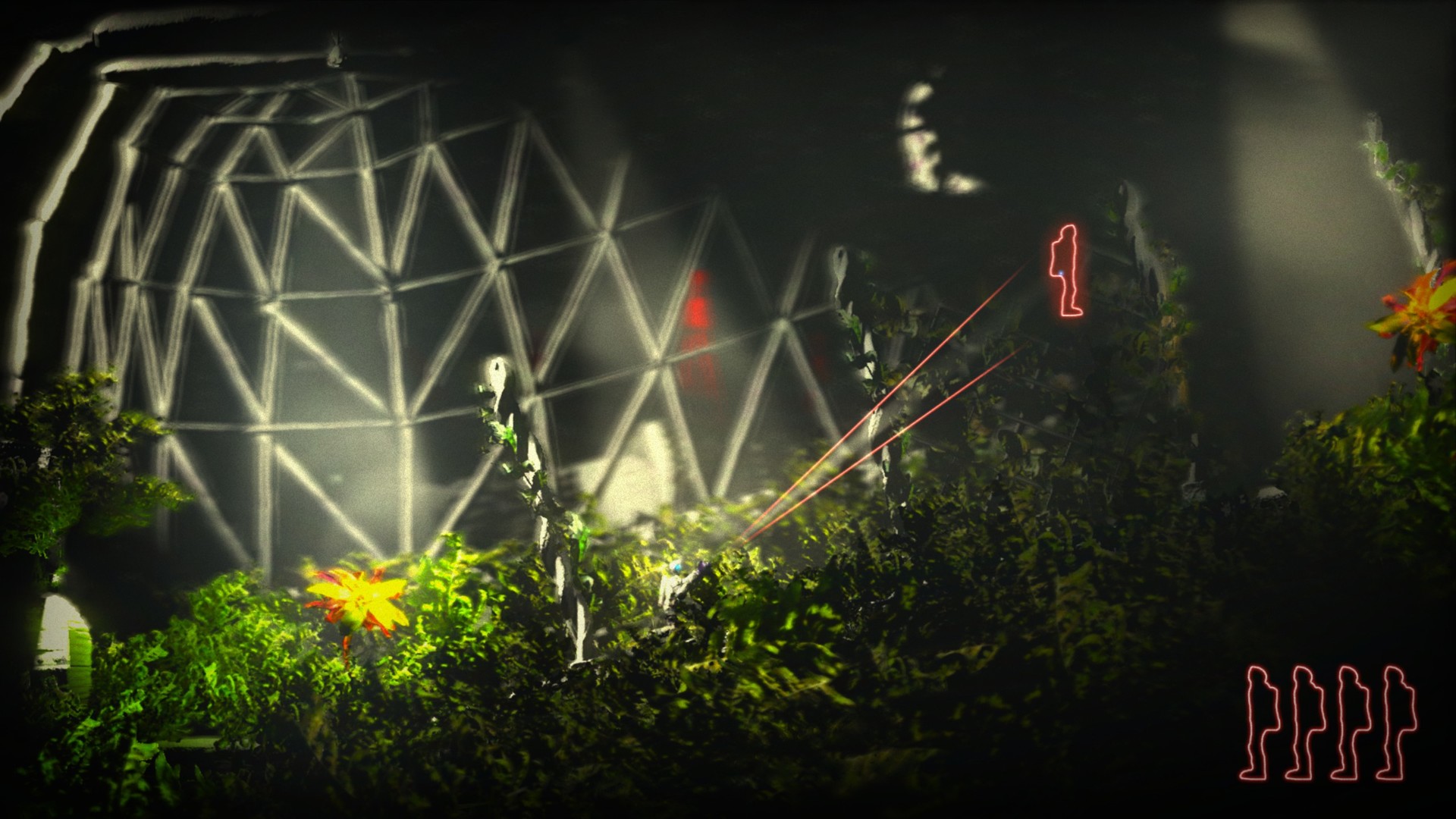
The visual presentation is built from photographed clay models and other everyday materials, then arranged into a two-dimensional science-fiction world. The result gives industrial corridors, machinery and alien forms a tactile surface that differs from smooth computer-generated environments. Lighting carries much of the scene’s contrast: dark sections are punctuated by saturated blue and orange, luminous panels and the glow of equipment, while quieter areas let the station’s silhouettes and textures stand out. The look is not separate from navigation; bodies, platforms, barriers and interactive objects need to remain readable against layered backgrounds, especially when several duplicates occupy the same room. Ambient sound and restrained musical passages support the isolation of moving between machinery and empty compartments. Text records and occasional voices punctuate that quiet without making the station feel continuously populated. The presentation’s handmade basis is part of the original game’s identity across its computer and console releases. On Steam, The Swapper is listed as a single-player game (app 231160); Facepalm also lists releases for Windows, macOS and Linux as well as PlayStation 3, PlayStation 4, PlayStation Vita and Xbox One.
- Developer
- Facepalm Games
- Genre
- Single-player science-fiction puzzle platformer