
About The Spirit and the Mouse
After a storm leaves Lila the mouse sharing electricity with Lumion, a stranded spirit guardian, she explores Sainte-et-Claire to help its residents. By guiding playful Kibblins back to their electrical boxes, solving small environmental puzzles and gathering energy and happiness, Lila can restore power across the village and help Lumion return to the sky.
The Spirit and the Mouse makes Sainte-et-Claire feel large by placing its story at mouse height. Lila is a small resident of a French village whose familiar streets, homes and public spaces become a landscape of ledges, gaps, wires and hidden corners. During a storm, she tries to help a villager and is caught in a lightning strike that brings her together with Lumion, a spirit guardian stranded away from the sky. The encounter gives Lila electrical abilities and gives Lumion a reason to stay close: he needs happiness gathered from the people he was meant to help. Their partnership begins with practical friction as much as magic. Lila wants to do good, while Lumion is more concerned with getting home. The difference between them gives the journey a character thread that develops alongside the village’s recovery. Rather than following a human-sized hero through distant regions, the game stays with one community and asks what its people need, letting small acts of assistance carry the plot forward.
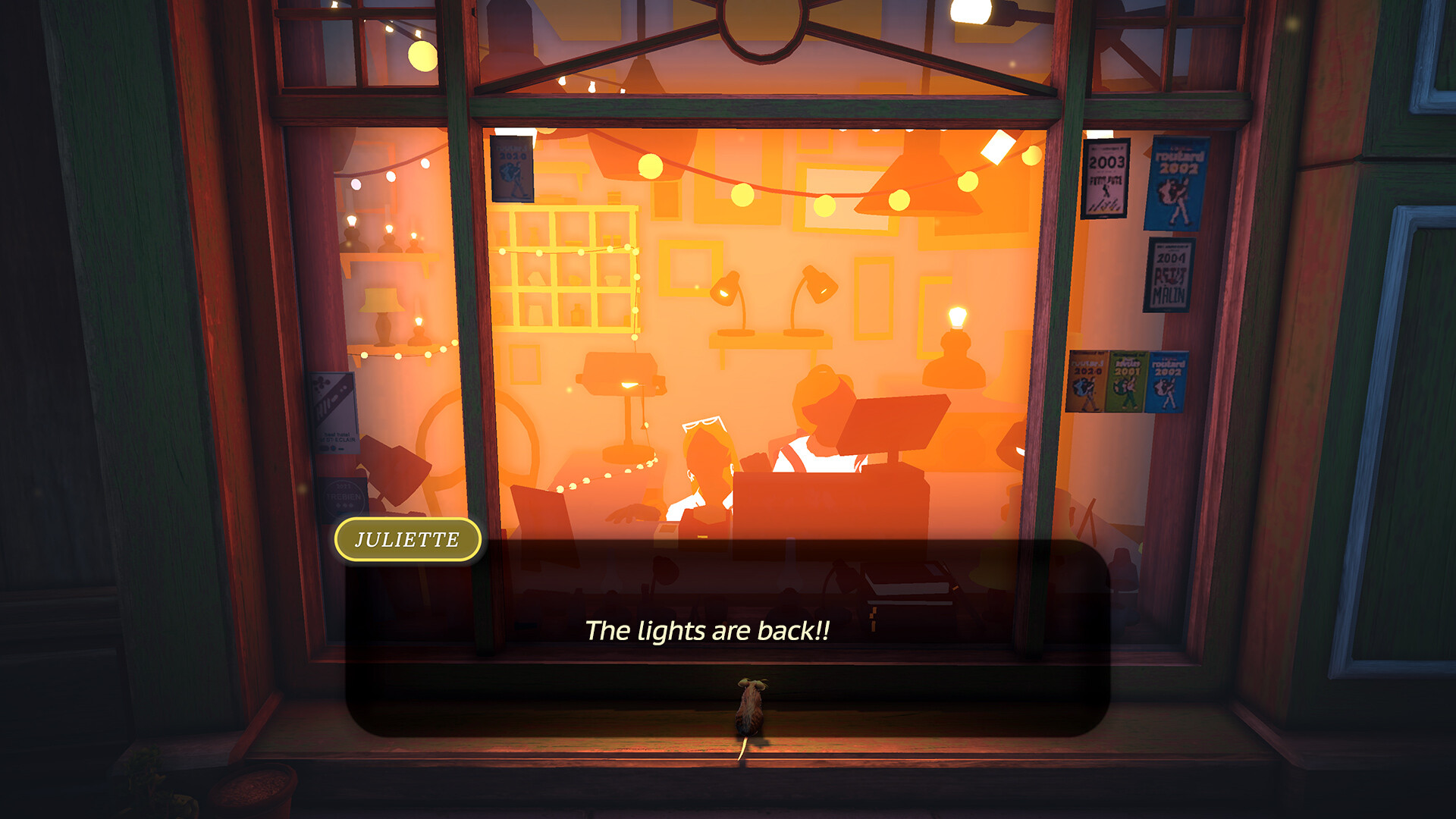
The central routine links listening, searching and repair. Villagers describe troubles caused by electrical problems, and Lila must locate the relevant Kibblins, lively little spirits that have wandered from the boxes supplying power to homes. Each resident’s Kibblin box provides a natural focus for a short local story: find the spirit, understand what it needs, and help it return so the household’s power can work again. Reaching a solution is not usually a matter of fighting an enemy or executing a precise sequence of jumps. It asks the player to look around, follow clues and work out how the space connects. The residents do not necessarily see the tiny helper responsible for the fix, so the result is expressed through their relief and the happiness Lila collects. Returning to a person after resolving the trouble closes that small narrative loop. A succession of separate households gradually becomes a portrait of village life, while each restored box also contributes to Lumion’s larger need to return to his place in the sky.
Kibblin encounters vary in the kind of attention they ask for. Some are playful searches; others involve assembling clues, working out a code or helping a Kibblin with a particular challenge. These episodes give each rescue a different shape without turning the game into a set of unrelated minigames: every spirit is tied to the same problem of getting electricity and happiness flowing again. Residents’ circumstances give the tasks their context, from people worried about strange lights to someone under pressure to complete important work. The tone remains gentle, but the tasks still ask the player to interpret the environment and remember what a character has said. A journal helps keep track of clues, and Kibblin boxes can offer hints about locating a missing spirit. That support keeps a missed detail from turning a modest errand into a prolonged search. It also suits the story’s scale: the main challenge is noticing and connecting things in a compact town, not overcoming combat encounters or a punishing obstacle course.
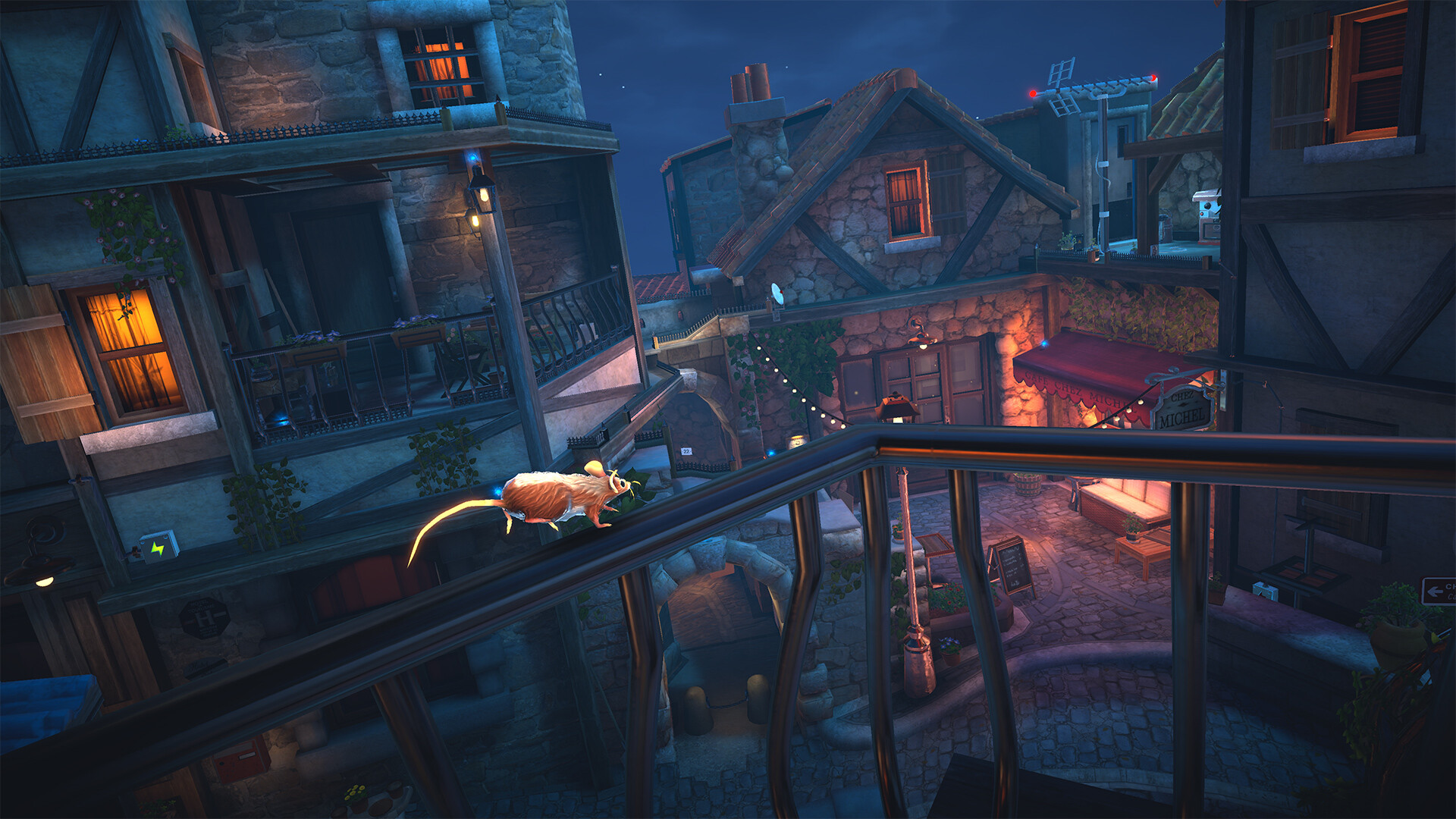
Lila’s movement is built around climbing and route-finding. She can scamper through human spaces, climb appropriate surfaces and use her new electrical nature to travel through parts of the town that ordinary movement cannot reach. Electric boxes act as points of entry into wiring, turning cables into routes between locations; other powers later let her pass through particular electric fences. These abilities change the map from a collection of streets into a layered network of interiors, walls and electrical paths. The developers describe exploration as a puzzle, with no jump button: access depends on finding sensible surfaces, openings and paths through the modeled environment. From Lila’s low viewpoint, furniture, masonry and household fixtures become route markers or obstacles. The third-person camera follows a quadruped character close to the ground, so the readable shapes of climbable surfaces and environmental hints matter. The game presents itself as exploration and puzzle work rather than precision platforming, giving the player time to inspect a route and decide how to approach it.
Electricity and happiness support a gradual expansion of what Lila can do and discover. She can zap suitable objects to gather electric energy, which is used to unlock abilities and other useful or playful additions. Helping people and returning Kibblins also produces happiness, linking progress directly to the residents’ stories instead of treating rescue as a detached score. This gives exploration two complementary purposes: search for immediate resources that can be spent, and complete local tasks that move the broader story forward. Lightbulbs are scattered around the village as a separate collectible trail. Bringing them back to the Kibblin associated with the town square’s string lights unlocks bonuses, including area maps, teleportation and a photo mode. The reward structure makes wandering worthwhile even when a bulb or hidden route is not required for the current resident’s problem. It also creates a return loop: new tools can make other parts of Sainte-et-Claire easier to reach, while maps and teleportation help with revisiting places already explored. The village’s full set of secrets sits alongside, rather than replacing, its character-led errands.
The visual presentation holds together spaces that operate at different scales. Sainte-et-Claire uses detailed, grounded environments, while the Kibblins are brightly expressive and the human residents have a distinct, more graphic appearance. That contrast supports Lila’s perspective: household objects and architecture feel tangible, but the spirits make electricity visible as a cast of characters with their own behavior. The nighttime setting and piano-led soundtrack give the village a quiet, sometimes wistful mood, even as the errands are built around kindness and comic exchanges. Lila and Lumion’s relationship also changes the emotional emphasis of the journey. Their initial arrangement is practical, but helping one household after another gives them repeated reasons to talk and reconsider each other. There is no combat system competing for attention; the central verbs remain exploring, climbing, using electricity, solving small puzzles and helping people indirectly. The story’s destination is clear from the outset, but its progress is made through many local connections: restore the Kibblins’ place in the village, bring happiness back to its residents, and help Lumion find his way home.
The Spirit and the Mouse is a single-player narrative adventure about moving through a compact town with a very different sense of scale from its human inhabitants. Its systems reinforce one another: electrical powers turn wires and barriers into routes, Kibblin tasks connect puzzles to individual residents, and collected energy and happiness open further possibilities. Lightbulbs reward curiosity with tools that make later exploration more convenient. Because the story is organized around the village rather than a sequence of distant destinations, completing one household’s problem changes how Sainte-et-Claire feels as a whole. Lila’s kindness is not a special ability that replaces the game’s mechanics; it is the reason to use those mechanics on behalf of people who may never know she was there. Lumion’s return-home goal gives the errands an overarching direction, while his exchanges with Lila keep that goal personal. The result is a journey whose scale is intimate but whose spaces invite careful exploration, letting a tiny mouse connect a town’s electrical mishaps to the happiness of the people living through them. The deliberate absence of jumping also shapes the rhythm: progress comes from reading architecture, spotting a climbable edge or tracing a cable, then testing how those pieces meet. Searching is therefore part of the puzzle, not a pause between story scenes.
- Developer
- Alblune
- Genre
- Third-person exploration-puzzle narrative adventure