

About The Roottrees are Dead
In 1998, after a jet crash kills the Roottree sisters and their parents, an inheritance dispute turns into a search for the family’s surviving blood relatives. Use a period computer to search records, connect clues and place names and portraits on a growing family tree. The Steam edition also includes the Roottreemania mystery.
The Roottrees are Dead places a genealogical investigation in 1998, after a private jet carrying the wealthy Roottree sisters and their parents crashes. Their great-great-grandfather Elias has left an inheritance arrangement that directs the family fortune to surviving blood relatives, making the investigator’s first task a question of identity: who belongs on the Roottree family tree? The player works from a quiet room rather than travelling to crime scenes, using a late-1990s computer to follow the evidence outward from the crash and the family’s public history. Names, portraits, occupations and relationships must be connected across scraps of information that rarely explain themselves in one place. A newspaper reference may point toward a person, a photograph may provide a face, and a family detail may change what another document means. The case also requires separating blood relatives from people connected to the family in other ways, so a familiar surname or photograph is a lead rather than proof. The mystery grows as the tree fills, because each confirmed relationship narrows the remaining possibilities while the later branches depend on more obscure clues. The central activity is to assemble a defensible picture of a family from records that were not created as a neat case file.
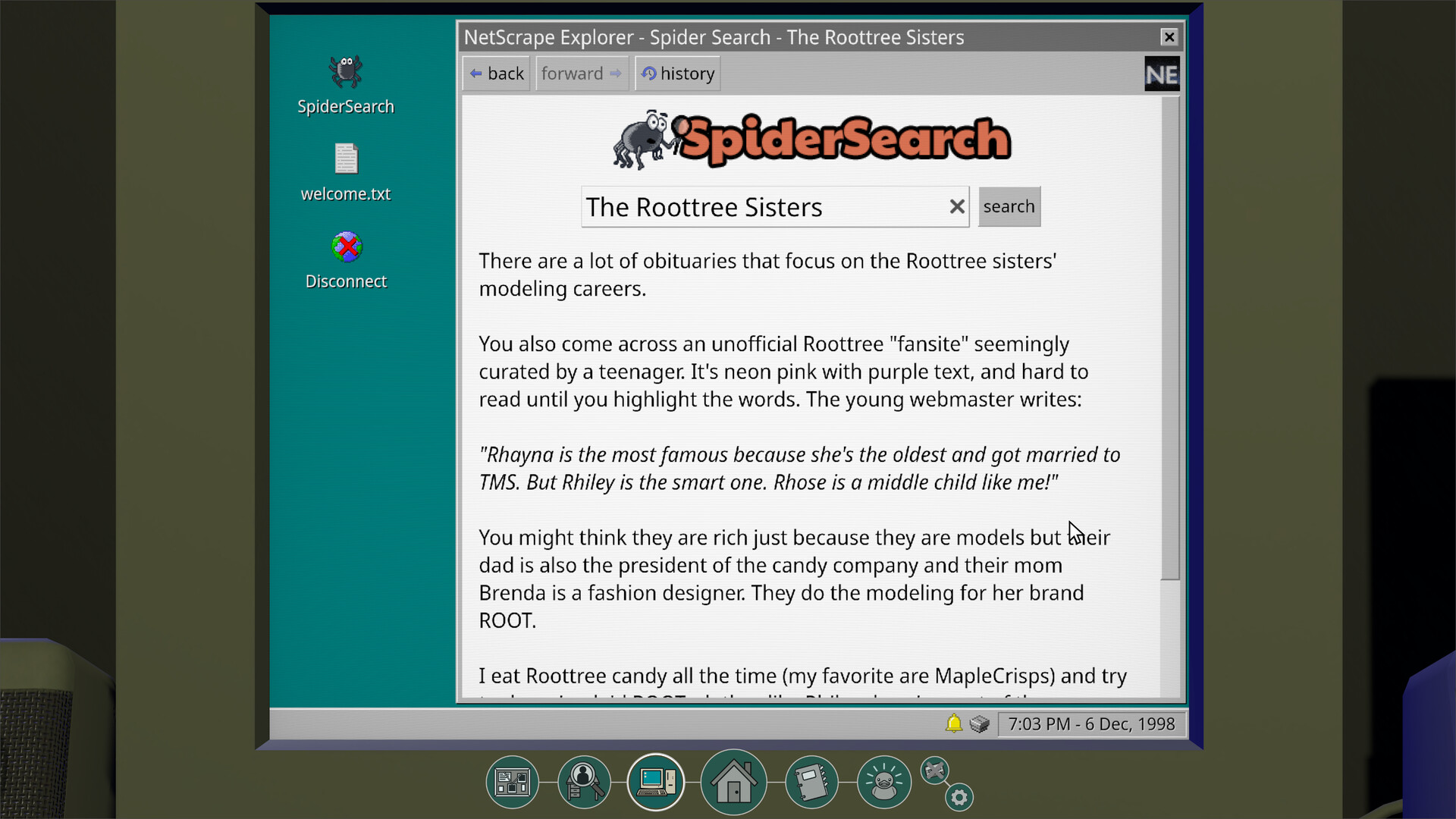
The game’s main space is an investigator’s desk and computer interface, presented in the Steam edition through a 3D living-room setting. Clicking through the room leads to the evidence, the family tree and a simulated early internet, where SpiderSearch turns names and phrases into leads. Rather than moving an avatar between locations, the player moves among documents, search results, collections and the family-tree board. Some records are available immediately; others become useful after clues reveal a publication, a book title or a person to investigate. The interface makes browsing part of the deduction: a query may return a useful article, a dead end, or a new proper noun worth carrying to another search. Evidence can be revisited and compared, so progress depends on keeping track of where an idea came from and what it actually proves. As the case develops, the board gives the player a visible record of which branches have been established and which remain open, while the browser supplies the next possible line of inquiry. The confined workspace concentrates the game on research decisions, while the expanding collection gives the investigation a changing structure.
The evidence is deliberately mixed in form. The investigator can find photographs, books, newspaper articles, interviews, advertisements and periodicals, each offering a different kind of clue. A photograph may provide a face without establishing a name; an article can offer a date or occupation; a publication reference can point toward another source rather than answer a question directly. Searches for names, phrases or businesses bring these records into relation, but the player still has to decide what each one demonstrates. One document can identify a person while another establishes a family connection, and a third can clarify when or where the connection makes sense. Comparing those details helps separate evidence from a plausible guess. As the record grows, discoveries can make previously gathered information more useful, because a name found in one place may connect to a photograph or relationship encountered elsewhere. Some sources provide a direct identification; others supply only a date, occupation or passing reference, leaving a gap that another record must fill before the relationship can be placed confidently. A clue can matter twice: first as evidence, then as a way to make sense of a name found elsewhere. The investigation therefore moves between reading, searching and checking the family tree, with each source contributing only part of a larger account.
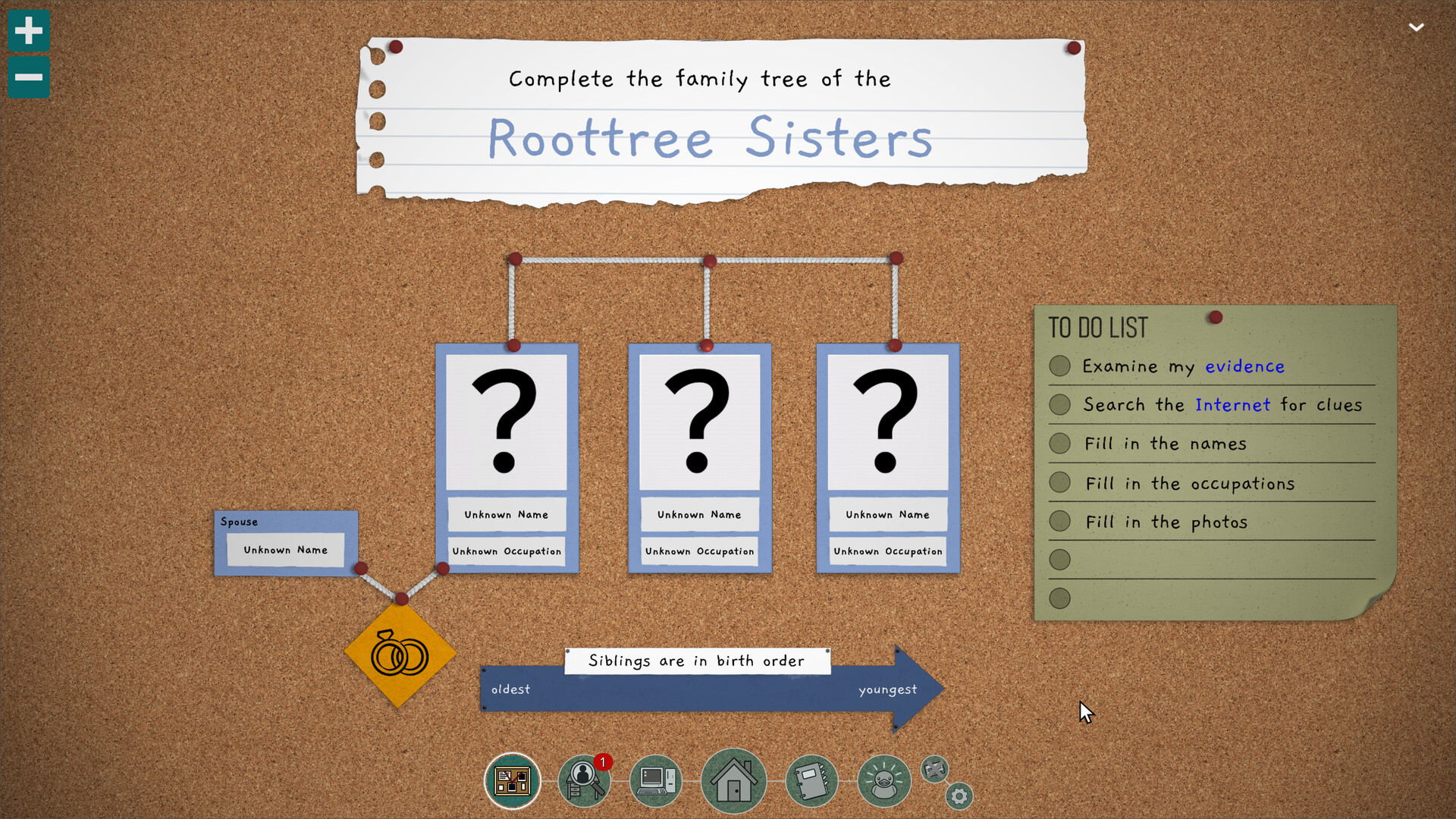
The family tree is both the investigation’s objective and its working model. It provides places for people and their photographs, and the player uses evidence to determine which names belong in which branches. Each accepted placement reduces the number of plausible destinations for the remaining faces and names, turning earlier discoveries into constraints on later deductions. Names, portraits and family relationships must be checked against the documentary trail; a shared surname or a plausible photograph alone does not settle a person’s place in the family. The board therefore encourages a cycle of tentative identification and cross-checking: a proposed person must fit what is known about parents, siblings or descendants as well as the relevant biographical clues. A correct entry can make another clue newly legible, while an uncertain entry can signal that a missing portrait or an unexamined source is still blocking the chain. The game is not asking for an answer based on family resemblance alone; it combines documentary evidence with the internal logic of the tree so the player can test whether a branch holds together.
Research develops through repeated searches in the game’s simulated early internet and comparison with the documents those searches uncover. The player follows names and phrases from one record into another, checks people against photographs and biographical details, and compares occupations, relationships and timelines. A search may produce a relevant article, a new reference or no useful result, so each lead has to be evaluated against the existing tree. When several records point toward the same connection, the player can make a more specific placement; when they conflict or leave an identity unclear, that gap indicates what to investigate next. The range of source types gives the inquiry its texture: periodicals, websites, advertisements, interviews, books and photographs each present information differently, and their claims need to be read in context. The game’s difficulty rises with the size of the tree because later relationships depend on more indirect, less obvious evidence. There is no single route through all the material; progress comes from choosing which missing face, disputed connection or unfamiliar name is most useful to pursue, then checking the result against the wider family record.
The Steam release reimagines the free browser game made for Global Game Jam 2023 and includes a second case, Roottreemania. The original case asks who belongs to the Roottree bloodline after the jet crash; the additional mystery follows the family afterward and introduces another tree to complete. It turns attention toward the relationships and secrets behind the Roottree Corporation’s maple-candy business. This is a continuation within the same fictional family, not an unrelated investigation or a separate purchase. A player who completes the first tree can therefore apply the method of searching, comparing records and checking relationships to a new set of identities, while the second case changes what needs to be established about that family.
The late-1990s setting shapes how information looks and sounds. Hand-drawn illustrations by board-game artist Henning Ludvigsen supply individual character portraits and documentary imagery in the Steam edition; the 3D living-room perspective keeps the computer desk, evidence board and surrounding room visible together as the case develops. Interface improvements support the search and organization of clues, while remastered music and sound effects and fully voiced cinematics add sound and speech around the research interface. The revised interface also changes how clues are held in view: the player can move from a search result to the family tree and back without losing the sense of working at one desk. That setting makes the growing archive visible as part of the room rather than presenting each record as an unrelated screen. The period styling matters to the investigation because a slow, text-heavy search can produce a small clue whose value becomes clear only after the player compares it with a photograph or a branch on the board.
- Developer
- Evil Trout Inc. (Steam version); original browser game by Jeremy Johnston
- Genre
- Genealogical mystery and deduction puzzle adventure