
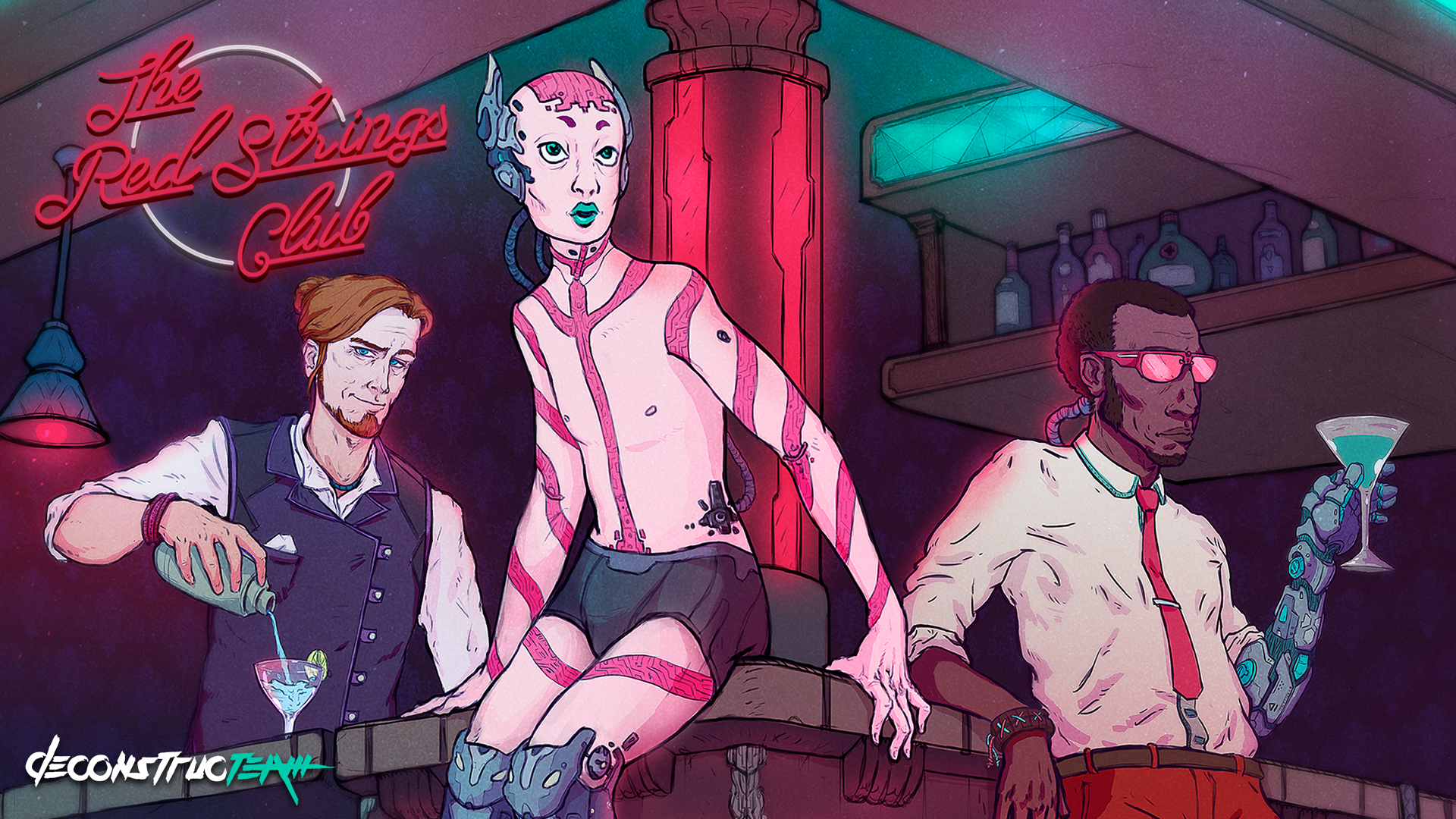
About The Red Strings Club
In a corporate-controlled cyberpunk city, bartender Donovan and hacker Brandeis investigate Supercontinent’s plan to remove negative emotions through a system called Social Psyche Welfare. A damaged empathy android draws them into the scheme, which they challenge through emotionally tuned cocktails, crafted implants, conversations and phone impersonation.
The Red Strings Club is a cyberpunk narrative adventure set in a society where advanced technology has become part of ordinary life and corporate power reaches into people’s private decisions. Supercontinent Ltd presents Social Psyche Welfare as a programme for removing depression, anger and fear, promising a happier population. The proposal turns an appealing goal into a question about consent: if distress is part of human experience, who should have the authority to take it away, and what does a corporation gain by defining wellbeing for everyone? The story approaches that conflict through three connected roles. Donovan runs the Red Strings Club, a clandestine bar; Brandeis is a freelance hacker and Donovan’s partner; and a damaged empathy android brings information about Supercontinent’s plans. They do not begin with an army or a conventional set of weapons. Their means are conversation, technical intrusion and the ability to influence what other people feel or know.
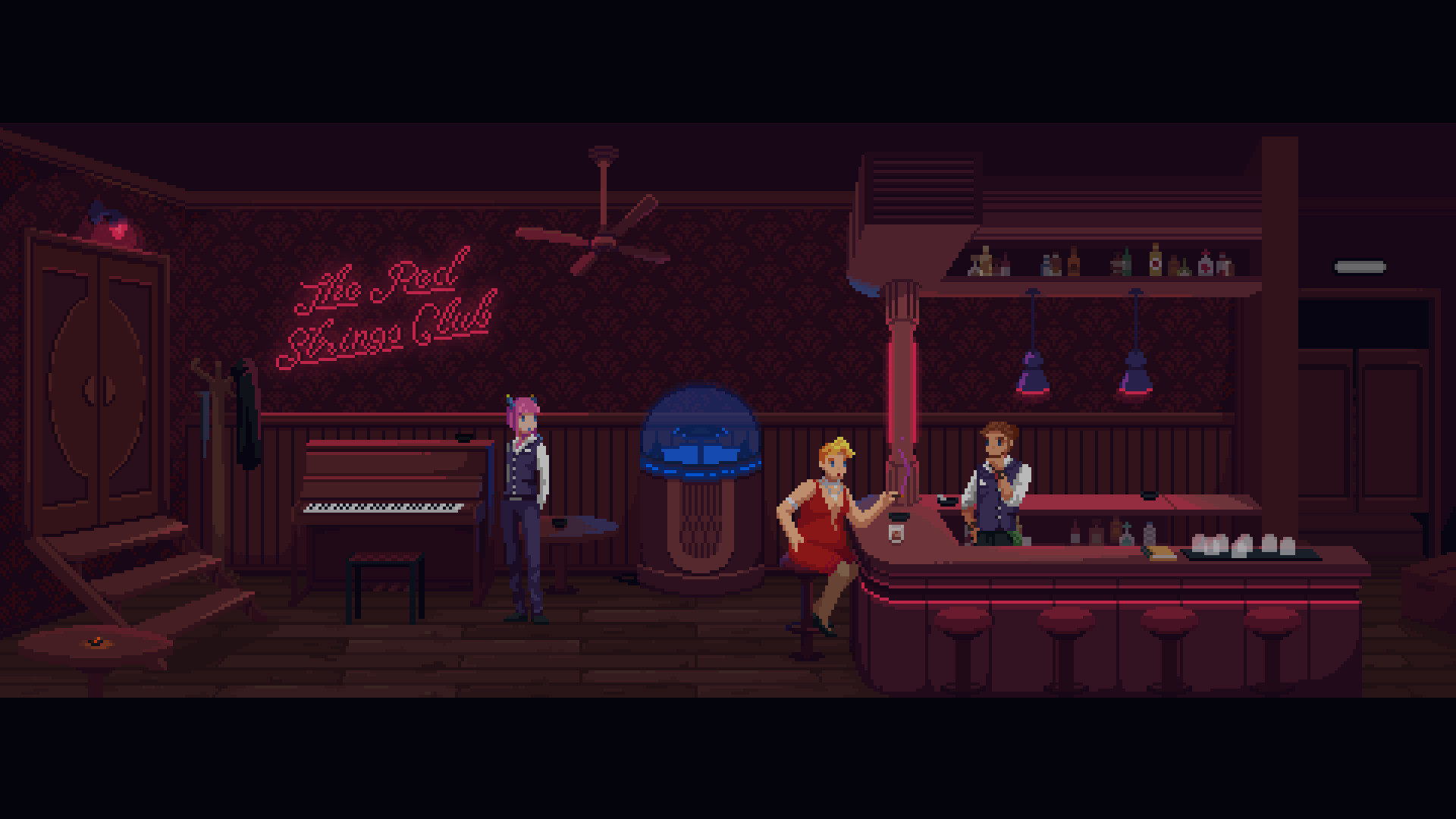
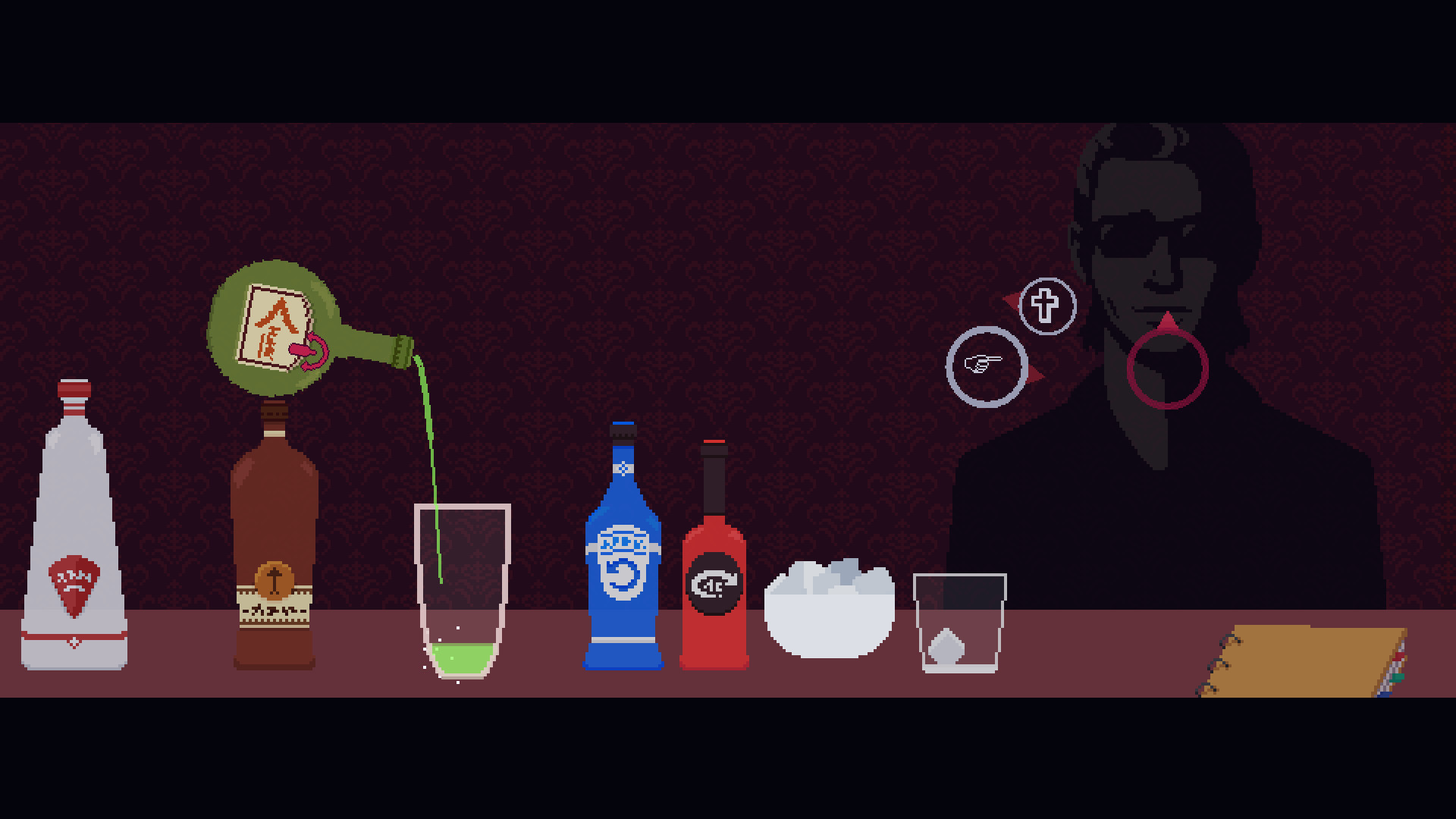
The bar is the most recurring setting and the point where the game’s social systems become concrete. Donovan talks with clients while preparing drinks, and those exchanges are more than dialogue selections over a static background. Each customer has emotional states that can be brought forward, and a cocktail is assembled to target one of them. The player handles the bottles and pours measured amounts into a glass, using different liquors to shift the mix toward different emotional positions; ice changes its size, while later tools allow more involved combinations. A drink that reaches a particular feeling can alter the conversation that follows and give Donovan access to a different response or piece of information. The minigame therefore ties what the player does with their hands to what Donovan is trying to do socially. He is reading a person, deciding which vulnerability or disposition to draw out, and making a drink that can steer the exchange.
That bartending work also gives the story an uncomfortable parallel. Donovan objects to a corporation intervening in people’s emotions at population scale, yet his own drinks can influence customers without their clear awareness. The game places this tension inside the routine of serving someone: listening, interpreting a mood and choosing how to affect it become parts of one action. Information gathered at the bar can help the investigation, but the method is not neutral simply because its target is a powerful company. The question of manipulation returns in a different form when the player works with the empathy android. Rather than using a drink to influence a conversation, this section asks the player to shape implants for customers. Supercontinent’s programme and the smaller modifications requested at the club both concern altering how people think or act. Their scale and purpose differ, but the repeated act of designing a change makes the ethical issue tangible instead of leaving it as abstract argument.
The android’s implant work uses pottery as its central interaction. A customer describes a desired change, such as gaining social popularity or becoming more persuasive with potential investors, and the player forms an implant from a block of material on a high-tech lathe. Rotating the workpiece and using shaping tools turns a request about personality or ambition into a physical object. The task has a practical sequence: inspect the requested outcome, build the shape that corresponds to it, then refine the result. These are not decorative ceramics detached from the plot; the finished object is intended to change a person through technology. This scene gives the player a different perspective from Donovan’s. At the bar, the desired effect is produced through a temporary emotional prompt; at the workbench, it is embodied in an implant. Both activities ask the player to translate a social goal into a tool that can influence another person, while the larger plot keeps asking who gets to choose that goal.
Brandeis’s investigation shifts from the personal scale of a customer conversation to the company’s communications network. The player uses a phone system and assumes other people’s voices to call employees connected with the Social Psyche Welfare project. Each call becomes a small act of corporate espionage: the voice must sound appropriate to the identity being used, and the conversation is directed toward exposing information or setting people’s motives against one another. The calls are built around the gap between the identity presented and the person on the other end, so choosing what to say and whose authority to invoke are part of the same deception. The aim is to make the company’s internal relationships legible from outside, using one employee’s stated aims to open a path to another conversation. This is not presented as a combat mission or a free-roaming hacking sandbox. The focus stays on what can be learned through a deliberately staged exchange and how one person’s account can be used to reach another. The phone sequences complement Donovan’s work because both depend on shaping what a listener believes, while their methods differ: one adjusts a drink to a customer’s emotional state, and the other borrows an identity to enter a guarded conversation.
The narrative moves among these activities and the people they bring into contact with Donovan, Brandeis and the android. Supercontinent’s employees are not only faceless obstacles; conversations reveal individuals with their own ambitions, needs and relationships to the company’s plan. The club provides a place for people to speak, while the calls place the player outside the room and the implant work shows how technical solutions can affect a person after the immediate conversation ends. Together, the sections make the conspiracy legible through its human consequences: the policy is explained through a programme, but the player encounters it in what people want, what they disclose and what another person might change about them. Dialogue choices and the information uncovered shape how scenes develop. The decisions can affect who the player gets to know and how useful a person is to the effort against Supercontinent, so a conversation does not function only as a delivery system for background information. A character’s place in the unfolding investigation can depend on what the player learns or how an exchange goes. That gives the encounters a small-scale consequence within the wider conspiracy: the player is not managing a party roster, but the sequence and results of social contact can change which people matter in later scenes. The story remains focused on a limited cast and a central conflict, with the three playable perspectives giving that conflict different forms of interaction rather than expanding into a large map or a roster of combat missions.
The game’s presentation supports this intimate structure with detailed pixel-art scenes and a soundtrack that moves between electronic textures and piano-led moments. The bar’s counter, its customers and their expressions give the drink-making sequences a clear social frame; the implant station turns the work surface into a compact crafting space; and the phone scenes emphasize voices and the pressure of a conversation conducted under another identity. The shifts between these spaces mark changes in the player’s role while keeping the same question in view: how much influence over another person is acceptable when the stated aim is improvement? The Red Strings Club was developed by Deconstructeam and published by Devolver Digital. Its progression moves between bartending, implant pottery and phone impersonation as the group follows the corporate scheme. The intimacy of those tasks keeps the moral dispute close to individual conversations and decisions, even when the threat extends across society.
- Developer
- Deconstructeam
- Genre
- Cyberpunk narrative adventure