
About The Pedestrian
The Pedestrian turns public signage into a connected platforming world. You guide a small pictogram figure across doors, ladders and paths drawn on signs, then rearrange and reconnect those signs to make a route. Each solved panel also sits within a three-dimensional environment that changes as the journey advances.
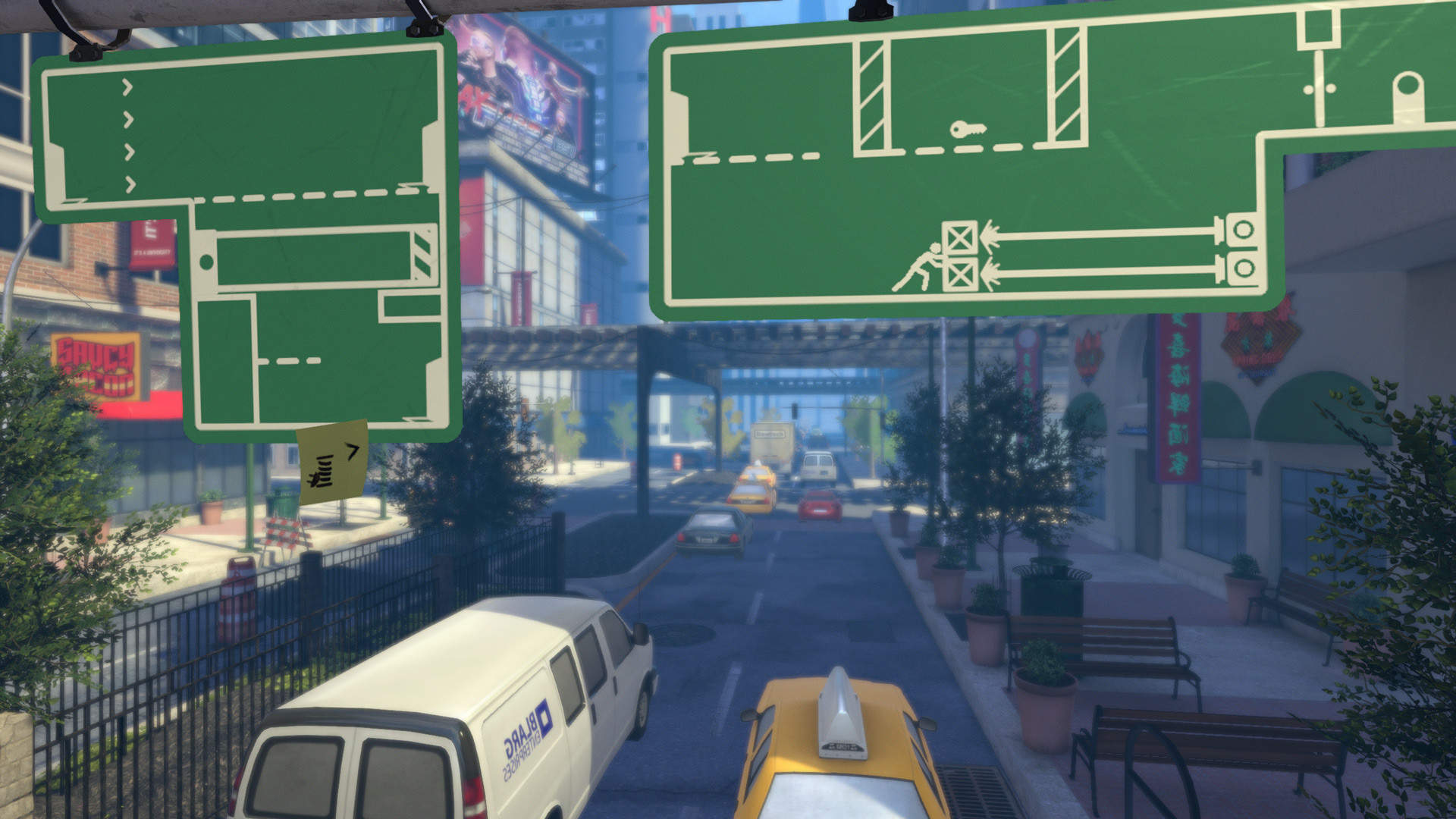
The Pedestrian gives control to the familiar stick figure printed on public signs. Rather than leaving the pictogram fixed in place, the game lets it walk across the two-dimensional surface, climb ladders and pass through drawn doorways. Those signs sit inside a larger three-dimensional world: a street, subway or other urban space can remain visible around the flat puzzle surface. The player’s route therefore has two connected scales. Inside a sign, the figure must cross platforms and reach an exit; outside it, the sign itself is part of a physical environment that can move or reveal the next place to go. The presentation does not rely on a named cast or dialogue to explain the journey. Instead, the small figure’s movement through ordinary graphics and city settings provides the premise, while the puzzles show how those printed routes can be rearranged into something usable.
A sign is a platforming room, but its doors and ladders also connect it to neighboring signs. The player zooms out to reposition the panels and join compatible exits, then returns to the figure to walk the route. The connection depends on alignment and placement: a door or ladder must meet a matching opening on another panel, and obstacles can block an otherwise useful arrangement. This makes each puzzle depend on both the layout of the signs and the platforming inside them. As more panels appear, their arrangement can form a longer passage with turns and crossings. The player must keep track of where the figure can stand and which transition it can reach while constructing that continuous route.
The signs gradually add more than simple doorways and ladders. Platforms, gaps and objects such as movable boxes turn the drawn space into a platform-puzzle course, while switches and levers affect machinery within the sign or in the world around it. A box may need to be moved through a chain of connected panels, with the route itself creating access to the next part of the puzzle. Bounce pads, pistons, elevators and platforms that change state introduce timing and sequencing to the route. Each device has a visible role in the space, so the challenge comes from deciding how the panels and mechanisms fit together rather than from combat. Some puzzles span several areas at once: an action in one sign can change the conditions in another, asking the player to keep track of both the pedestrian’s immediate platform and the broader route assembled from separate surfaces.
Electrical connections add a circuit-like layer to the puzzles. Symbols on different parts of a sign can be linked so that completing the connection powers a device. One example joins electrical nodes to start an elevator in the surrounding three-dimensional scene; as it moves, a smaller representation inside the sign changes too, opening a path to another sign below. The result is a chain in which the two-dimensional drawing and its physical setting respond to the same solution. The player has to recognize that the panel is both a place to walk and a diagram whose connections can operate nearby machinery. As the game introduces more elaborate arrangements, a solution may depend on reaching the right node, connecting it to its partner and then using the changed elevator or platform to continue the journey.
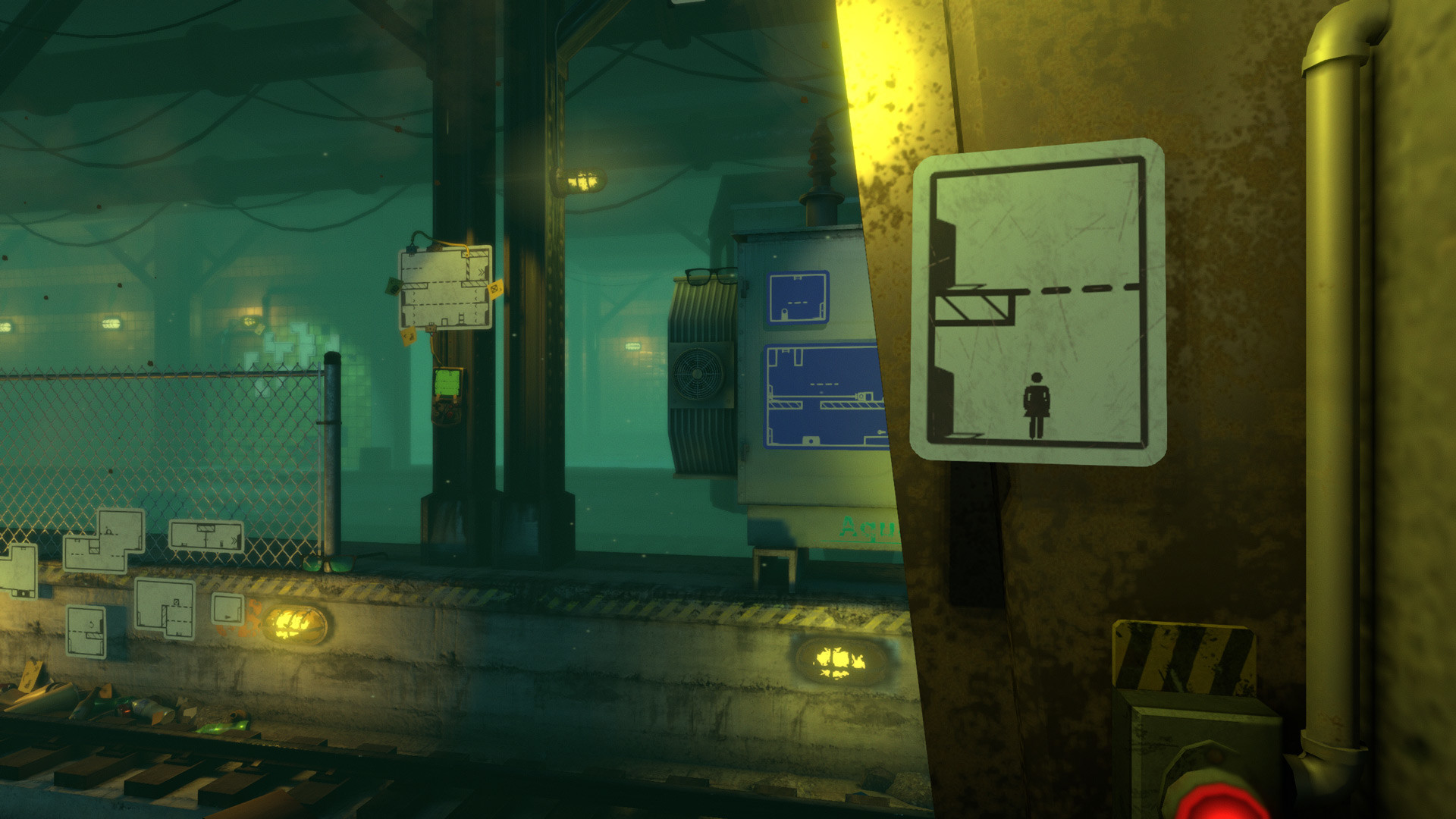
Progress moves through changing urban environments as the pedestrian links one surface to the next. Signs are the most frequent puzzle spaces, but the same idea appears on whiteboards, computer screens and blueprints, each set against a three-dimensional backdrop. These settings help show where a completed route leads: a working elevator can carry the figure through the larger scene, and a subway train can move the journey to another stop. The wider environment is not only scenery behind the panels; its machinery can be activated by actions inside them, and its transitions mark forward movement. The puzzles also build by combining familiar parts. A doorway connection, a box, a switch and an elevator can be folded into one route, so progress depends on reading how the pieces interact rather than learning an unrelated rule for every new area.
Rearranging signs can reset the contents of the panels: activated switches turn off and key items are lost when the layout changes. Green fluid introduces a way to preserve a room, preventing its contents from resetting while the other signs are reorganized. A multi-phase puzzle can therefore be built around a stable panel: keep a useful switch state or item in the preserved room, change the connected layout elsewhere, then route back to the room whose contents remain active. The decision is specific to the puzzle state, because preserving one room does not keep every panel fixed. It changes a reset from a complete restart into a choice about which local state must survive while the player creates another route.
- Developer
- Skookum Arts
- Genre
- 2.5D side-scrolling puzzle platformer