
About The Pathless
The Pathless follows the Hunter, an archer who reaches a vast island overtaken by a spreading darkness. With an eagle companion, she crosses forests, cliffs and ancient ruins, using timed bow shots to build speed, solving environmental puzzles to restore light at regional towers, and confronting the cursed spirits behind the island’s condition.
The Hunter arrives on a remote, forested island where a supernatural darkness has taken hold. Her task is to lift that curse, whose source is a powerful figure called the Godslayer and the giant spirits that dominate the island’s regions. The story’s history is conveyed through ruins, written lore and cinematic scenes rather than a crowded cast of townspeople: traces of earlier Hunters show that others came before and failed. The central relationship is between the Hunter and the eagle she befriends. The bird is a companion in travel and danger, and the game’s narrative follows their effort to restore light without disclosing the later turns of that conflict.
The bow serves first as a movement tool. Floating talismans are scattered through the environment, and the Hunter can lock onto and shoot them while running, leaping or gliding. A successful hit refills the dash meter and adds a brief burst of speed; chaining targets keeps her moving quickly across open ground and can carry momentum into the air. The challenge is less about aiming at a tiny target than reading the route ahead and timing shots as opportunities come into range. That turns travel into an active loop: sprint toward a line of talismans, fire in rhythm, adjust direction, and use the resulting speed to cross gaps or reach the next rise.
The eagle expands that route vertically. The Hunter can be carried through the air and glide across valleys, but the bird gradually loses altitude. Flapping provides a short lift, and crystals found while exploring increase how many times the eagle can flap before landing. The Hunter therefore alternates between ground movement and flight: use bow shots to maintain speed, gain height from terrain, then glide toward a distant landmark or ledge. There is no conventional map or fast travel. Instead, a magical mask reveals a heat-like trace of places already visited and briefly highlights points of interest in the visible landscape. Climbing to a ridge or tower gives the player a wider view, while returning to the ground exposes details among the ruins and trees.
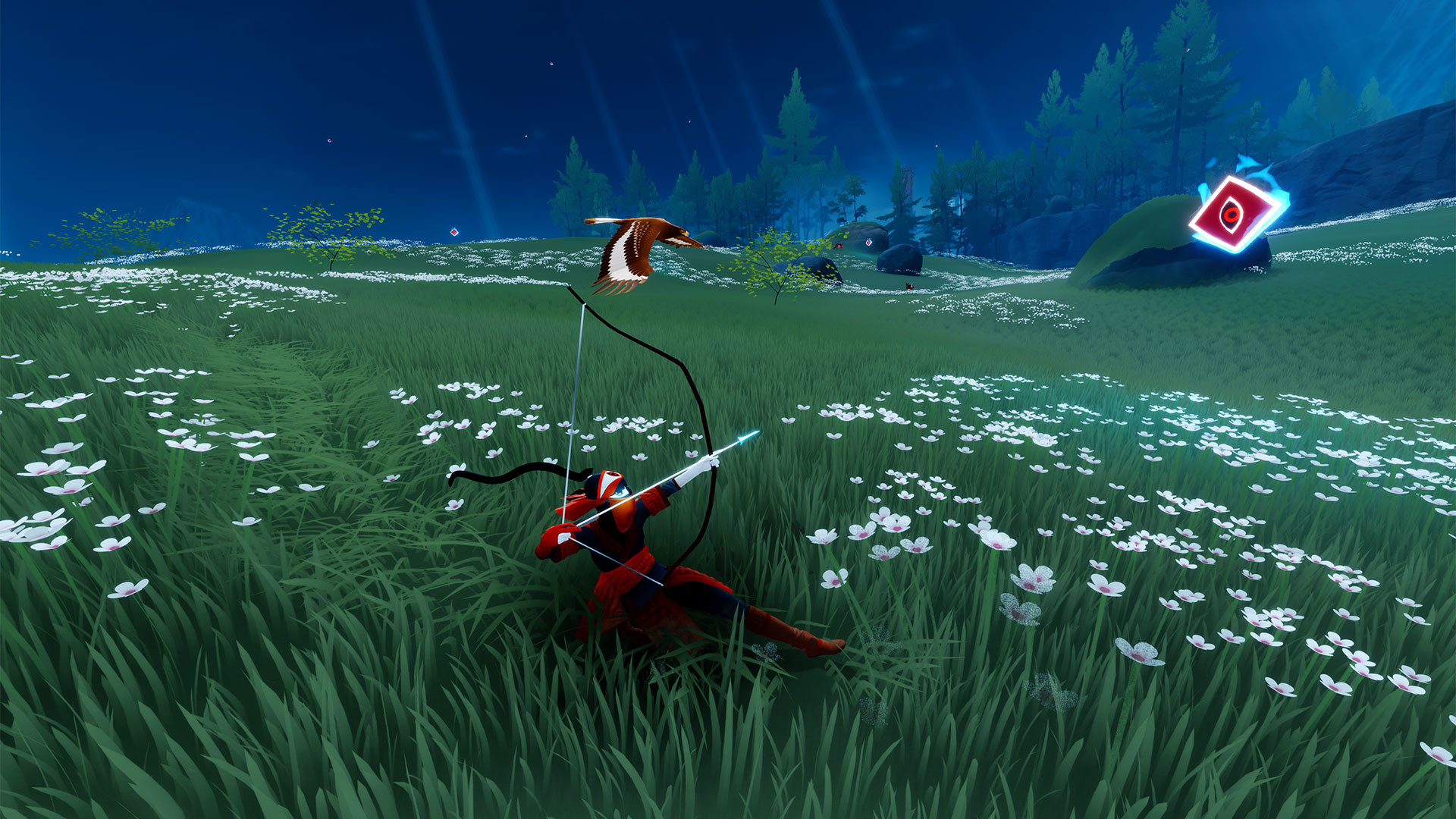
Each region links exploration to a sequence of light-restoration puzzles. Ancient structures hold Lightstones, usually protected by an energy barrier that can be opened by interacting with targets in the surroundings. These puzzles ask the player to understand the space and set up a bow shot: an arrow may need to pass through a flame before reaching a torch, or travel through aligned rings to strike a distant switch. Other challenges use the eagle’s ability to lift objects, adding positioning and movement to the puzzle. Finding a Lightstone contributes to lighting the region’s obelisks or towers. As those structures are restored, the curse’s grip is reduced and the dominant spirit can be confronted, so optional-looking detours feed into a clear regional objective.
The cursed spirits also shape how the Hunter moves through unsettled areas. Before a region is restored, its enormous beast can patrol the landscape, forcing the player to avoid its view and keep the eagle safe when danger closes in. Once the area’s towers are lit, the encounter changes into a hunt. The Hunter races after the spirit through the terrain, using talismans and gliding to keep pace, then aims at exposed weak points when openings appear. The pursuit leads into a direct battle with its own movement and timing demands. If a spirit catches the Hunter during a dangerous encounter, collected crystals can be knocked away; this affects the resource used to improve the eagle’s airborne flaps rather than resetting the whole journey to a checkpoint.
Exploration is deliberately self-directed, with no fixed order for the island’s objectives and no trail continuously pointing toward the next task. Spirit vision helps orient the player, but its information depends on what can be seen from the current position, so elevation and landmarks matter. Small discoveries include crystals for the eagle, hidden ruins, puzzle sites and remains that deepen the sense of earlier attempts to face the curse. Each region has its own terrain and sightlines, which changes how the player approaches traversal and searches for structures. Across the full adventure, the repeated cycle is to survey the land, move through it at speed, uncover the mechanisms that protect its Lightstones, restore its towers and pursue the spirit that has held that region in darkness.
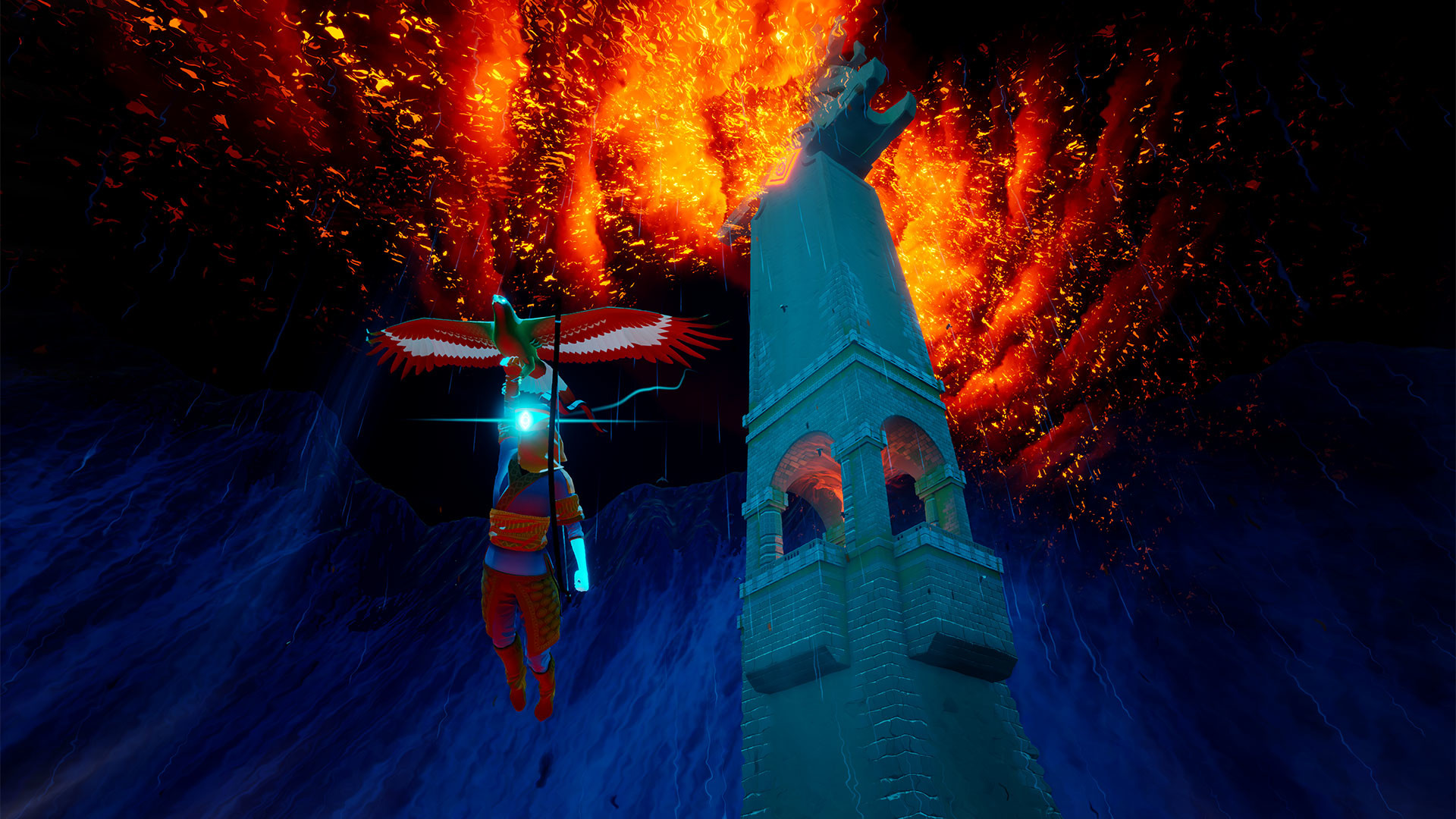
The island also carries a record of earlier attempts to end the darkness. Skeletal remains of past Hunters appear in the open world, turning some discoveries into evidence of how far those expeditions reached. Written tomes add another layer of context, while the cinematic scenes focus the broader history on the Hunter, the eagle and the Godslayer. These fragments are encountered alongside the practical work of crossing terrain and solving mechanisms, so the story is distributed through both deliberate scenes and the physical places the player chooses to inspect. The result is a setting where ruins serve two roles: they contain the puzzles and Lightstones needed for regional progress, and they show that the island’s present crisis has a long history beyond the current journey.
- Developer
- Giant Squid
- Genre
- Action-adventure