
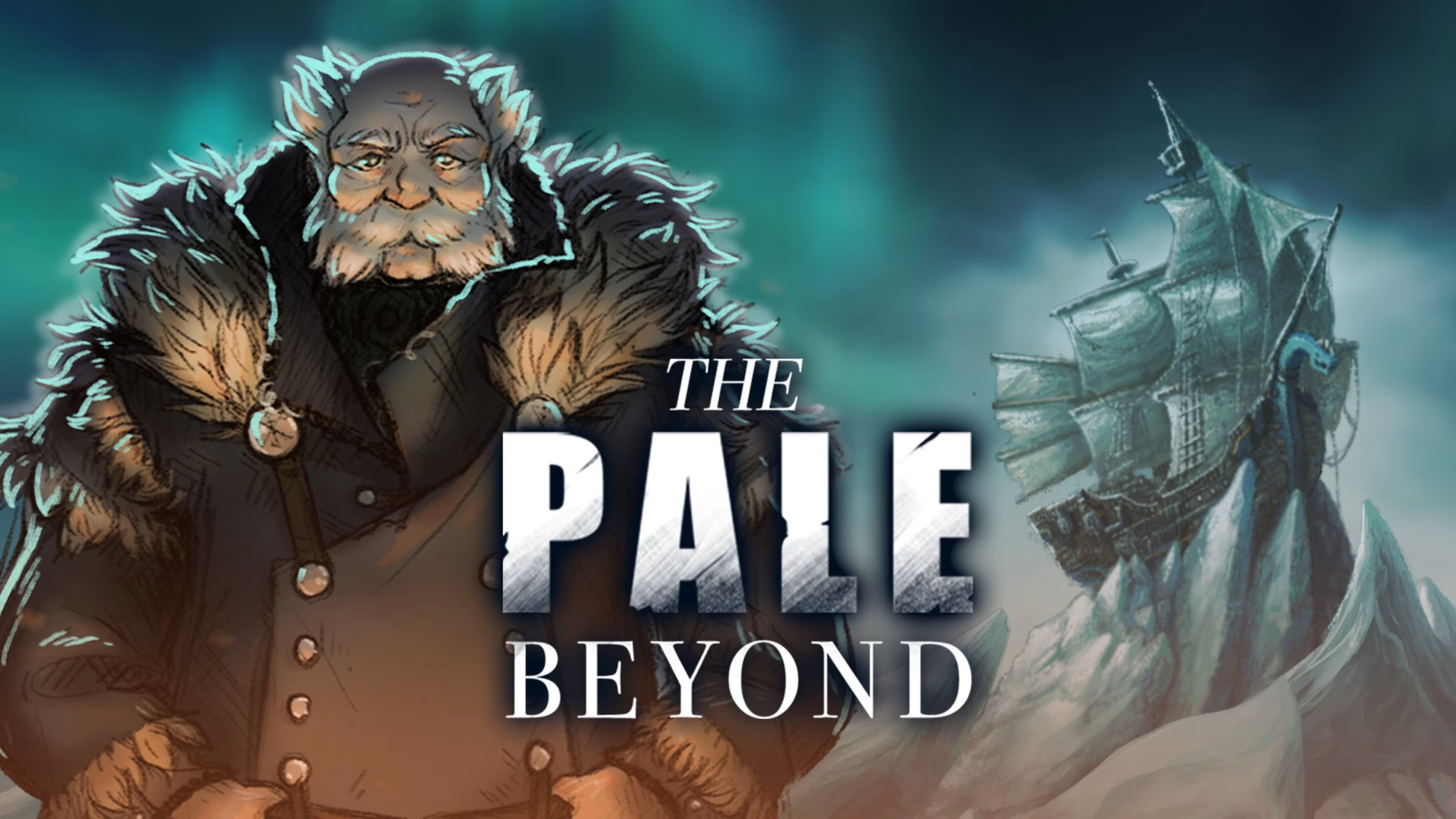
About The Pale Beyond
The Temperance sails south to learn what happened to its lost sister ship, the Viscount. When the vessel becomes trapped in ice and its captain disappears, first mate Robin Shaw must lead the crew through winter. The Pale Beyond ties weekly survival decisions to food, fuel, loyalty and the relationships that can hold an expedition together or break it.
Five years before the events of The Pale Beyond, the Viscount sailed through the Pale Passage in search of absolute magnetic South and vanished with its crew. The Temperance follows the same route, hoping to find an answer rather than simply repeat the disappearance. Robin Shaw joins as first mate after an interview with Captain Hunt, with a crew that includes sailors, specialists, scientists and people whose understanding of the expedition may differ from Robin's. The journey begins as an organised voyage with a command structure, a ship and a destination. Then the Temperance becomes caught in ice, Hunt disappears and the first mate inherits a job nobody prepared them to hold under those conditions. The lost vessel remains a mystery, but the immediate question is how to keep the present company alive long enough to pursue it. The setting draws on the hazards of historic polar expeditions without presenting itself as a documentary reconstruction. Isolation makes small decisions consequential: there is no nearby port where Robin can make up for a poor week of provisioning, and every person aboard has a view about who deserves to command when the original captain is gone.
Leadership is exercised through a weekly rhythm of conversations, assignments and supplies. Robin can speak with crew members, decide how to respond to concerns, allocate work and then advance time to see what the week has done to the expedition. Food, fuel and morale have to be weighed together. Feeding the crew generously can help the mood aboard, but it also reduces stores needed later; using more fuel provides warmth while consuming the material that keeps a furnace working in future weeks. When people fall ill, space for treatment and the labour still available to the group complicate a simple calculation of rations. The game is not asking the player to steer the ship in real time or swing an axe at the cold. It asks them to plan under uncertainty with numbers that represent living people. A decision that leaves enough heat this week may have to be revisited after weather, illness or a task changes the balance. The pressure intensifies as the journey moves from a stranded vessel to life on the ice. Survival becomes a chain of linked weekly choices rather than one dramatic order that solves the crisis.
The crew is more than a single morale bar. Named people have backgrounds, priorities and different degrees of loyalty to Robin, while some remain attached to Hunt's leadership after he disappears. A conversation can win trust with one specialist and trouble another; an action taken for the good of the expedition may still appear unjust to the person asked to bear its cost. The game makes that tension concrete through the possibility of a vote and mutiny. A camp that has food and heat can still fail if the people meant to use those supplies no longer accept the person distributing them. Robin therefore spends time hearing complaints and choosing responses, including opportunities to listen to less central crew members whose lives are otherwise easy to reduce to a count. Sailors, scouts, engineers and scientists bring different kinds of work to the mission, so their survival and cooperation affect what the group can attempt next. The fate of the sled dogs also belongs in the calculation of warmth and food. They are part of how an expedition can travel and work, not decorative animals placed beside the story. Keeping people on side cannot be detached from keeping them alive.
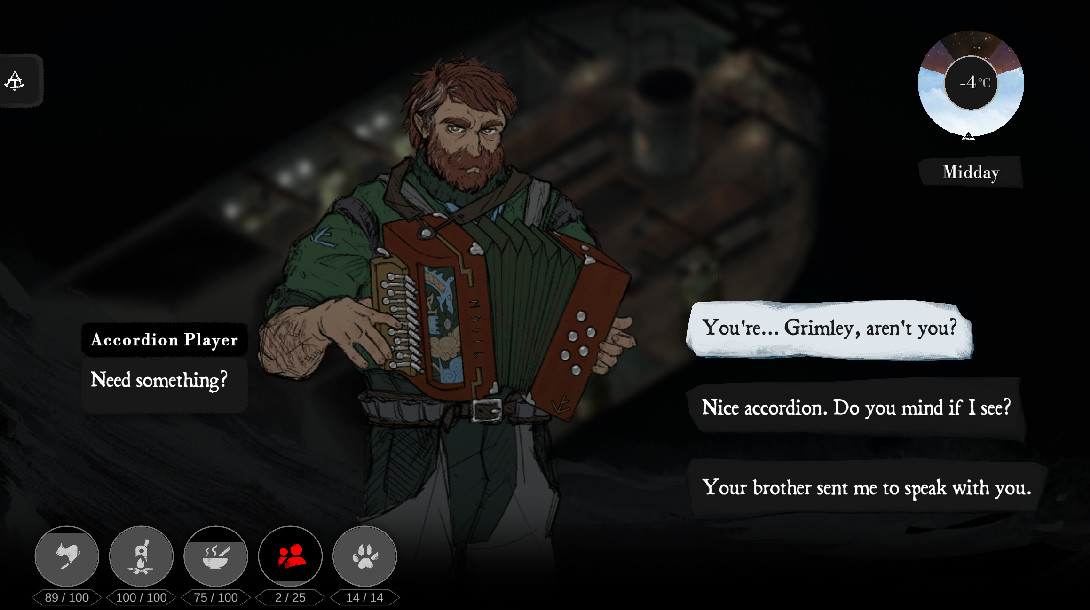
Tasks expose the practical costs of that relationship. Hunting can increase the supply of food, while searching or collecting materials can support heat and shelter; sending people out also means committing scarce labour to one purpose instead of another. Robin must decide how much to consume, what to store and which need can safely wait. The game's accounts of the expedition include sickness and strained medical capacity, so losing healthy workers can turn a plan that looked sound on paper into a much weaker one. The fixed sequence of weeks gives those tradeoffs a deadline. It is possible to survive an individual shortage and still worsen the overall situation if the solution exhausts the crew's confidence or leaves insufficient fuel for the next change in weather. Dialogue decisions and resource decisions are not separate modes that take turns. The specialist who argues for a course of action may be the person Robin needs to send into the cold; an order can alter both the inventory and the relationship behind it. The result is a management game in which the emotional meaning of a choice remains visible through the people carrying it out.
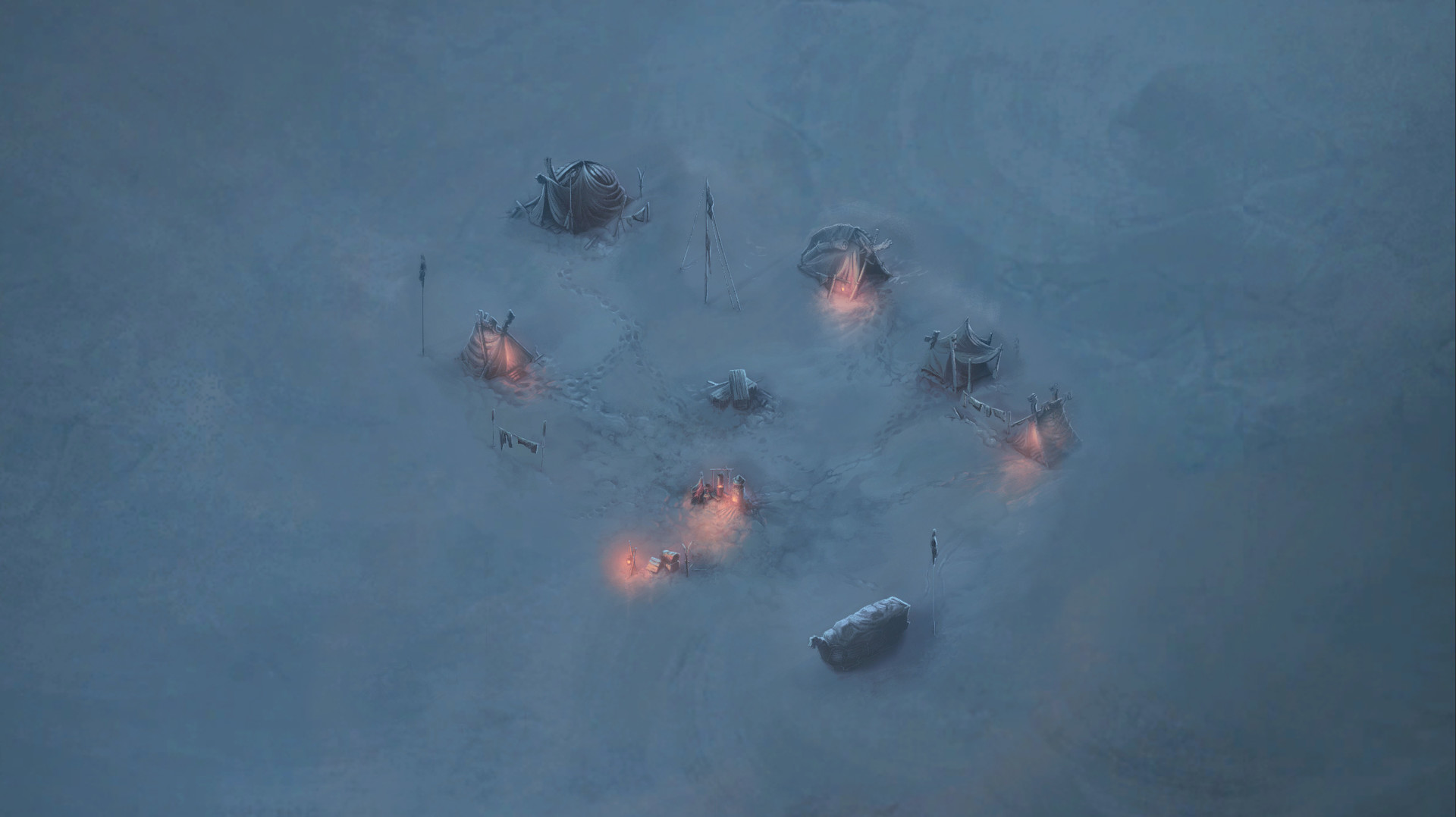
Exploration takes place through illustrated scenes of the ship and, later, the camp on the ice. The player moves between locations through the interface, selects people or action icons, and can pan across the camp to see where tasks and conversations are available. That approach leaves room for close character writing without making Robin's walking speed or dexterity the issue. A quiet talk can reveal how someone understands Hunt's disappearance, while an optional conversation heard nearby may fill in the life of a crew member who has not occupied the centre of a crisis. The Viscount's disappearance and the Temperance's predicament give those details a direction: each person is trying to interpret a journey whose original mission already carried uncertainty. The dialogue asks Robin to define a background and manner of command through choices, but the environment answers with limits that cannot be talked away. Finding another lead toward the missing ship matters only if the expedition remains capable of acting on it. This is why the narrative can linger on a meeting or disagreement and still feel bound to a survival system. The crew's voices are part of the working conditions of the expedition.
The Pale Beyond presents that world with painted 2D locations and expressive character portraits rather than a free-roaming model of the Antarctic. A face in conversation makes a loyalty decision harder to treat as a purely numerical adjustment; a wide view of an ice camp shows how exposed the same people are once the ship ceases to be a secure home. Writing carries most conversations, and the soundtrack includes original compositions, shanties and accordion music that shift with the journey. Those sounds connect the people to life aboard a vessel even as the landscape becomes less hospitable. The design is grounded in a limited number of readable spaces that change significance over time. A location initially associated with routine work may later be tied to a shortage, illness or argument. This illustrated approach makes the passage of weeks visible without requiring a huge geographic map: the player's mental map is also one of the crew, the supplies available and the obligations that now follow Robin. The art and music give human scale to a story whose exterior world is mostly cold, distance and the unknown fate of another ship.
Saltstone Studios developed The Pale Beyond, with Fellow Traveller publishing it on PC and Nintendo Switch in 2023. Earlier publisher material identifies the Belfast team as Bellular Studios; its present developer site and storefront use Saltstone Studios for the same game. Steam offers soundtrack and digital-artbook editions, which add supporting material rather than a verified new survival campaign. The full adventure follows the expedition's changing conditions and Robin's attempt to hold authority as the crew seeks a way through the ice. Its mixture of weekly resource allocation and character decisions gives the missing-ship mystery an unusual shape. An answer about the Viscount is not valuable in isolation if those searching for it have gone hungry, cold or unwilling to continue. Each new week tests whether the previous compromises left the group able to make the next one. That makes the voyage's central challenge more specific than enduring a hostile setting: Robin has to keep an expedition functioning as a community while its original purpose, and the survival of everyone pursuing it, remain unresolved.
- Developer
- Saltstone Studios (originally credited as Bellular Studios)
- Genre
- Narrative survival and resource-management adventure