
About The Messenger
A young ninja sets out to carry a scroll through a world under threat from a demon army. The Messenger combines precise action-platforming with acrobatic movement, combat, upgrades, branching routes, and a time-spanning adventure. Its levels reward chaining attacks into aerial movement, while conversations with a mysterious Shopkeeper bring humor and new context to the journey.
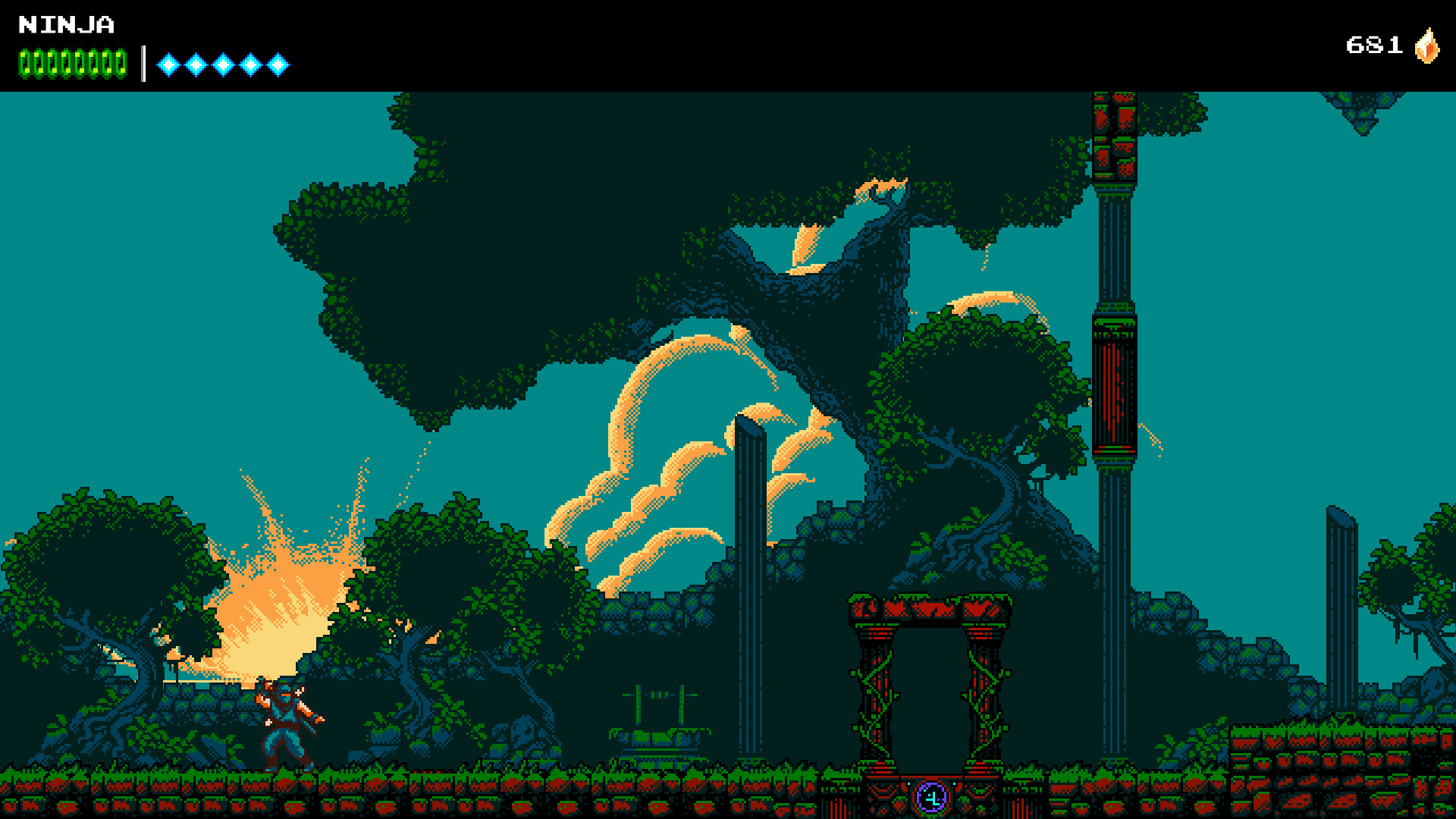
The Messenger begins as a direct mission: a demon army besieges the ninja’s village, and a young warrior is entrusted with delivering a scroll vital to the clan’s survival. The journey moves through a cursed world of forests, peaks, caves, and settlements, with a time-travel premise that gradually broadens what the opening suggests. A mysterious Shopkeeper appears at intervals, offering upgrades and comic conversations that add personality to the trip. The story uses humor alongside its serious mission, with offbeat villains and companions appearing as the route unfolds. Its presentation changes between 8-bit and 16-bit visual styles as the adventure moves across time. These shifts accompany a different structure later in the journey, while the core identity remains a nimble ninja platformer.
At first, each stage is a mostly linear side-scrolling route. The ninja runs, jumps, attacks with a sword, climbs walls with special claws, and crosses pits or hazards by judging momentum and timing. Lanterns and enemies can become anchors for Cloudstep: striking one in midair refreshes the ability to jump again, allowing the player to chain aerial actions across otherwise unreachable gaps. That interaction is central to movement and combat. A jump into an enemy can become a second leap if the hit lands, and a lantern placed over spikes can serve as a step in a sequence. The player looks for objects that extend the current jump. Levels teach this through short obstacles and increasingly demanding combinations, while checkpoints reduce the cost of learning a sequence.
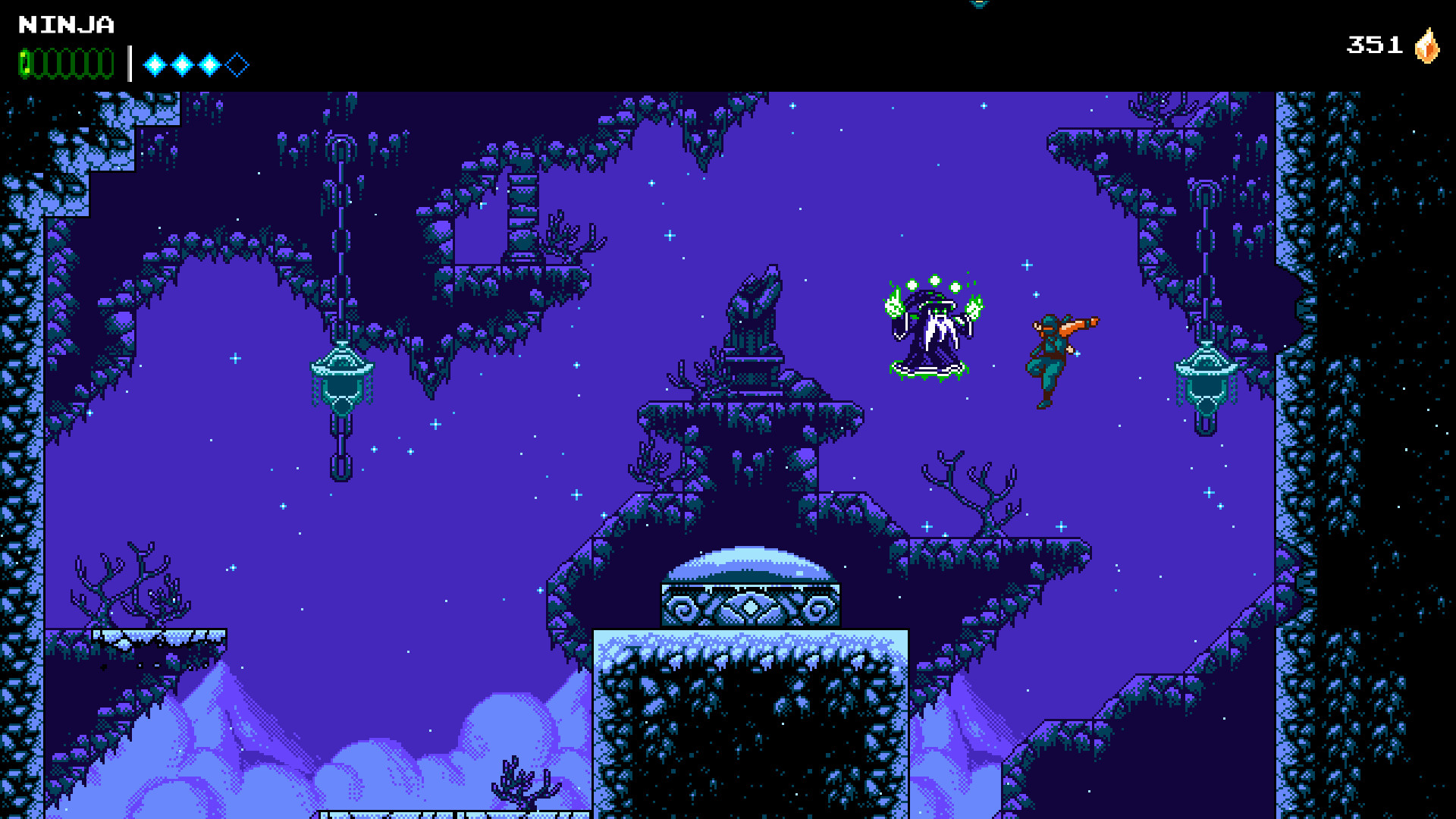
Combat uses the same movement vocabulary as traversal. The sword is the primary close-range attack, while enemies may rush, guard, or fire projectiles that must be avoided or answered. A successful hit can restore the midair jump, rewarding controlled aggression. Later upgrades add a ranged Energy Shuriken and allow certain enemy projectiles to be cut and used for another Cloudstep. The player can sometimes bypass a fight through geometry, but dealing with a foe may create the opening needed to cross a gap. Health is limited, and damage from spikes or enemies can turn a long sequence into a restart at the latest checkpoint. The challenge comes from combining enemy patterns with platform timing: an attack aimed at dealing damage may also be the move that keeps the ninja airborne.
The Shopkeeper’s upgrades use Time Shards, a currency gathered along the route and from defeated enemies. Purchases expand the ninja’s movement, attack options, and survivability; examples include climbing claws, a ranged shuriken, and armor that increases health. Some upgrades build on Cloudstep by letting attacks or projectiles trigger another aerial jump. Others add utility for dealing with enemies at range or reaching ledges. The Shopkeeper appears at checkpoints, where players can spend accumulated shards and hear more dialogue. This makes a checkpoint a planning pause: the player can decide whether a newly available technique will help with upcoming obstacles or whether to save resources. Shards are part of progression rather than a score alone, and returning after shopping can alter how the next sequence is approached.
Later, the structure opens into a connected map with branching paths, hidden areas, and places that invite a return after gaining another ability. The adventure continues to use action-platforming, but navigation now includes deciding which branch to explore and locating a route through connected zones. A passage that once appeared unreachable may become accessible after acquiring the right upgrade, and detours can hold Power Seals or other rewards. Optional rooms test a concentrated version of the platforming, asking for precise jumps or attacks. This broader exploration changes the pace without discarding the underlying controls. Players still use sword strikes, wall climbs, and Cloudstep, but must also remember earlier junctions and consider how a new movement tool changes them.
The visual change between 8-bit and 16-bit forms helps distinguish different periods of the journey, and the soundtrack shifts alongside those styles. Backgrounds and sprite animation preserve a deliberately retro look, while the character’s movement remains fluid and acrobatic. Boss encounters bring platforming and combat together in larger arenas, where attacks must be recognized and avoided before a safe response. Between these encounters, the Shopkeeper’s stories interrupt the pace with jokes and reflections, making the journey feel like a conversation as well as a mission. Hidden routes reward curiosity, but the central loop stays legible: move through a dangerous space, use a sword hit or lantern to extend an aerial sequence, collect shards, and strengthen the ninja. The separate Picnic Panic island adventure is outside this base-game overview. The upgrade loop reinforces this movement design because a new technique can answer a combat problem and a platforming one at once. A projectile can remove a distant threat or supply another airborne target, while wall climbing gives the player a way to recover from a missed jump and inspect side routes.
- Developer
- Sabotage Studio
- Genre
- Action-platformer; Metroidvania-style exploration