

About The Mermaid Mask
The Mermaid Mask brings Detective Grimoire and Sally aboard the Mortuga Submarine after its captain is found dead in a locked room beside an ancient cauldron. The point-and-click mystery sends the pair through hand-painted rooms, suspect interviews and 3D clue examinations, with a case file to help connect evidence and test what happened.
The Mermaid Mask begins with a murder that seems to have no room for an ordinary explanation. Captain Mortuga is dead inside a locked chamber of the submarine that bears his name, and an ancient stone cauldron sits close enough to become part of every possible theory. The vessel lies in dark water beyond an abandoned fishing town, its crew carrying stories about a captain who may have been an immortal traveller, a cursed vampire or something less supernatural and no less dangerous. Detective Grimoire and Sally arrive to establish what happened, not simply to choose the most colourful rumour. The setting keeps the suspect pool and the physical evidence close together: the people under question work and live aboard the same unusual submarine, while its rooms are full of objects that might contradict what they say. The mystery has the appealing shape of a classic locked-room case, but the cauldron and the vessel's eccentric inhabitants prevent it from feeling like a bare logic diagram. Each new compartment makes the submarine more legible as a place, and each interview raises another reason to doubt an easy account of Mortuga's death.
This is a point-and-click adventure built around investigation rather than combat. The player moves between hand-painted spaces, examines objects, speaks to the crew and works through puzzles that test an emerging theory of the case. Grimoire and Sally bring different temperaments to that work. He is patient and methodical, inclined to keep asking when a detail has been brushed aside; she is quick to notice a weak explanation and far less willing to let it pass without a comment. Their exchanges give the interviews a rhythm beyond selecting every available question in turn. A suspect can be amusing, defensive or apparently helpful, but the practical question remains whether their words fit the places and objects the detectives have seen. The submarine makes that comparison manageable without making it trivial. Its compartments feel distinct, yet the case repeatedly asks the player to carry information from one room into another. A clue found in a workplace can change the meaning of a statement elsewhere, and an apparently theatrical part of the ship may still contain an object that matters to the locked-room problem.
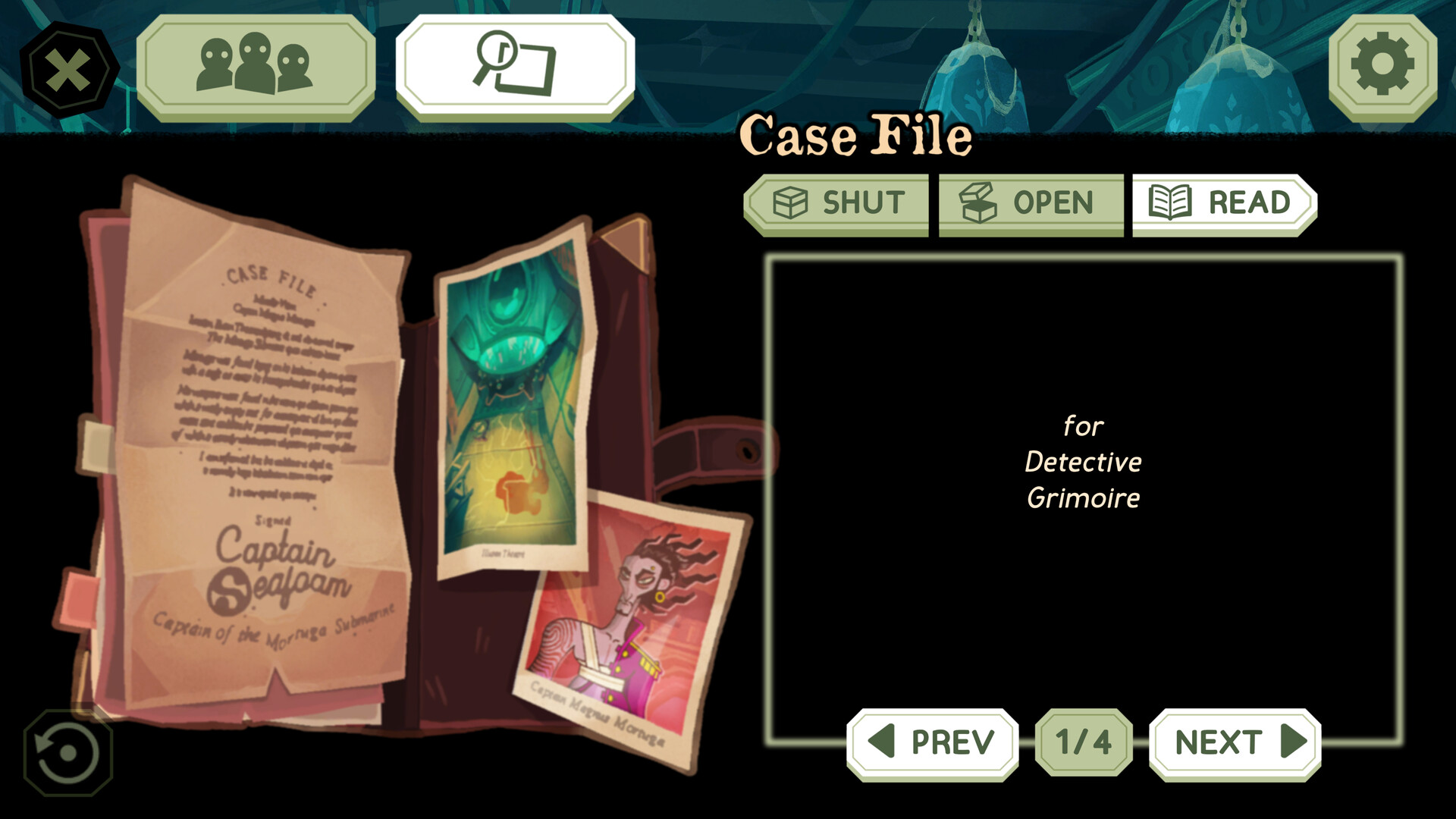
Evidence in The Mermaid Mask is not limited to a small icon and a line of explanatory text. The game presents clues as 3D objects that can be inspected for hidden details, even though its characters and rooms retain a drawn, storybook look. Turning attention to an object's surface, construction or contents can reveal why it belongs in the case file at all. The case file then becomes more than a record of collected items. It gives the detectives material to revisit, read and sometimes use together as the investigation advances. The case file marks stored clues that need another look or an interaction, and makes it possible to move between related clues. Those features support the game's central rhythm: discovery is followed by reconsideration, then by testing how the new information fits with a person or event. Suspicions are not supposed to appear merely because the player clicked every room; the evidence has to support them. The result is a mystery where handling a clue and understanding its significance are separate steps, allowing a simple physical object to become the hinge of a later conversation.
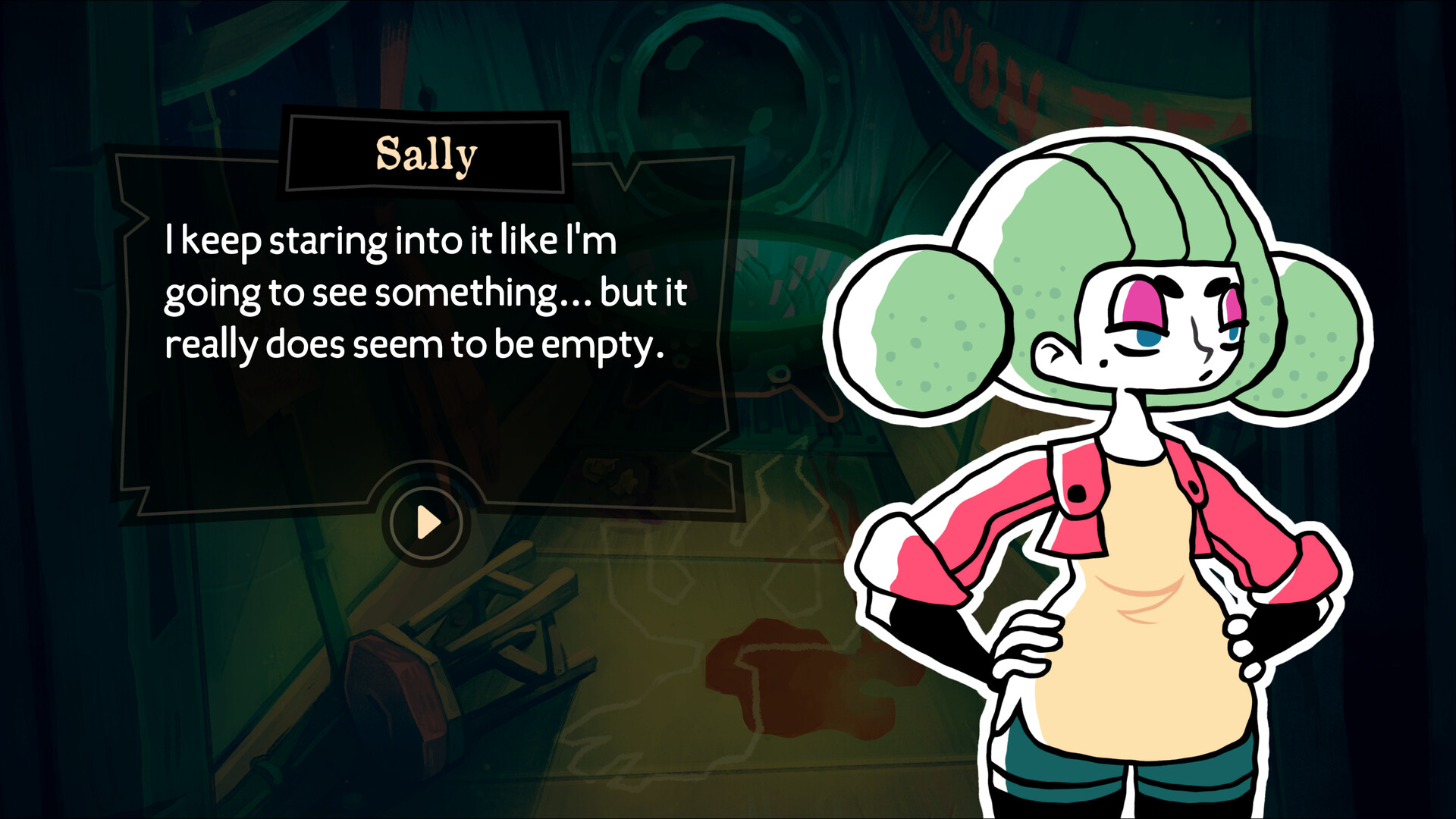
The victim's reputation invites the player to imagine a supernatural answer, but the investigation continues to demand ordinary detective work. Mortuga is a former captain whose death leaves a young new captain, Sinthia Seafoam, trying to manage an unsettled crew and an even less settled story. The locked room called the Illusion Theatre and the cauldron give the case striking focal points, yet neither is a substitute for interviewing the people who knew what happened on the submarine. Each suspect has a role aboard the vessel and a possible reason to keep something back, so the case-file portraits become a starting point for comparing testimony. The game uses that setup to turn dialogue into evidence rather than decorative character writing. A claim about a room, a relationship or the captain's movements can be checked against the environment and another person's account. Grimoire and Sally have to connect those accounts without assuming that an odd personality is itself proof of guilt. The detailed character animation and full English voice performances keep the crew memorable while the closed setting ensures that their stories remain relevant to the same central question. The visual clues are useful because a face, a room and an object can all be revisited after another witness changes the meaning of a conversation. This gives the investigation a reason to return to familiar scenes rather than treating each compartment as a puzzle to clear once and forget.
The Mermaid Mask belongs to the Detective Grimoire series, following earlier mysteries such as Tangle Tower, but its immediate problem is complete enough to be approached as its own case. Returning players will recognise the partnership between Grimoire and Sally; newcomers can understand it through the way the two work together aboard the submarine. The art continues the series' bright, expressive character design, while the Mortuga's painted interiors can move from inviting to uncanny as the investigation descends deeper. That contrast is important to the tone. A joke in an interview may sit beside a disturbing possibility about the captain, and a whimsical mechanism may be hiding a vital part of the evidence. The original score, performed by the Budapest Art Orchestra, adds a larger sense of drama to a setting whose rooms remain intimate and cluttered. Because the ship contains both living spaces and deliberately theatrical areas, its painted detail does more than establish a mood. It gives every interview a physical context: who could have seen a room, what might have been moved, and which peculiar object deserves inspection rather than dismissal. The game does not need to abandon its visual charm to maintain the tension of a murder investigation. It lets a friendly-looking drawing, an elaborate prop and a suspicious silence coexist, asking the player to decide which details are atmosphere and which belong in the reconstruction of the crime.
The central pleasure of this kind of mystery is the point at which separate details begin to support, or undermine, a single account. The Mermaid Mask gives that moment a physical foundation in inspectable objects, a conversational one in its voiced suspects, and a spatial one in the layout of the submarine. The player can return to the case file when a line of questioning stalls, look again at a clue, and then try to connect it with a room or testimony that seemed unrelated. There are puzzles along the way, but the larger progression is the gradual narrowing of possibilities around the locked room. The released game is a single-player adventure by SFB Games, available on PC, PlayStation 5 and Nintendo Switch systems, with the Switch and Switch 2 sold as separate versions. The review of evidence, character interviews and hand-painted exploration are its defining activities; the outcome of Captain Mortuga's case is best left for the investigation itself. What starts as a question about a cauldron in a sealed room expands into a study of a vessel full of people who have reasons to shape the story before the detectives can piece it together.
- Developer
- SFB Games
- Genre
- Point-and-click detective adventure