

About The Longest Journey
Art student April Ryan discovers she can cross between Stark, a technologically advanced world, and magical Arcadia. Guided by the enigmatic Cortez and drawn into a struggle over the Balance linking the worlds, she follows clues through conversations, locations and inventory puzzles in a chapter-based point-and-click adventure.
The Longest Journey follows April Ryan, an eighteen-year-old art student who has left her rural home to live in Newport, a sprawling city in a future shaped by corporate technology, fast transport and pervasive networks. Her immediate concerns are recognisably ordinary: college, work, friends, money and the unsettled relationship with her parents. Strange dreams and encounters with the mysterious Cortez begin to make those routines look different. He tells April that the dream imagery points toward another world, Arcadia, and toward a role in preserving the Balance between the two realms. This is not a story about April starting as a trained adventurer. She begins as an observant young artist, and the plot gradually connects her personal uncertainties with a much older conflict. The contrast between a plausible future city and a world organized around magic provides the adventure's central frame, while April's humour and questioning responses keep the enormous stakes tied to one person's point of view. Her doubts about what Cortez tells her make the first encounters with Arcadia a process of testing an explanation, not simply accepting a quest.
Stark and Arcadia are presented as complementary worlds rather than as simple good and evil territories. Stark is governed by science and technology: Newport's streets, transit and institutions suggest a society that has developed familiar urban life far into the future. Arcadia is a broad fantasy realm of strange landscapes, peoples and creatures, where magic shapes the natural and political order. The Balance is the principle that once held science and magic, order and chaos, in relation; the danger is that this division has become unstable. April's ability to Shift between the worlds makes that conflict traversable. She can begin a line of inquiry in one setting and continue it in the other, learning how local customs, histories and beliefs differ. A conversation in a city district and a journey through an Arcadian settlement do not feel like interchangeable backdrops: each world has its own visual language and assumptions about what is possible. The story uses that difference to turn travel into a way of understanding the setting, not merely a transition between scenes. The contrast matters to April because a method that works in Newport may make little sense to someone whose knowledge comes from Arcadian magic and tradition.
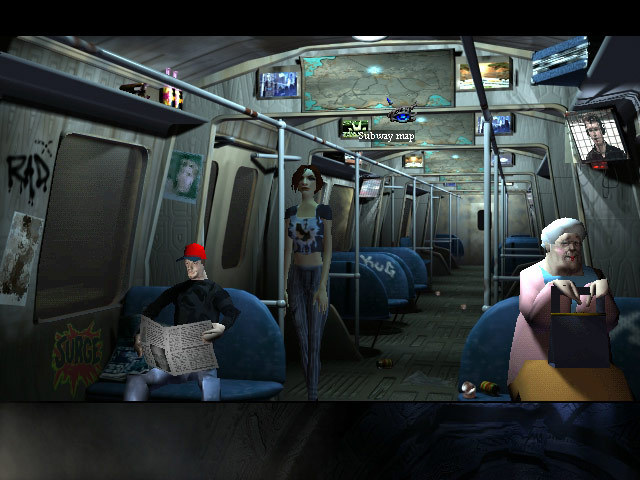
The game is controlled as a classic point-and-click adventure from a third-person view. April moves around illustrated locations as the player guides her with the mouse and selects hotspots through a cursor whose available actions distinguish looking, talking, taking or using. Examining an object can reveal details that are not obvious from its appearance, and examining collected items can add context or uncover a hidden component. The interface makes the screen itself a place to investigate: doors and exits lead to adjacent areas, while people and objects can offer several kinds of interaction. The game is divided into chapters, and the spaces available at any moment are authored locations rather than a continuous open world. As April learns where to go, the route expands between neighbourhoods, landmarks and, later, the separate environments of Arcadia. Movement therefore consists of choosing exits, arriving at a new scene and looking carefully at what its inhabitants and objects make available. Inside a train, April can open a full-screen subway map and select an available destination, giving the authored city routes a practical navigation layer.
Conversation is one of April's main investigative tools. She can ask people about their lives, a local problem, or something encountered elsewhere; dialogue often reveals both character and the practical information needed to continue. Her diary records important events and observations, giving the player a place to revisit the developing story as the chapter sequence grows. A person may seem incidental when first met, yet a later question or object can make that encounter useful. The game includes many speaking characters, from friends and landlords in Newport to the communities April meets beyond Stark. These exchanges help establish the difference between worlds as well as their internal detail: what sounds like an everyday topic in a future district may be unfamiliar to a person in Arcadia, while a local custom can explain why a simple request has consequences. Dialogue options are part of the investigation, but the central progression remains a directed narrative. The player advances by learning enough about a place and its people to identify the next useful action. The diary and conversation log let the player revisit an earlier exchange when a new place or object gives it fresh meaning.
Puzzles connect observations, conversations and items carried in April's inventory. An object may need to be examined before its purpose is clear, combined with another item to make a useful tool, or used on a hotspot in the environment. The game expects the player to carry knowledge between steps: someone can explain a problem, an object can reveal a property, and the solution may require applying both ideas in a different location. The early dream prologue establishes that logic in a compact example, while later chapters develop it across larger networks of characters and places. Some tasks are practical, such as repairing, retrieving or operating something; others rely on interpreting a clue, understanding a custom or asking a particular person about what April has found. There is no combat skill tree or character build to improve. Progress is measured by solved obstacles, recovered information, new destinations and the unfolding chapters. The item-based structure rewards inspecting the environment and remembering what people have said, because a clue can matter after April has moved far from its source. Close-up inspection can reveal a hidden component inside an item or allow April to operate a piece of machinery before returning to the wider scene.
April's journey crosses a wide range of distinct settings, from Newport's lived-in urban districts to Arcadia's settlements, wilderness and other unusual environments. The game's scale comes through a large collection of authored locations and a substantial cast rather than through free roaming. Returning to a previously visited place can matter when new information changes what the player should ask or use there. The narrative also changes the meaning of familiar objects as April's understanding develops. Her diary, carried items and conversations provide continuity across episodes, helping the player keep track of both the immediate puzzle and the larger question of the Balance. There are threats and frightening moments in the story, but April does not use a standard combat system to clear encounters. The core activity is still investigation: notice a detail, work out what it means, talk to the right person, and use available objects to create a path forward. This keeps the focus on observation and reasoning throughout the adventure rather than on fighting or numerical progression. The growing route across both worlds gives each new community its own voices and practical problems, extending the contrast with April’s familiar life in Newport.
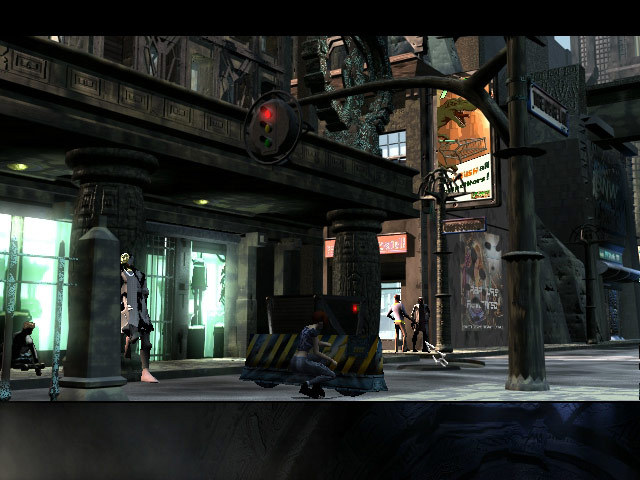
Funcom's original The Longest Journey released for PC in 1999, and its point-and-click design remains distinct from the third-person movement and combat added in Dreamfall. The single-player chapters keep April as the player character as she crosses between Stark and Arcadia. Stark's science-led streets, transit and corporate systems contrast with Arcadia's magical settlements, peoples and landscapes, making the Shift visible in the setting as well as central to the plot. The game's scenes combine backgrounds, animated characters, voiced dialogue and a musical score, with the diary preserving a record of April's growing understanding. More than twenty minutes of high-resolution pre-rendered video punctuate the story, while play returns to investigation and inventory puzzles. Its progression follows an authored route through locations rather than an open map; players move by following exits and clues to the next part of April's journey. The original story centers on April alone, while Dreamfall later follows three protagonists and introduces direct movement, stealth and combat.
- Developer
- Funcom
- Genre
- Single-player point-and-click adventure