
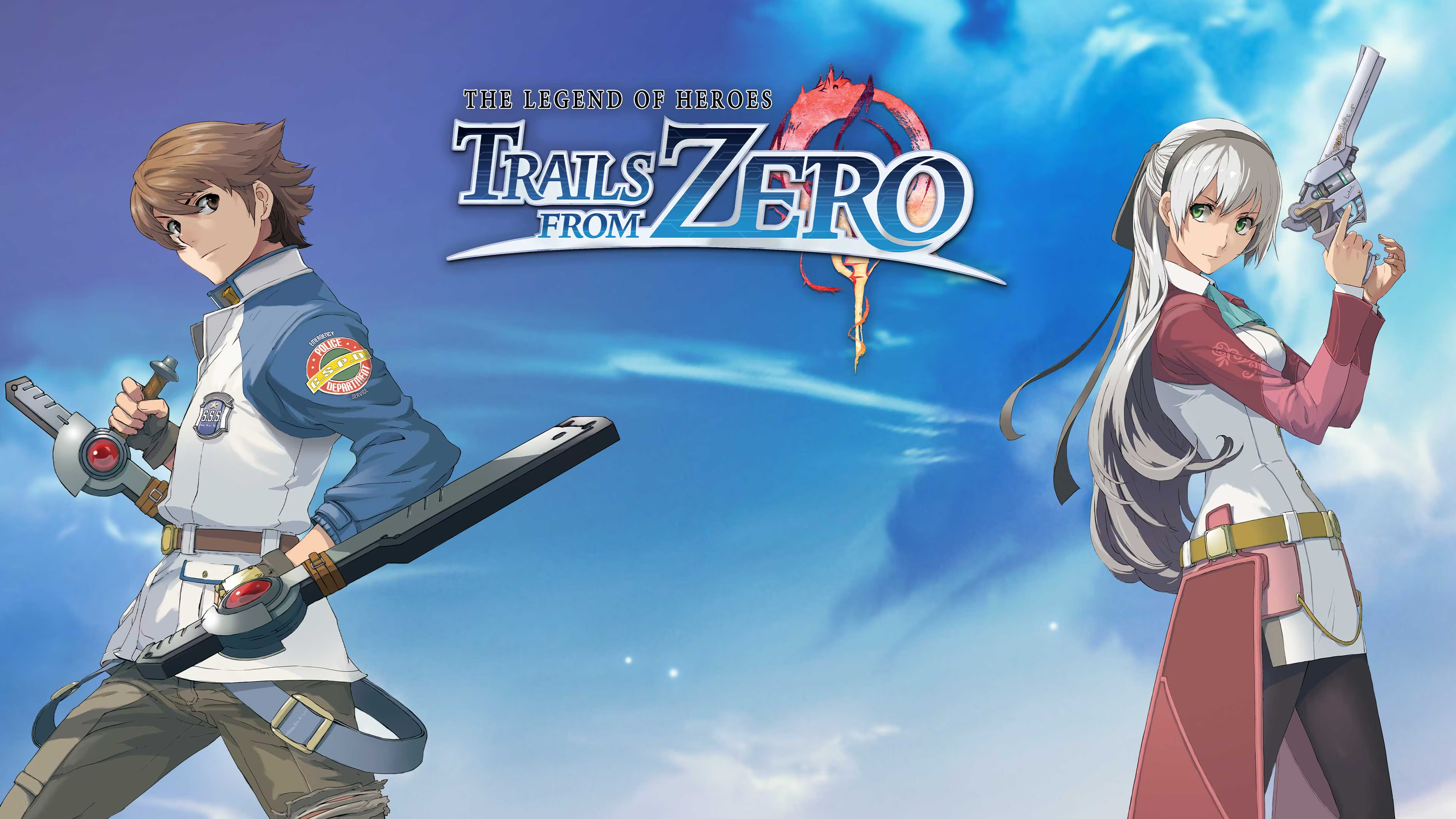
About The Legend of Heroes: Trails from Zero
Newly assigned officer Lloyd Bannings joins Crossbell’s Special Support Section, a small police unit given requests that range from everyday help to dangerous investigations. As the SSS travels between the city and nearby communities, its cases expose the pressures, rival powers and hidden history shaping this prosperous border state.
The Legend of Heroes: Trails from Zero begins with Lloyd Bannings returning to Crossbell, his hometown, after police training. He expects to join the city’s police department, but instead finds himself assigned to the newly formed Special Support Section, or SSS. The unit is a small group of young officers tasked with work that other departments overlook: helping residents, investigating incidents and earning public trust. Crossbell is prosperous and densely connected to trade and finance, yet its position between the Erebonian Empire and the Republic of Calvard leaves it under pressure from both. Political influence, corruption and criminal organisations overlap in the city’s daily life. Lloyd and his initial teammates, Elie MacDowell, Tio Plato and Randy Orlando, approach this setting as working officers. Their cases give them a practical reason to meet people across the city while the larger questions around Crossbell emerge gradually. The story concentrates on this state and its cast, while remaining part of the broader Trails world.
Crossbell City serves as the SSS headquarters and the hub for much of the investigation. From its commercial districts and residential streets, the team travels to places such as the mining town of Mainz, the rural village of Armorica and other settlements connected by roads and public transit. A chapter commonly begins with the group back at the office, where a terminal lists requests from residents and organisations. The SSS gathers details, visits the relevant people or locations, then reports back before the main case advances. Some jobs are straightforward errands; others lead to monster encounters, missing people, damaged infrastructure or suspicious activity. The repeated circuit gives the player a growing familiarity with Crossbell’s routes and institutions. Travel can involve revisiting streets and paths, particularly when a request sends the party back to someone already met. Fast movement options become available as destinations are discovered, and the Steam edition includes a high-speed mode that accelerates movement and battles. These conveniences ease repetition without changing the city’s hub-and-spoke structure.
The cases also provide a reason to pay attention to the people who live and work in Crossbell. Shopkeepers, officials, residents and recurring figures add local context to the SSS’s assignments, and conversations can change as events move forward. The team’s role is not limited to a single central investigation: chapter requests build a record of smaller needs and reveal how those needs sit within the state’s larger tensions. Lloyd’s efforts to prove the new unit useful are shaped by his teammates’ different temperaments and experience. Elie brings a connection to the city’s political life; Tio is reserved and observant, with technical knowledge; Randy contributes an easy confidence and a soldier’s background. Their conversations, reactions and professional disagreements give the group a continuing presence between major developments. Previous entries in the Trails series provide additional setting and character connections, but the opening premise is legible on its own: a young police officer and an unconventional unit take public requests while trying to understand why trust in the police has weakened. The plot keeps its larger revelations for later chapters.
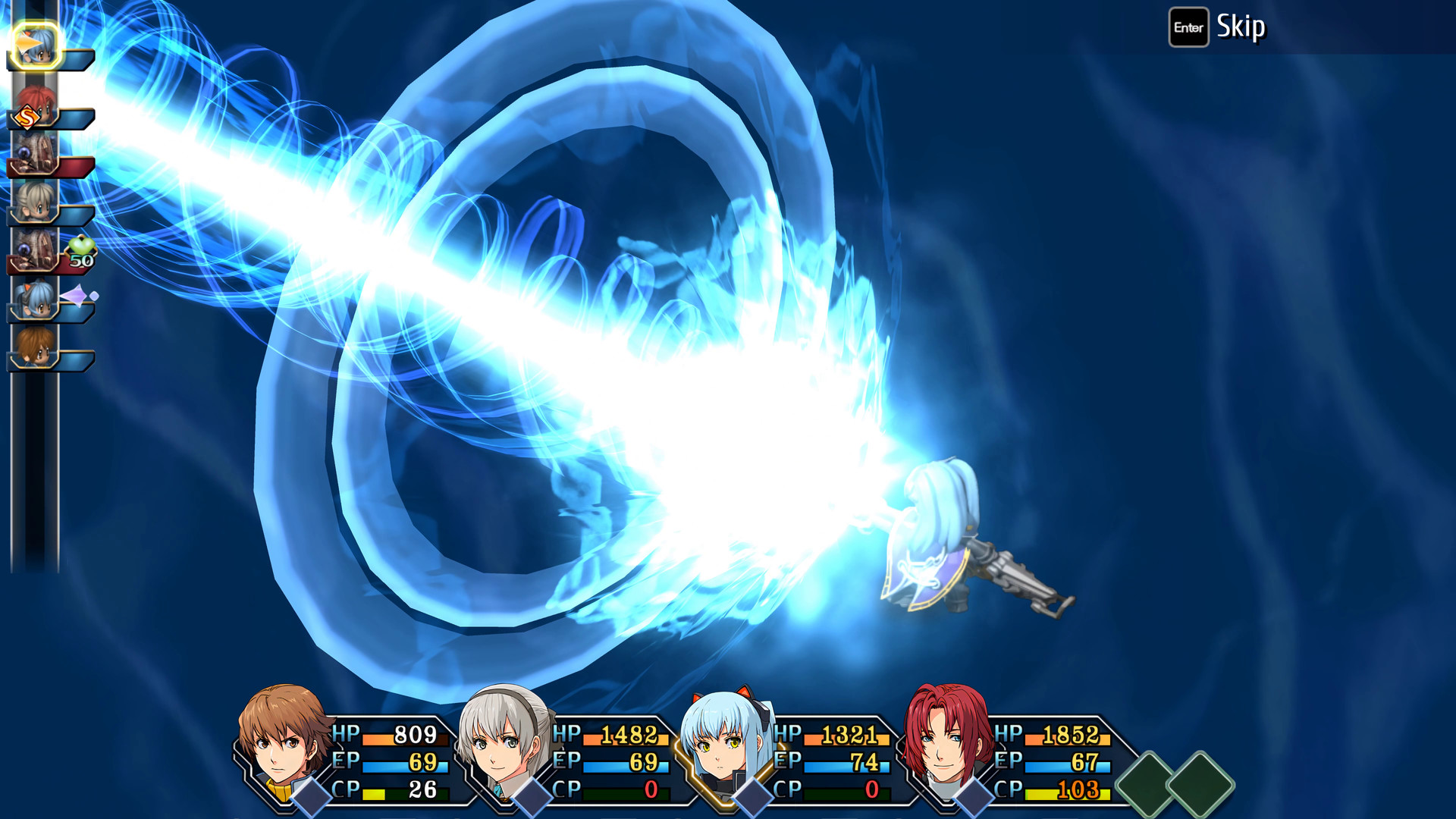
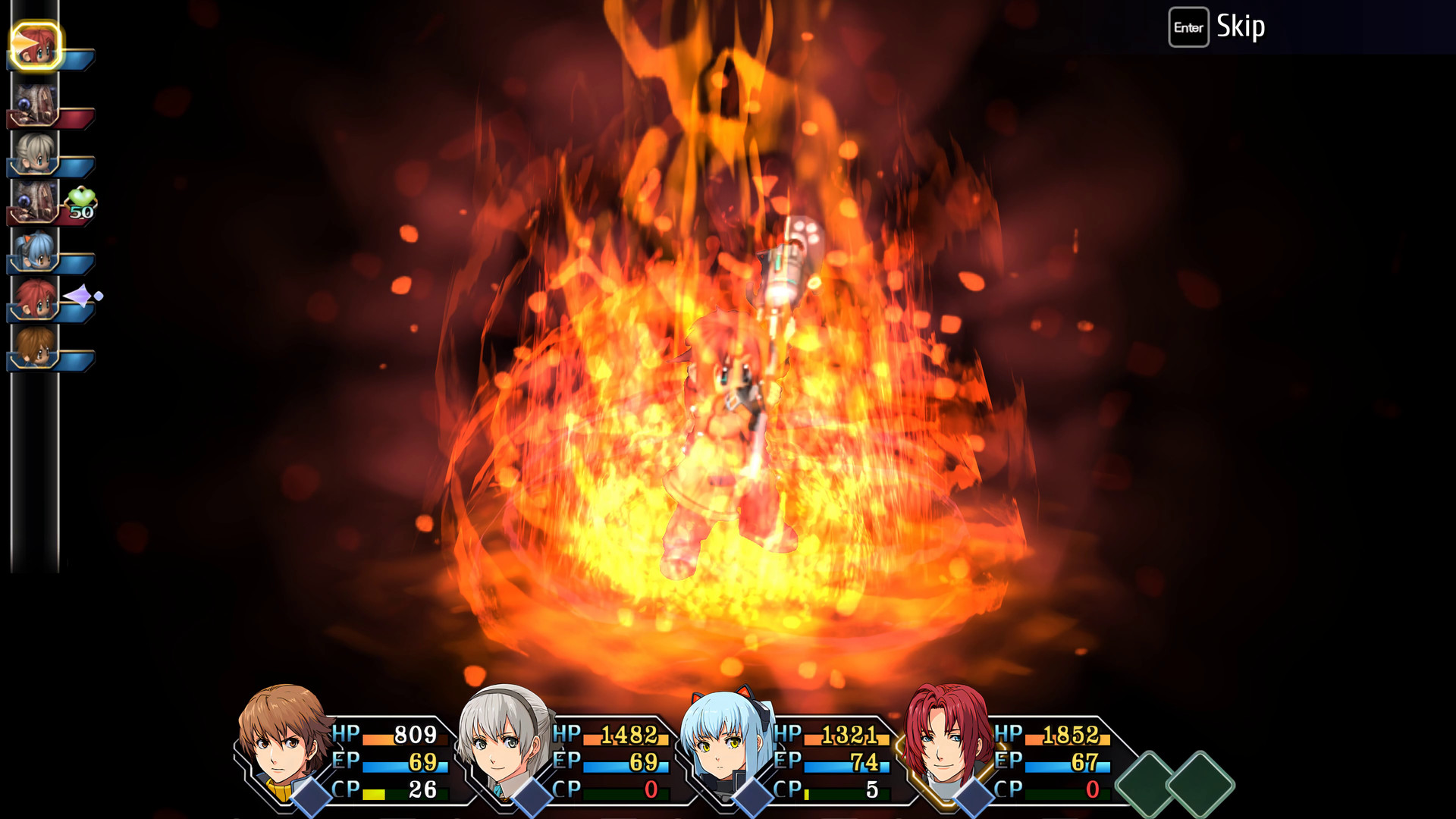
Outside the city, investigation paths and dungeon-like areas lead to turn-based encounters. Enemies appear on the field, where approaching carefully or striking first can influence the opening of a battle. Combat then shifts to a small grid: characters have movement ranges, and the location of allies and enemies matters because Crafts and Arts affect defined shapes or areas. Lloyd’s staff, Randy’s polearm, Elie’s firearm and Tio’s orbment support different attack ranges and tactical roles. The turn order is visible, so the party can respond to upcoming enemy actions, exploit an opening or use a move that delays a foe. Arts are magical techniques, while Crafts are character-specific skills powered by CP. Powerful S-Crafts spend accumulated CP for a stronger attack or a major support effect. A Team Rush can trigger under particular circumstances, letting the group strike together across a broad area. Choosing a target is therefore more than selecting the weakest foe: a line attack may catch several enemies, a movement skill can reposition an ally, and a healing or status effect may be more valuable than damage. The high-speed option can shorten routine encounters while leaving the tactical choices intact.
Character builds centre on the ENIGMA orbment system and its quartz. Each party member has an orbment with connected lines into which quartz can be fitted. Quartz provide stat changes and elemental values, and the arrangement determines which Arts become available. A quartz that grants water value, for example, contributes toward healing Arts, while stronger spells require larger totals or particular combinations. Not every character has the same line layout, so an arrangement that works well for one member may not give another the same choices. Quartz are found, bought or created using sepith earned during the adventure, which creates a link between exploration, combat rewards and party planning. Equipment, armour and accessories add another layer of preparation, while character levels expand the party’s capabilities over time. The system invites adjustment as new quartz and recipes become available: players can decide whether a character should focus on healing, elemental attacks, speed or physical resilience. It is a menu-based form of progression that sits alongside the story chapters, giving battles a broader set of options than the initial skills suggest.
Optional requests, treasure and local activities fill out the journey between the central story beats. SSS assignments are tracked through the office terminal, and completing them contributes to the unit’s detective rank and its reputation. Some jobs ask the team to locate an object or speak with a particular person; others send them into dangerous areas to clear monsters or investigate a troubling report. Missed details can matter because chapter progression moves the calendar forward, so players who want to complete available work should check the terminal and explore before advancing the main case. The city and surrounding routes also contain chests, hidden items and conversations that reward taking a detour. Cooking lets the party make dishes from ingredients, with results that can restore resources or provide items for later use. Fishing is another recurring activity, offering a change of pace and catches that can be exchanged for useful rewards. Books and other collectible records add small threads of local history. These diversions are integrated into the same compact region rather than separated into a large collection of unrelated modes; they encourage the player to revisit familiar places with a practical reason to look more closely.
Trails from Zero’s presentation reflects its origin as a 2010 Japanese role-playing game. The original release was for PlayStation Portable in Japan, and the later PC edition is an official English release published by NIS America on Steam in 2022. That Steam listing credits Nihon Falcom and PH3 GmbH as developers and NIS America as publisher. It offers English interface text and subtitles, alongside Japanese interface, subtitles and full Japanese audio. The 2022 Windows edition is distinct from the original PSP release and from its direct sequel, Trails to Azure. Pixel-based environments, compact character models and illustrated dialogue portraits frame a story told largely through conversations and text. The result is a focused RPG built around a persistent city, a small ensemble of officers, turn-based battles and a long sequence of connected cases. Players can follow the central investigation or spend time on requests, encounters and discoveries across Crossbell. The first game establishes the SSS and the state’s conflicts while leaving the wider arc to continue beyond its own ending.
- Developer
- Nihon Falcom; PH3 GmbH (Steam PC edition)
- Genre
- RPG / story RPG