

About The Last Show of Mr. Chardish
Years after helping build a rural English theatre with director Robert Chardish, actress Ella returns to its abandoned rooms after his final radio interview calls her back. She searches the venue for letters, objects and five theatrical masks, each opening a separate play whose shifting viewpoint and mechanics turn Chardish’s artistic history into interactive memories.
In 1976, Ella returns to the neglected theatre she once shared with Robert Chardish, the celebrated director whose career and private history are bound to the place. The building is more than a backdrop: it is the quiet frame around the performances and the relationship the game gradually reveals. Ella moves through rooms and backstage spaces that have lost their former purpose, encountering letters, discarded objects and traces of the people who worked there. A recording of Chardish’s last radio interview accompanies this search, giving the present-day exploration a second voice. Its reflections on his work and the theatre’s past give context to what Ella finds without turning the opening into a conventional action sequence. The central question is personal as well as historical: what did the theatre and its productions mean to the two artists, and what can Ella understand about that shared past now that the venue is empty? The answer arrives through a structure that alternates between this grounded location and the imaginative worlds Chardish made for the stage.
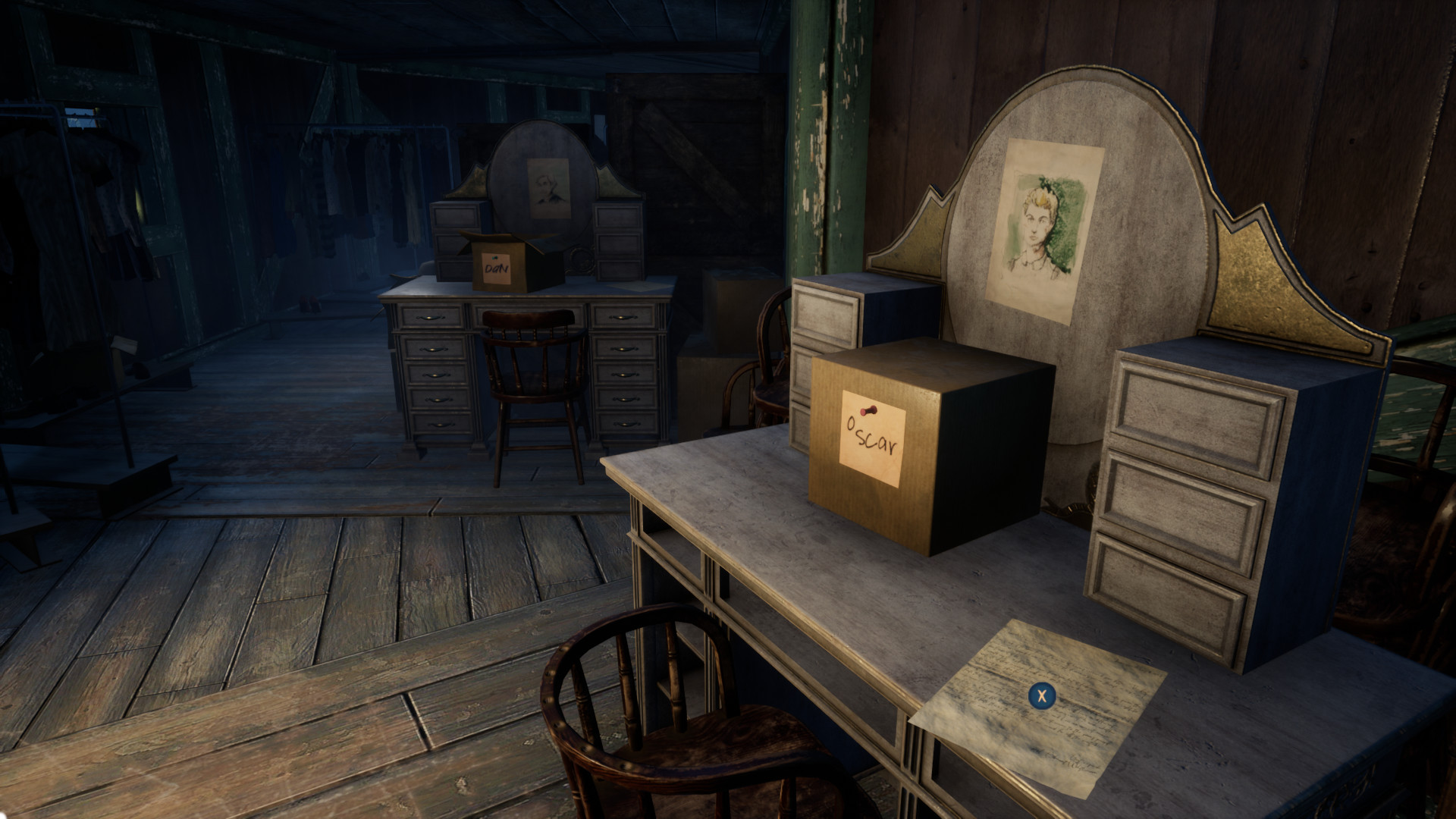
The theatre is a first-person space for walking, opening doors, looking at objects and reading notes left by the company. Its interactions are kept easy to spot: important objects carry a bright marker, so attention can stay on what they reveal about the venue rather than on searching every surface. The principal transition into a performance comes from finding a mask and putting it on. That action transfers control from Ella’s quiet inspection to a character inside one of Chardish’s productions, where movement and interaction follow the rules of that play. The theatre remains the stable location against which those changing roles can be understood. In practical terms, its loop is to inspect rooms, gather the visible traces of the troupe and locate the next mask; the larger narrative is assembled through the contrast between those concrete objects and the fictional worlds created for the stage.
Each performance changes the game’s visual language and its central activity. The theatre uses a restrained, realistic space; the plays adopt painterly scenery built from brushlike marks and splashes, with perspective and playable roles shifting between chapters. Five masks lead to five distinct plays: Solitude, Symmetry, Anger, Ascension and Daydreaming. Each act introduces a focused interaction suited to its imagery and mood. One section asks the player to work with light, another places paired robots under simultaneous control, while later sequences involve sword swings, flight and painting color into a muted world. This variety changes the pace as Ella alternates between the theatre’s slow inspection and the more directed tasks inside a performance. The recurring theatrical frame supplies continuity, while each play is free to express a different fragment of Chardish’s imagination.
Solitude turns visibility into the main navigation problem. The player manipulates light so that objects and portions of the route appear, then uses what has become visible to continue through the staged space. That simple relationship between illumination and passage makes the act’s puzzle logic readable: progress comes from noticing how a scene changes when its light is handled and using what appears to move through the staged space. The sequence also introduces the basic rhythm of a play: observe a set, identify an interaction, and move toward the next stage of the performance. The light puzzle stays local to Solitude’s stage: altering illumination reveals the route forward within that performance.
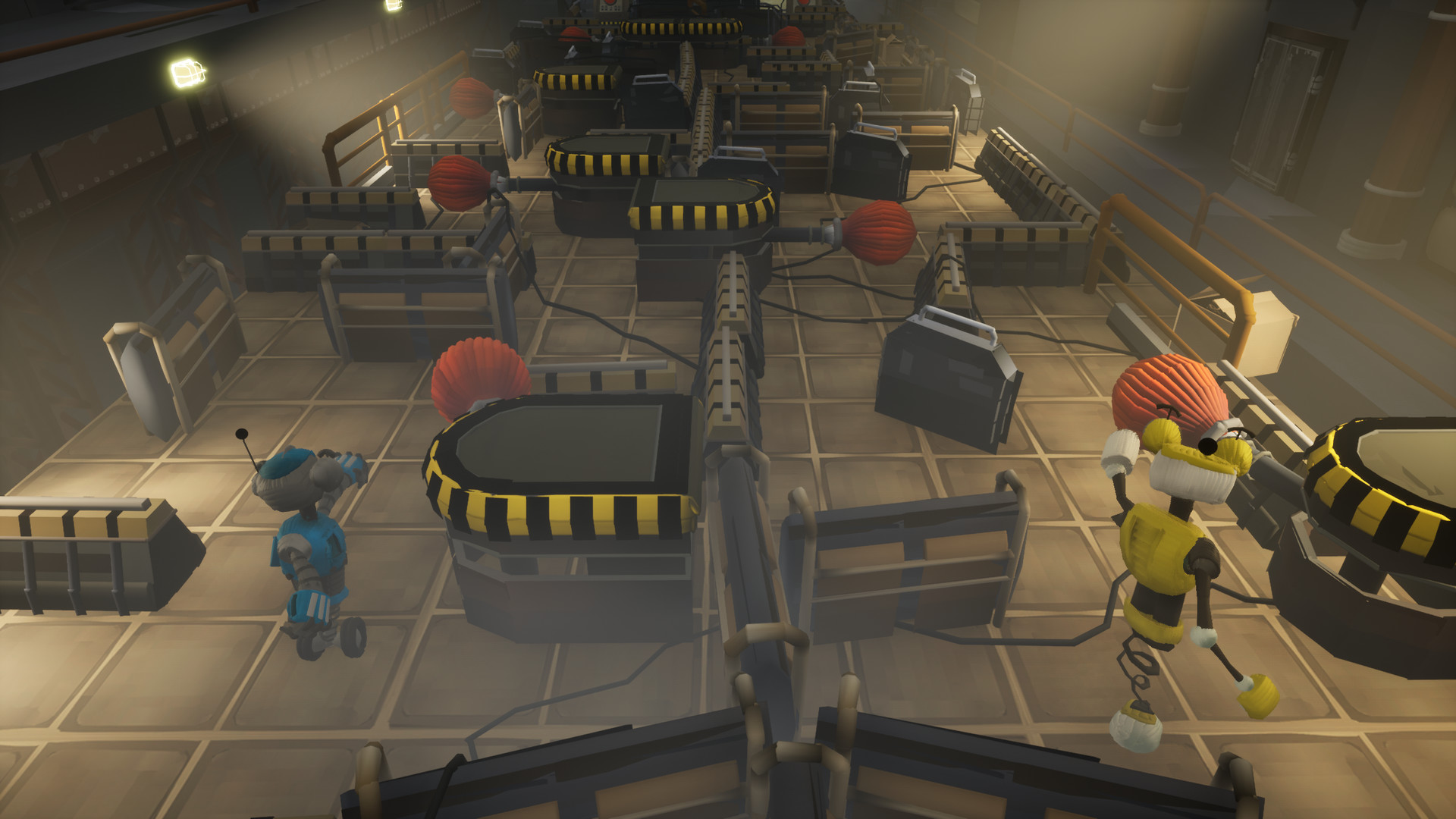
Symmetry and Anger shift the emphasis from revealing a route to controlling movement through a more active scene. In Symmetry, the player guides two robots at once during parts of the performance, so positioning and timing have to account for both figures rather than a single avatar. The act also uses platforming, placing movement and route-finding within a science-fictional factory setting. Anger takes a more direct, comic-fantastical form: the player controls a boastful musketeer and uses sword swings against the play’s targets, including bee- and chicken-shaped opponents. These encounters are staged as part of the production, not as a combat system carried into the theatre or other plays. The contrast is useful to the game’s structure: one act makes coordination the puzzle, while the other turns a simple attack into the defining action of its character’s story. Neither replaces the underlying narrative frame; both express it through a brief sequence of tasks that feels specific to the play being performed.
Ascension and Daydreaming use movement and transformation to give their scenes a different character. Ascension begins with a character dashing toward targets and develops into flight, changing the player’s relationship to distance and the space above the stage. Daydreaming centers on a large paintbrush: applying color to a largely muted environment can trigger changes and events, so the act’s primary interaction is to make the scene respond through painting. These are not cosmetic overlays on the same platforming challenge. Flight changes how the player crosses a space, while painting makes visual alteration part of the puzzle language. The stories of the acts are conveyed through their play and voice-over as well as their imagery, allowing each mechanic to work as both an objective and a metaphor. Their stylized sets make the difference from the theatre especially clear, and the shift between roles keeps the sequence of performances from settling into one repeated control pattern.
Each play contains optional sound points that take forms such as a glowing ball, a gramophone or a jukebox. Activating one plays a short character exchange. These recordings add another layer to the act: a line can echo the scene unfolding onstage or cast it in a different light, while also recalling relationships from the theatre’s history. Because the sound points sit within the performances, the player can discover them while moving through the act’s own spaces and mechanics. They reward attention beyond reaching the exit, yet the central story remains understandable without collecting every recording. This makes listening an optional part of exploration, with audio details extending the characters and ideas already suggested by each play.
The plays use sharply different settings to give their brief stories distinct dramatic identities. Solitude follows a performer’s movement from a small company toward a stage occupied alone. Symmetry places robots in a science-fictional world marked by loss; Anger recasts a musketeer’s struggle as an anti-fairy tale. Ascension follows a bird seeking greater heights, while Daydreaming centers on a painter whose brush brings color into the world and whose story includes a flutist. These are compact vignettes rather than long, fully explained biographies. Their changing characters and settings let the performances suggest creative frustration, loneliness, regret and the complicated relationship between artists through playable scenes. The player encounters each theme through the act’s particular world and actions, rather than through one continuous avatar moving across every stage. Most of the play worlds are lush outdoor landscapes, while the cold metallic factory and a flight above a golden-hued city provide striking changes of setting. Voice-over continues through these scenes as the player moves toward each play’s ending, so the performances tell their stories through a combination of staged surroundings, actions and spoken lines. The shift into third-person roles also makes these scenes feel like separate productions: Ella observes and searches in the theatre, while each play places the player inside a character’s route through a constructed world.
- Developer
- Punk Notion
- Genre
- Adventure