
About The Last Clockwinder
Jules returns to a clocktower built inside a colossal tree, where Edea has vanished and rare plants need care. In this VR-only puzzle adventure, recorded hand actions become looping Gardeners. Arrange them to grow, harvest and route resources through increasingly intricate production rooms.
The Last Clockwinder takes place in a clocktower rooted inside a colossal tree, a refuge that houses rare plants gathered from across the galaxy. Jules once lived there as a child with Edea, the Clockwinder who cared for the structure and its living collection. Years after leaving, Jules receives a distress signal and returns to find Edea missing and the tower in danger as it sinks toward the ocean. The premise gives the puzzles a practical purpose: restoring the plant systems helps keep the place alive while Jules searches for what happened. The setting brings together precise mechanisms and organic forms. Rooms are built around growing, harvesting and handling unusual plants, while gears and clockwork devices give the old tower an engineered character. The story unfolds within this compact space alongside the central activity of restoring its systems. Each new area changes the working arrangement of the tower and introduces another problem for Jules to solve, so the player learns about the place by making its systems operate again. The tree’s scale is expressed through a sequence of contained workspaces, with plants and devices defining what each room needs. Jules’ return gives those spaces continuity: the machinery is practical, the rare flora is vulnerable, and keeping the tower functioning is tied to finding its missing caretaker.
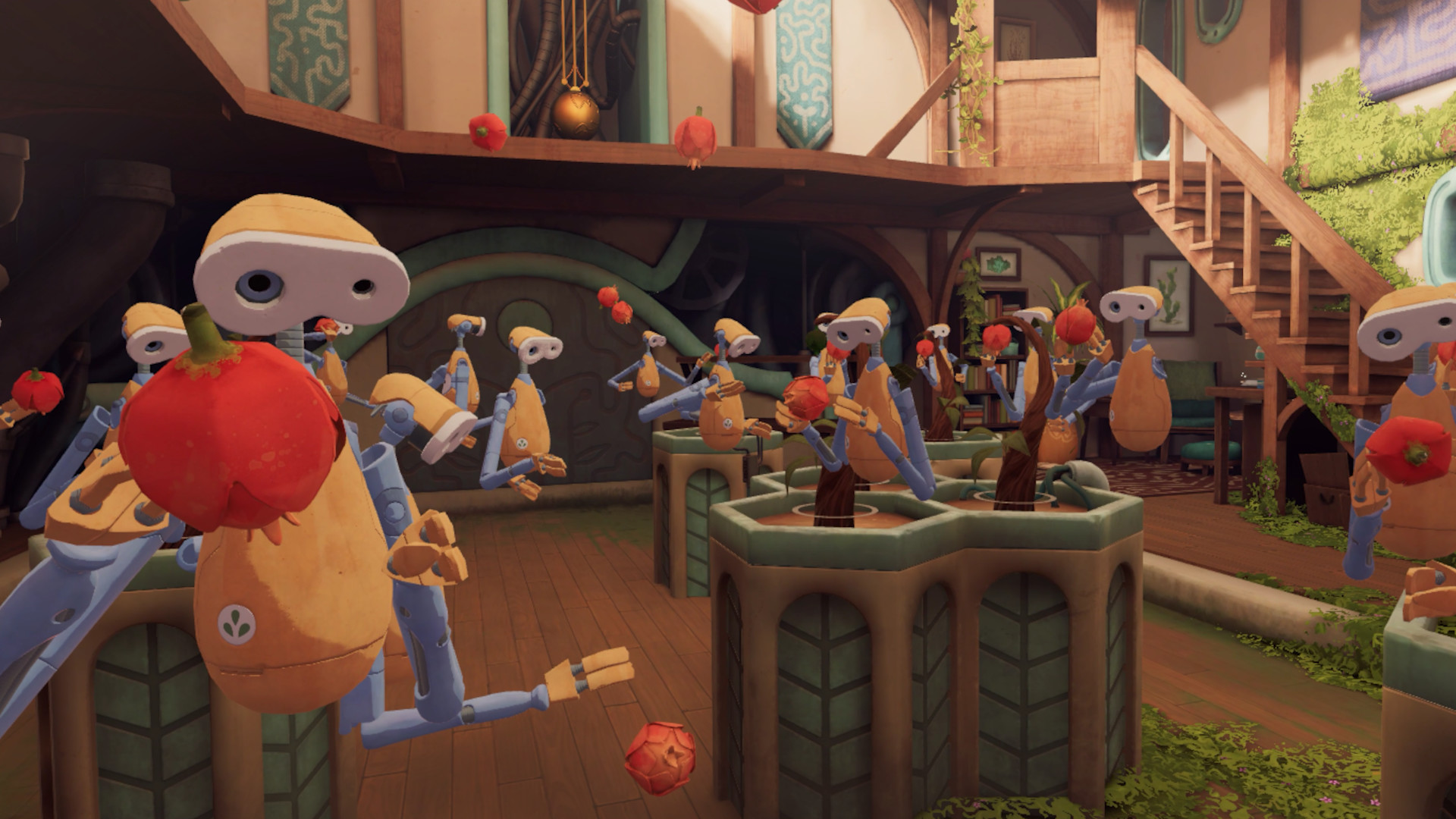
The Clockwinder’s Gloves provide the main tool. Jules can record a short sequence of physical actions, then turn that performance into a clockwork clone called a Gardener. A clone repeats its captured movements in a continuous loop: a reach, a grasp, a tool use, a throw or a catch can become one step in a process that runs again and again. Recordings are brief and use fixed loop lengths, so a useful action has to fit the available timing. The player is effectively programming by demonstration, moving their own hands and body to show a Gardener what to do. One clone may pluck fruit from a branch; another can receive it, turn and pass it onward. Because every action repeats, small changes in where a Gardener stands or how a movement is performed can alter the flow of the whole line. The system is tactile and spatial. Players place themselves in the room, work with objects at arm’s reach and inspect the loop as it plays, then record additional Gardeners to fill gaps or coordinate a handoff. The result is an automation puzzle programmed through performed gestures. The official loop lengths are two, four or eight seconds, and recordings stay synchronized so clones can repeat their contributions together. A sequence that arrives a moment too early can miss its handoff; matching a clone’s rhythm to the next action is as important as choosing the action itself.
Each room asks the player to make a productive arrangement from these repeated actions. Plants grow or present harvestable resources, and the Gardeners need to move those resources to the required destination or machine. The tasks begin with understandable actions, such as picking an item and placing it into a container, then invite players to coordinate several clones into a stable chain. One Gardener can collect fruit while another catches a pass, carries it along, or throws it across a gap. A machine may need a steady supply; a growing plant may have to be tended before it produces more. Since the clones remain active as their loops repeat, the production line continues while the player observes it. A good design depends on timing actions so that objects arrive when the next clone is ready, and on making sure the repeated movement reaches the right place each cycle. That creates a clear feedback loop: build a system, watch its output, notice where items are lost or delayed, and revise the sequence. The room becomes a small workshop in which the player can see how every recorded movement contributes to a larger process. For example, a fruit can be collected from a plant and delivered to a bin by a single throw, or carried through several shorter passes if the room layout makes that easier. The choice is visible as the line runs, and each added Gardener becomes another repeated action the player can observe and adjust.
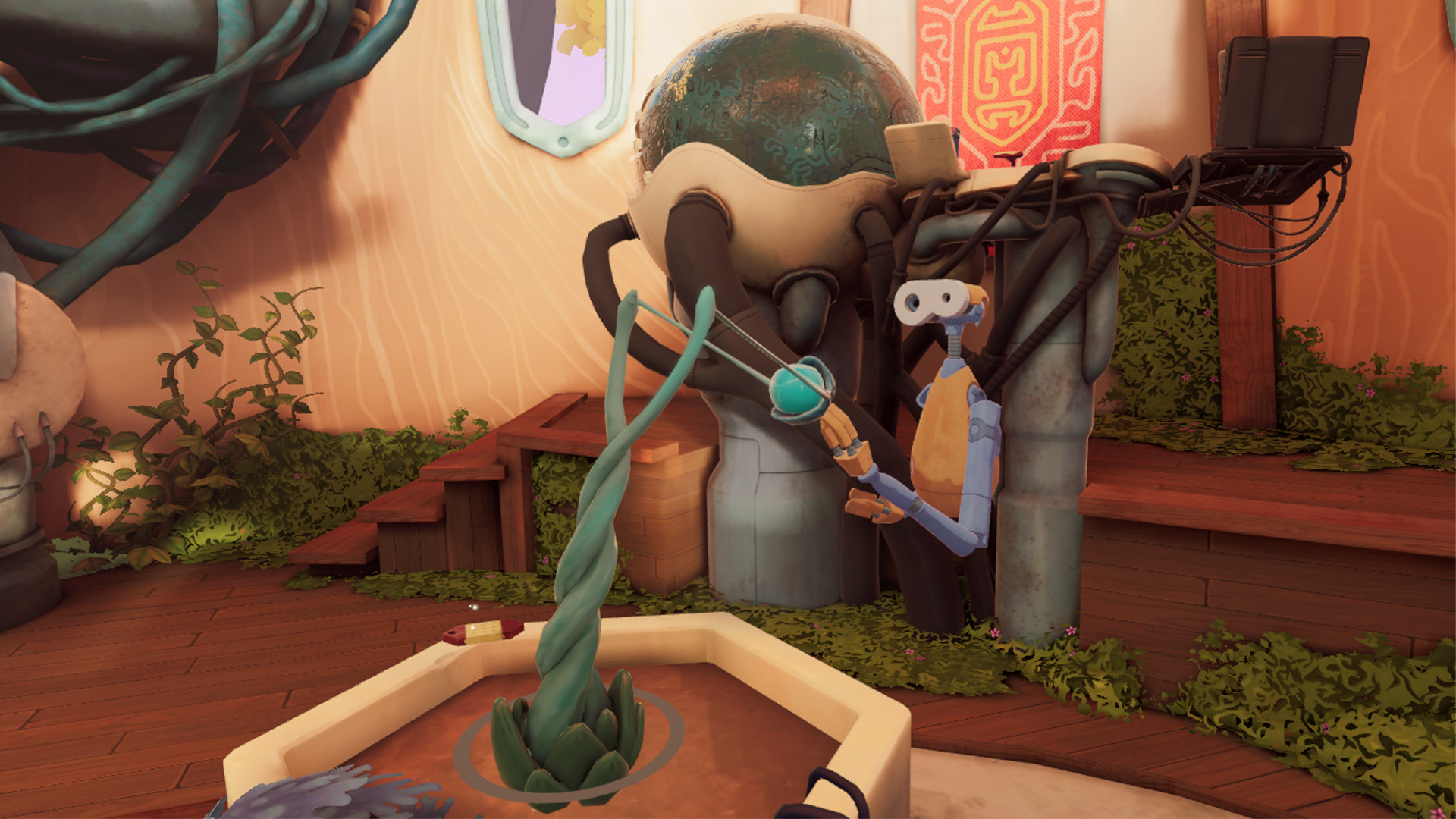
The plants make those processes vary. Different fruit types introduce their own physical behaviour and handling needs, so a line that works for a simple harvest may need another tool or transfer method in a later puzzle. Some fruit can be attached together with sticks, creating a combined object that must be assembled before delivery. Other crops require cutting tools, while some float or move in ways that change how clones can catch and route them. These properties turn the room’s geometry into part of the solution: a Gardener might need to angle a throw, intercept an object in midair or place a tool where the next clone can use it. The game also supplies production targets and optional efficiency goals in its puzzle spaces. A solution can focus on meeting the basic resource requirement, then be refined to produce more with a limited number of Gardeners. The challenge is frequently in deciding how to organize a workable chain, and then finding whether it can be shortened, synchronized or made more dependable. Multiple layouts can solve the same task, allowing the player to experiment with handoffs, throws and machine placement until the system behaves as intended. Whiteboards in rooms provide tiered production targets that show how clone limits and output rates can be traded against each other. They give optimization a measurable shape: players can compare a compact line with a faster, larger one and decide how much refinement a task needs. Meeting the basic requirement is enough to continue, while higher efficiency remains an optional puzzle within the puzzle.
Resources connect individual rooms to the wider restoration effort. Harvested plants can power machinery, provide seeds for further growth and contribute to unlocking additional spaces in the Clocktower. This makes output useful beyond the room where it was collected: a productive arrangement helps reveal more of the structure and its plant collection. Gardeners continue their repeated work after Jules leaves a room, so the player can move on while a line keeps gathering resources, then return later to observe its performance or rearrange the setup. Optional challenges add tighter restrictions, including limits on the number of clones available for a task. These goals encourage careful placement and efficient timing, but the main route also allows players to make progress with a slower arrangement. New rooms expand the campaign’s working space and introduce further plant and machine combinations, while the basic act of recording and coordinating loops stays consistent. Progress comes from learning to organize each new system and accumulating the resources needed to restore more of the tower, giving the player both an immediate puzzle and a larger reason to keep the garden operating. That structure rewards returning with a specific change in mind. The player might move a Gardener nearer to a plant, replace a slow chain of handoffs with a throw, or give a new crop its own tool-assisted route. Since room output accumulates into the larger restoration, even a modest adjustment can make the next area accessible sooner.
The story follows Jules’ connection to the Clocktower and to Edea through messages and recordings found around the structure. These can be paused or replayed, letting the player listen between construction decisions and puzzle attempts. The narrative supplies context for why the place matters to Jules and who cared for it before the distress call, while leaving the player free to focus on the work in front of them. The VR format is central to the design: the player’s tracked hands are the interface for recording useful actions, and the space around them becomes the stage where Gardeners repeat those actions. The game is VR-only, with releases for PC VR, Meta Quest and PlayStation VR2. Each automation begins as a physical recording: Jules performs a plant pickup, then Gardeners repeat and relay that action until its harvest reaches the machinery needed to open more of the Clocktower.
- Developer
- Pontoco
- Genre
- VR puzzle-automation adventure