

About The Last Case of Benedict Fox Definitive Edition
The Last Case of Benedict Fox: Definitive Edition follows a detective bound to a demon as he investigates murder and a missing child in a decaying mansion. His companion lets him enter the memories of the dead, where clues, puzzles, platforming and combat turn private trauma into explorable places. This edition revises traversal and fighting while adding story material.
Benedict Fox calls himself a detective, but the partner he brings to his last case makes this investigation unlike an ordinary search of a crime scene. A demon bound to him can carry him into the minds of the recently dead. The physical starting point is a large, deteriorating mansion where a young couple have been murdered and their child has disappeared. Its rooms hold evidence of a family and its secrets; the minds Benedict enters contain an equally important, less stable version of the truth. He is looking for clues about the crime, the child and the people around them, while secret organisations and forbidden rituals widen the case beyond one household. The premise establishes a reason to examine both a place and the memories attached to it without telling the player how the mystery ends. A piece of evidence in the mansion may gain a different meaning after an excursion into Limbo, and an obstacle in Limbo may send Benedict back to the living world for help. The case is intimate even when its supernatural implications become large. The partnership is present in conversation as well as in the supernatural premise. Plot Twist describes the reserved Benedict and his more talkative companion as a pair who can argue and work through what they discover together. That continuing exchange gives a solitary investigator someone to test ideas against, while reminding the player that his access to the dead depends on a relationship he does not fully control.
Limbo is the name the game gives to the dimension of memory and psyche that Benedict explores through his companion. The developer describes it as maze-like, a quality that helped move the project away from an earlier linear design toward a Metroidvania structure. In Limbo, emotions and trauma can take physical form, so the route through a dead person's mind is also a way of piecing together that person's history. Exploration alternates between the mansion and these surreal spaces. The mansion serves as a hub for clues, people and improvements, while the labyrinth grows more accessible as Benedict gains ways to overcome its barriers. That structure encourages returning to a location after finding an ability or understanding a clue elsewhere. It also makes memory more than a sequence of cutscenes: the player travels through it, reaches blocked passages, faces threats and solves problems inside it. The parallel between a house full of concealed family history and a mind full of inaccessible rooms carries the mystery into the game's geography.
The investigation does not suspend action. Benedict moves through side-scrolling environments, jumps between platforms and fights demons and other enemies while searching for routes forward. The official Definitive Edition description emphasises reworked traversal, faster animations and a revised combat system, alongside new puzzles and story content. It is important to name the edition because an impression formed from the original 2023 release may not describe the version now presented on the store page. Weapons, demon abilities and the environment can be combined in an encounter; the publisher stresses concentration and a tactical approach rather than treating every fight as a simple rush forward. The demon is consequently both a way into testimony and a source of strength when the memories turn hostile. The action has a practical relationship to investigation: a route that cannot yet be crossed or an enemy that cannot yet be handled can send the player back to gather resources, improve equipment or learn more about the space. Solving the case involves understanding where to go as well as what happened.
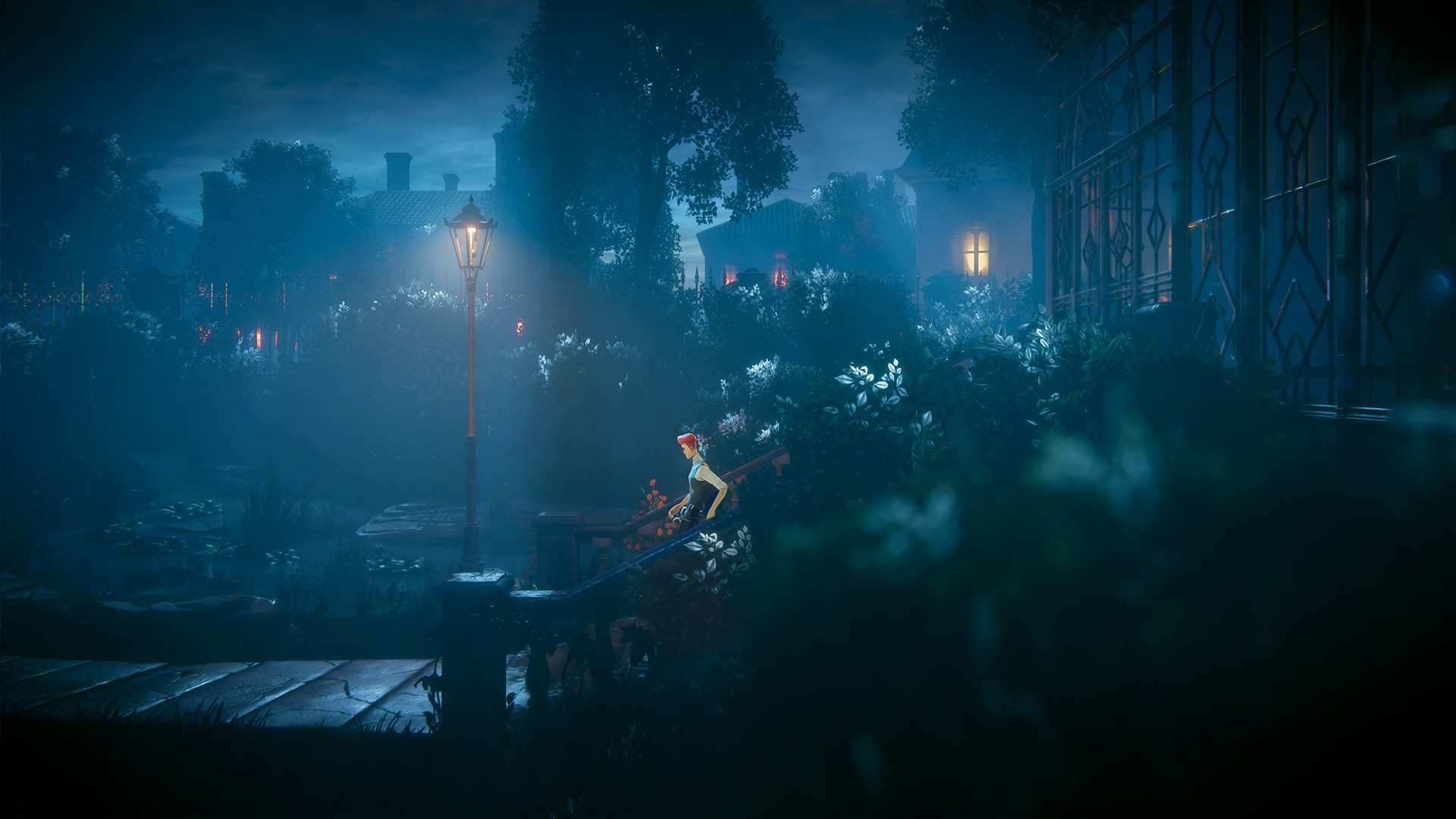
Several of those improvements come from people Benedict can meet in the mansion. In a developer interview, creative director Bartłomiej Lesiakowski describes a Weaponsmith who can improve the flare gun and bayonet, and a Tattooist who uses ink collected from defeated Limbo creatures to strengthen Benedict's bond with his demon. The ink is a useful piece of world logic: something drawn from a hostile creature becomes the material for new powers. The interview gives examples of powers that can alter movement or grab an enemy, showing how an upgrade may serve exploration and combat at once. It also identifies Harry Houdini as a merchant in the library, offering items such as healing Miracle Water, smoke bombs and a temporary defensive device. Those specific residents make the mansion feel like a place where help has a face and a cost, rather than a collection of anonymous upgrade menus. They also give Benedict reasons to return from Limbo before pushing into another unfamiliar branch. The case advances through equipment, knowledge and relationships with the people who occupy the house.
Puzzles occupy the space between those excursions. The game asks the player to decipher information and work through elaborate mechanisms, sometimes with enough complexity that keeping notes is useful. A cipher or an unsettling organic lock is a different kind of barrier from a monster, but both stand in the way of learning what the family has hidden. The developer has explained that the shape of Limbo invited a more open-ended structure, while the focus on a dense story shaped the puzzles placed within it. The player is therefore not following one uninterrupted trail of evidence. A clue may be found in one room, a means of interpreting it in another, and the route to use it elsewhere in the mansion or a memory. The Definitive Edition adds new stories and puzzles, extending the investigation presented in the original release. This overview avoids printing solutions or treating those additions as a separate sequel: they belong to the current edition of the same case. In an Xbox developer interview, Lesiakowski explains that some of the genre locks and keys are puzzles rather than physical abilities. This is why noticing a symbol or understanding a mechanism can matter as much as gaining a new movement option. It also explains the alternation between talking to a resident, following a trail, solving a device and fighting through a dangerous room: these activities serve different parts of the same investigation.
The visual and musical setting joins noir detective fiction to the fantastic. Plot Twist places Benedict in a 1920s world and cites a warped, almost illustrated look influenced by Tim Burton, set against mature and gothic subject matter. The mansion can be richly coloured even as the story is grim; Limbo pushes further into impossible shapes and creatures made of ink. Jazz anchors the historical mood, though the developer sought a more uneasy sound than a straightforward period pastiche. These choices help distinguish the human evidence Benedict handles from the dreamlike terrain he enters while keeping both halves of the game recognisably part of one mystery. The Last Case of Benedict Fox first appeared in 2023, and its Definitive Edition arrived later with revised play and further story material. Steam lists Plot Twist as the current developer and publisher, while an earlier developer interview names Rogue Games as the publishing partner for the original launch. The version distinction matters more than that business history for a reader deciding what the game contains: the current case combines exploration, puzzles and combat with a deliberate investigation of the dead, without requiring that the resolution be revealed before entering the mansion. The early-twentieth-century frame also allows the mansion to borrow from detective fiction without making the supernatural feel like an unrelated second game. Benedict follows testimony and material evidence, but the means of questioning a victim turns memory into a space where the player must move and act. The eerie jazz and exaggerated architecture keep that transition legible even when the setting becomes more abstract.
- Developer
- Plot Twist
- Genre
- Puzzle-rich supernatural Metroidvania