
About The Horror at Highrook
The Horror at Highrook sends four occult investigators into a mansion whose noble family has vanished. Rooms form a board, while people, objects and actions appear as cards that can be combined to uncover clues, make supplies and perform rites. Across eight chapters, the team must follow the mystery without succumbing to hunger, injury, illness or madness.
A noble family has disappeared from Highrook, leaving a mansion full of rooms that seem to hold more than an ordinary household's possessions. A team of investigators arrives to learn what happened. The Horror at Highrook treats their work as an extended inquiry rather than an immediate confrontation with a single monster: the first useful discovery might be a note, a material for a tool, or a room whose purpose is not yet clear. The house stands on a cliff in the game's gothic world, and its floor plan becomes familiar as access to new spaces opens over eight chapters. Letters and records give the family a history that the team can assemble gradually. That makes the disappearance more than a sentence supplied at the start; each account of the household can change what an earlier clue means. The investigators are also individuals with different strengths and private ambitions, so sending someone to a room is a decision about who can interpret what is found there. Occult entities and a mounting sense of danger surround this human question, but the central invitation is to uncover a chain of events whose pieces have been left in different parts of the house.
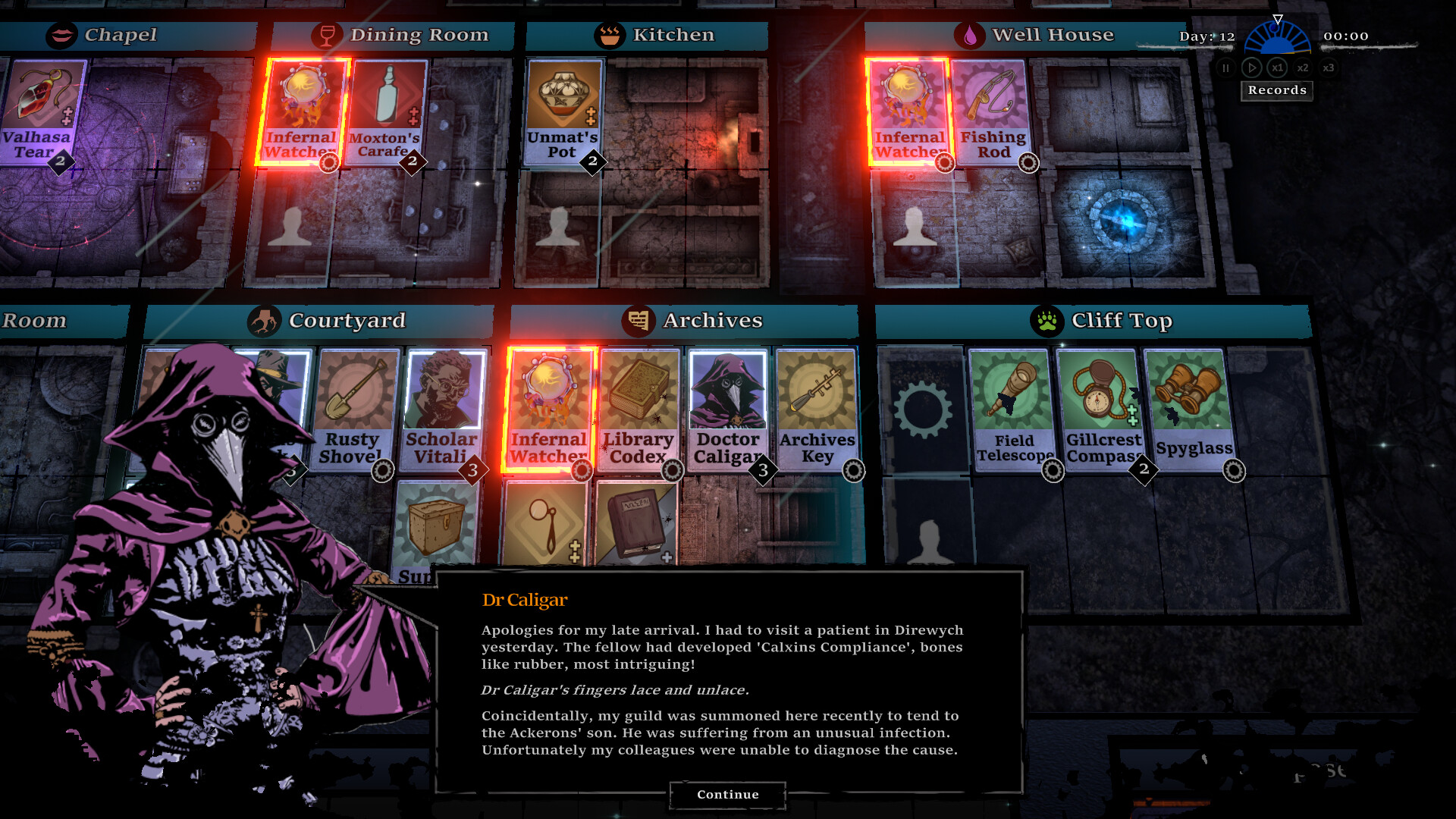
The mansion is laid out like a board rather than a freely walked 3D building. Cards represent the investigators, actions and items, and the player places them into room slots to attempt work there. A character paired with an appropriate action in the right location may reveal a clue, produce a resource or create a new lead. That result can become a card in its own right, ready to be examined or combined elsewhere. The arrangement turns the house into a practical puzzle: an archive, laboratory and machine room do not all do the same job merely because each has an empty slot. Learning what kind of inquiry belongs in a room is as important as noticing a suspicious object. The board can be zoomed and panned, letting the player move between a view of the whole investigation and a close reading of one location. As later chapters open further rooms, the original spaces do not simply disappear from use. A new material or occult understanding can give an old room fresh work to do, so progress often means revisiting a known place with a more capable team.
Each investigator has a different way of turning the house's evidence into progress. Atticus the Hunter can gather and scout; Astor the Mechanist makes particular sense around the machinery and objects that need investigation; the scholar Vitali works through books and records; Dr Caligar joins later and becomes valuable in laboratory work. These roles are not four separate campaigns. They share a board and can be active at the same time, so one person's search can supply the component that another needs to complete a different action. An apparently stalled lead may therefore be a problem of assignment rather than a missing secret door. A character's secondary abilities also matter when their obvious specialist room has no immediate task. Cards and upgrades can strengthen later attempts, but they must be developed from materials that the team has found. The result is a rhythm of parallel work: gather, inspect, craft, then return to a more demanding question with the right person and preparation. The named specialists help make that rhythm intelligible. A player is not merely feeding coloured cards into matching sockets; they are deciding whose knowledge and effort should be applied to a particular piece of Highrook's history.
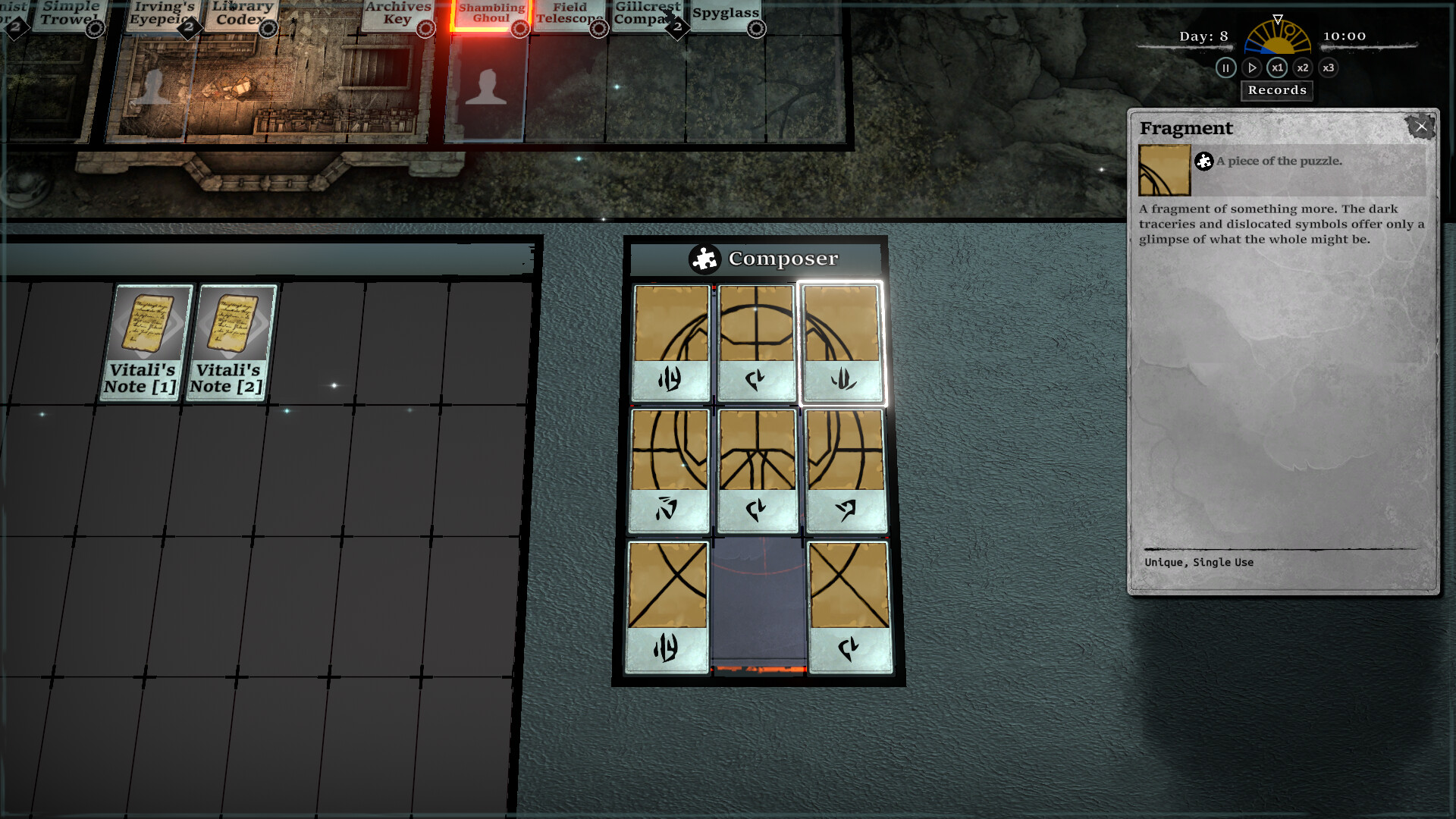
Crafting connects the investigation to the occult threat. Characters, items and locations can be combined into mundane tools, potions, protections and rites. A document may suggest what kind of object is needed; a prepared item may allow a character to attempt something that was unsafe or impossible before; that attempt may expose another part of the mystery. The system is nonlinear enough that a single discovery can suggest several possible experiments, yet it is anchored to the mansion's rooms and the team's specialities. This is why searching for raw materials remains meaningful after the first chapter. More elaborate challenges require more than one promising clue, and a room that once supplied a simple item may later support a stronger working. The occult side also changes the meaning of preparation: a relic or rite is not a decorative collectible when entities can intrude on the investigation. Steam describes summoning and banishing ancient horrors, while the board-focused play asks the player to arrange the conditions for those acts. Expect a chain of inference and production rather than a real-time duel with a weapon drawn.
The investigators must stay functional while they work. Hunger, injury, illness and madness are named pressures, and keeping the team equipped is part of pursuing the missing family's story. Food and healing supplies have to be made or found; rest can restore them, and dreams and visions may offer another route to a hint. An investigator sent constantly into danger cannot be treated as an unlimited action card. The player has to notice whether another task is worth delaying while somebody eats, sleeps or receives care. Horror then becomes a cost of knowledge as well as a matter of imagery: exploring deeper may unlock an answer while exposing the group to another threat. Difficulty settings can adjust the severity of these survival demands, but their presence explains why the game is not simply a logic grid whose pieces wait unchanged for the player. The shared resources, limited people and different rooms form a small operating system. When several leads are open at once, an available action is worthwhile only if the team can sustain the effort long enough to finish it.
Highrook's story is delivered through writing, cards and images rather than through a voiced cinematic telling. The library of letters and notes can reveal the mansion's past, while new events and characters enter as the eight chapters unfold. Its hand-drawn gothic art makes the board readable as a working space and gives the people placed on it distinct silhouettes; the contrast between illustrated portraits and the orderly room layout helps an occult event feel like an intrusion into a controlled investigation. Nullpointer Games was primarily a solo development project, with additional help on editing, testing, music and community work. That scale shows in the deliberate focus on a single house and a set of interlocking systems rather than a vast explorable landscape. The result asks the player to read closely. Even a short record can matter if it gives a name, points toward a room or suggests why an occult working exists. The writing is substantial, so the pace is closer to studying a case than rushing from fight to fight, and its gothic and cosmic influences emerge through the clues the investigators manage to connect.
The full PC game released in 2025 after a separate demo had introduced its first portion. Nullpointer Games and Outersloth are credited on Steam, and the complete edition carries the mansion investigation through eight chapters rather than ending at the demo's early boundary. That scope distinction matters because a first encounter with the board shows only part of its crafting and room network. Opening another area can bring a new character, action or hazard into contact with cards already in hand. The game also offers Steam achievements and cloud saves, but neither changes the work inside Highrook: the player keeps translating discoveries into assignments for a team whose condition must be managed. The mystery is not solved by walking every room once. It is built from repeated visits under changed circumstances, an expanding set of possible combinations, and decisions about which investigator should take the next risk. Highrook's family history gives that system its destination, while the occult challenges make each step toward an answer something the team has to prepare for.
- Developer
- Nullpointer Games
- Genre
- Occult card-crafting narrative RPG