
About The Gunk
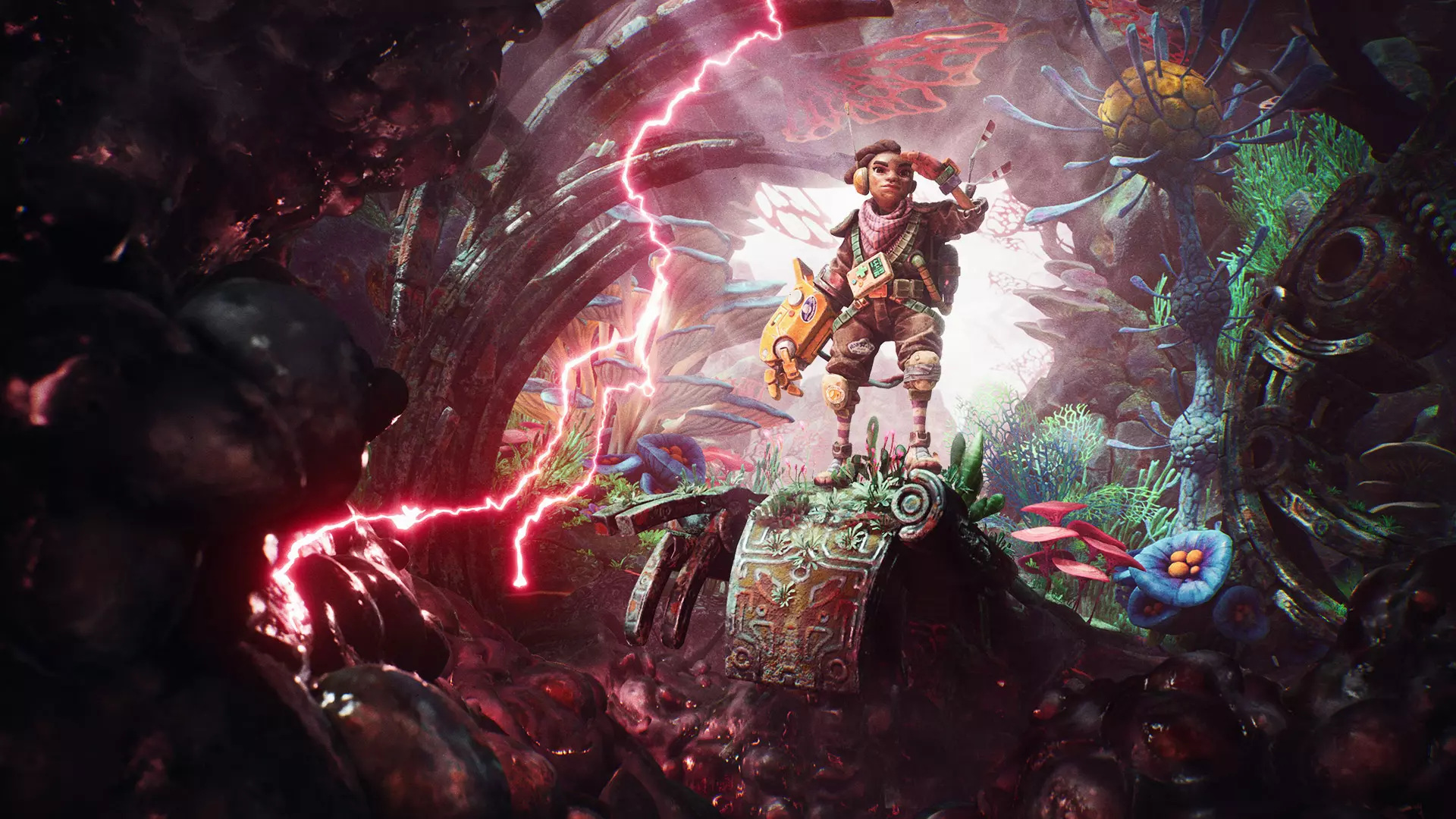
Rani and Becks, two indebted space haulers, land on a lush alien planet in search of valuable energy. Rani explores with her mechanical Power Glove and finds the world smothered by toxic Gunk. Cleaning restores damaged habitats, opens routes through the landscape and draws the pair into the ruins of a vanished civilization.
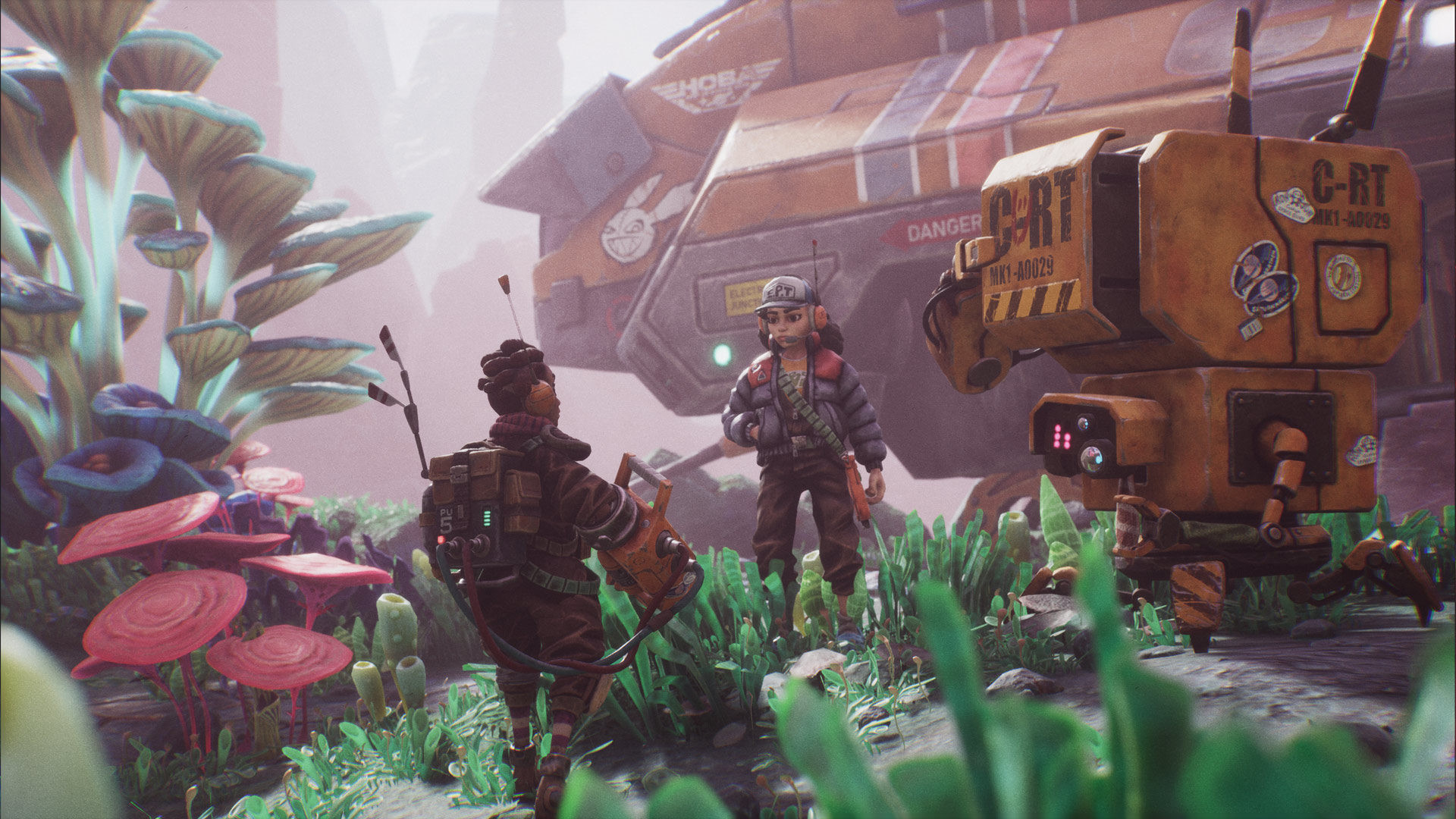
The Gunk is a third-person action-adventure game starring Rani, one half of a small space-hauling crew. She and Becks travel aboard the Dust Bunny, a ship whose repairs and debts make the prospect of a rich resource deposit especially tempting. The planet they discover looks abundant, but the first samples reveal a more complicated picture: black, organic masses are covering its life, and clearing them exposes pools of bright green energy. The hunt for something valuable to sell therefore becomes an investigation into what is happening to the planet. Rani is the one who leaves the ship to explore, while Becks remains at the controls and speaks with her over the radio. Their different approaches shape the story: Rani is curious and willing to push into unknown places, while Becks weighs danger against the crew’s immediate need to keep their ship running. Their conversations continue as the landscape changes and the discoveries become harder to treat as a simple salvage job.
The planet is presented as a sequence of connected wild regions: dim caves and narrow passages lead into open stretches of jungle, cliffs, streams and unusual plant life. The Gunk’s dark coating makes these places appear drained and inert. When Rani removes the growth from an area, a pulse of green energy spreads through the ground and the scene fills with colour and vegetation. The shift is both a visible sign of progress and a way to read the environment: cleared ground reveals resources and living things that the sludge hid. Exploration also uncovers remnants of a society that once inhabited the planet. Ruins and relics provide evidence that the world has a past beyond the current contamination, while later discoveries deepen the mystery without turning the adventure into a sequence of explanatory documents. Rani’s scanning tool identifies unfamiliar objects and records information about the life and materials she encounters, giving her investigations a practical role as well as a narrative one.
Movement through the world is built around straightforward third-person traversal. Rani runs and jumps across ledges, clambers through cave routes and crosses platforms formed by the local plants. The layout guides her through a main path but often leaves small side pockets to inspect for resource nodes, scannable life and patches of Gunk. There is no need to manage a large inventory of weapons or survival equipment; the same mechanical arm serves as scanner, suction tool and means of interacting with objects. This limited set of actions keeps attention on what the terrain is hiding and how a passage can be opened. Some locations connect back to previously visited sections, and fast-travel beacons at segment entrances make returning to the ship or retracing a route less cumbersome. The game’s spaces are not an open-world map: progress moves through authored areas, with exploration occurring within and around those routes rather than through free-roaming across a single continuous landscape.
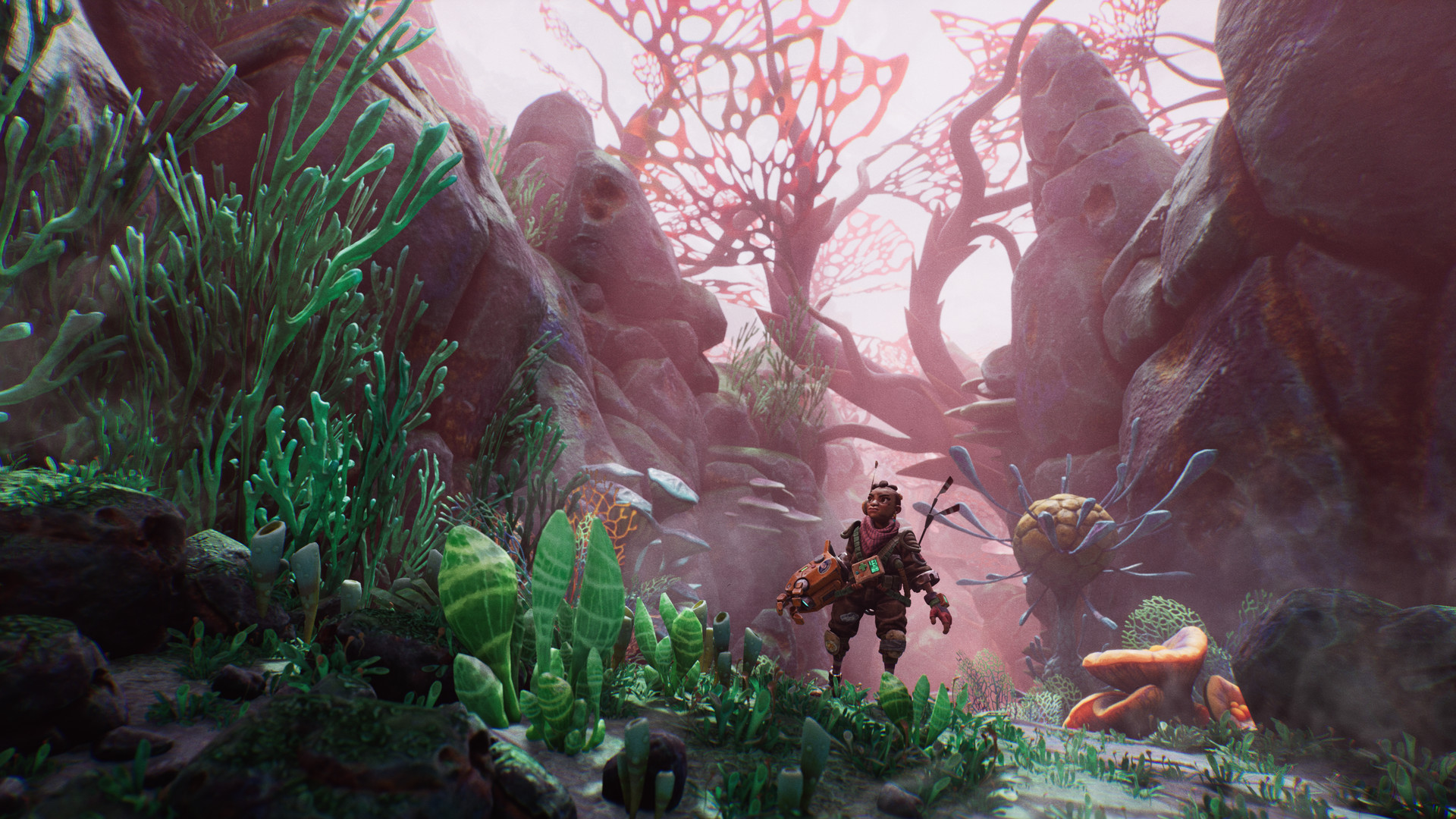
Rani’s prosthetic arm, nicknamed Pumpkin, is the central tool for interacting with the planet. Its scanner can examine plants, creatures, materials and other points of interest, recording information and contributing to the discovery of upgrade blueprints. Switching to its vacuum function lets Rani pull in the black Gunk, along with loose resources. Cleaning is not simply a cosmetic task. The growth can cling to surfaces or cover an area around a living pool, so Rani has to aim the suction at each mass and clear the obstruction before the ground can recover. The arm’s reach is limited, which means she often needs to move closer, find a better angle or use the surrounding plants to access a distant cluster. Once a patch is fully removed, the world visibly changes and may reveal a route, a resource or a healthier patch of ecosystem. This repeated cycle ties observation, tool use and environmental change together: scan what is unfamiliar, remove what is smothering the area, then inspect what that action has uncovered.
Plant life supplies the main environmental puzzles. Rani can detach round, mushroom-like growths known as mycelium coils with Pumpkin and launch them into pools of green energy. The energy makes large fungal platforms grow, creating steps and footholds that lead to high ledges or across gaps. A different plant, the mulligan melon, can be pulled free and thrown; after a short delay it explodes, making it useful for reaching Gunk that is out of vacuum range or clearing an obstructing mass. Puzzles ask the player to identify which object suits the situation, then position Rani to use it. A coil is useful when the route needs a new platform, while an explosive melon solves a blockage that cannot be reached directly. Cleaning can also expose the energy pools and surfaces that these plants depend on, so the acts of restoring the area and navigating it reinforce each other. These interactions keep the traversal grounded in the planet’s biology rather than in a collection of unrelated switches and keys.
Combat appears intermittently as hostile creatures and defensive plant life threaten Rani along the route. Pumpkin remains her main means of dealing with them, so encounters extend the tool’s suction-and-release logic instead of introducing a conventional arsenal. Smaller creatures can be drawn in and thrown, while rooted projectile-spitting plants can be pulled from the ground in a manner similar to harvesting useful growths. That makes combat closely related to exploration: the player reads the threat, uses the arm to control distance and removes hazards from the space. These encounters are brief parts of a broader adventure whose emphasis stays on environmental puzzles and clearing the landscape. Rani is not framed as a heavily armed soldier, and the game does not build its progression around collecting a range of guns or fighting through constant waves. The creatures are part of the damaged ecosystem and the obstacle course through it, while the primary forward motion comes from reaching new areas and understanding how the local life can be used.
Resources gathered in the field feed a modest upgrade system. Scanning living things and objects unlocks blueprints for Pumpkin; collecting the required organic, metal, fibre or alien materials then allows Rani to craft those upgrades at the workbench aboard the Dust Bunny. Materials can be drawn from plants and clusters embedded with metal, so optional looking side routes can support improvements to the arm. Some blueprints contribute to basic progression, while many offer additional benefits rather than being mandatory for the campaign. The loop gives scanning and resource collection a direct purpose: information reveals what can be built, and vacuuming the planet supplies the ingredients. Returning to the ship connects fieldwork with crafting, and fast-travel points provide a route back from explored segments. This system sits alongside the main story rather than replacing it with a deep character build or equipment economy; the central tool remains Pumpkin, and upgrades expand its usefulness as Rani encounters new obstacles.
The story is carried through both discovery and the ongoing radio exchange between Rani and Becks. Since Becks stays with the ship, her perspective arrives through dialogue while Rani sees the ruins and ecological changes firsthand. Their discussion about risk, money and what the pair owes one another gives the alien mystery a personal scale. The world’s quiet stretches, shifts from shadowed cave to vivid vegetation, and the contrast between the damaged surface and its restored state support that tone. The Gunk is a single-player adventure developed by Image & Form Games and published by Thunderful; the Steam listing identifies the PC release, while the Xbox store lists Xbox One, Xbox Series X|S, PC and Xbox Cloud Gaming availability. The game combines exploration, platform traversal, light combat, scanning, resource collection and environmental puzzles within a focused campaign about two partners learning what their find means for the planet and for their own plans.
- Developer
- Image & Form Games
- Genre
- Action-adventure / platformer