
About The Evil Within
Detective Sebastian Castellanos and fellow officers Joseph Oda and Juli Kidman investigate a mass killing at Beacon Mental Hospital, then find themselves trapped in a shifting nightmare. The Evil Within is a chapter-based survival horror game built around scarce supplies, deliberate combat, environmental hazards, puzzles, and upgrades earned with Green Gel.
Detective Sebastian Castellanos arrives at Beacon Mental Hospital with his colleagues Joseph Oda and Juli Kidman to investigate a reported mass murder. The case quickly becomes an ordeal in a reality that shifts between familiar places and nightmarish spaces. Sebastian is the central playable character; Joseph and Kidman are fellow officers caught up in the same crisis, although the group is soon separated. Corridors, streets and buildings appear transformed by a force Sebastian does not yet understand, and the people he encounters offer fragments of the larger mystery. The first game’s distorted world draws on Krimson City, giving its horrors pieces of a recognizable urban setting. Its narrative is delivered through chapters, scenes, documents and encounters rather than through an open town to roam. The immediate aim is to survive and find out what happened at the hospital, while the fiction leaves Sebastian uncertain about which apparent dangers belong to the world he knows.
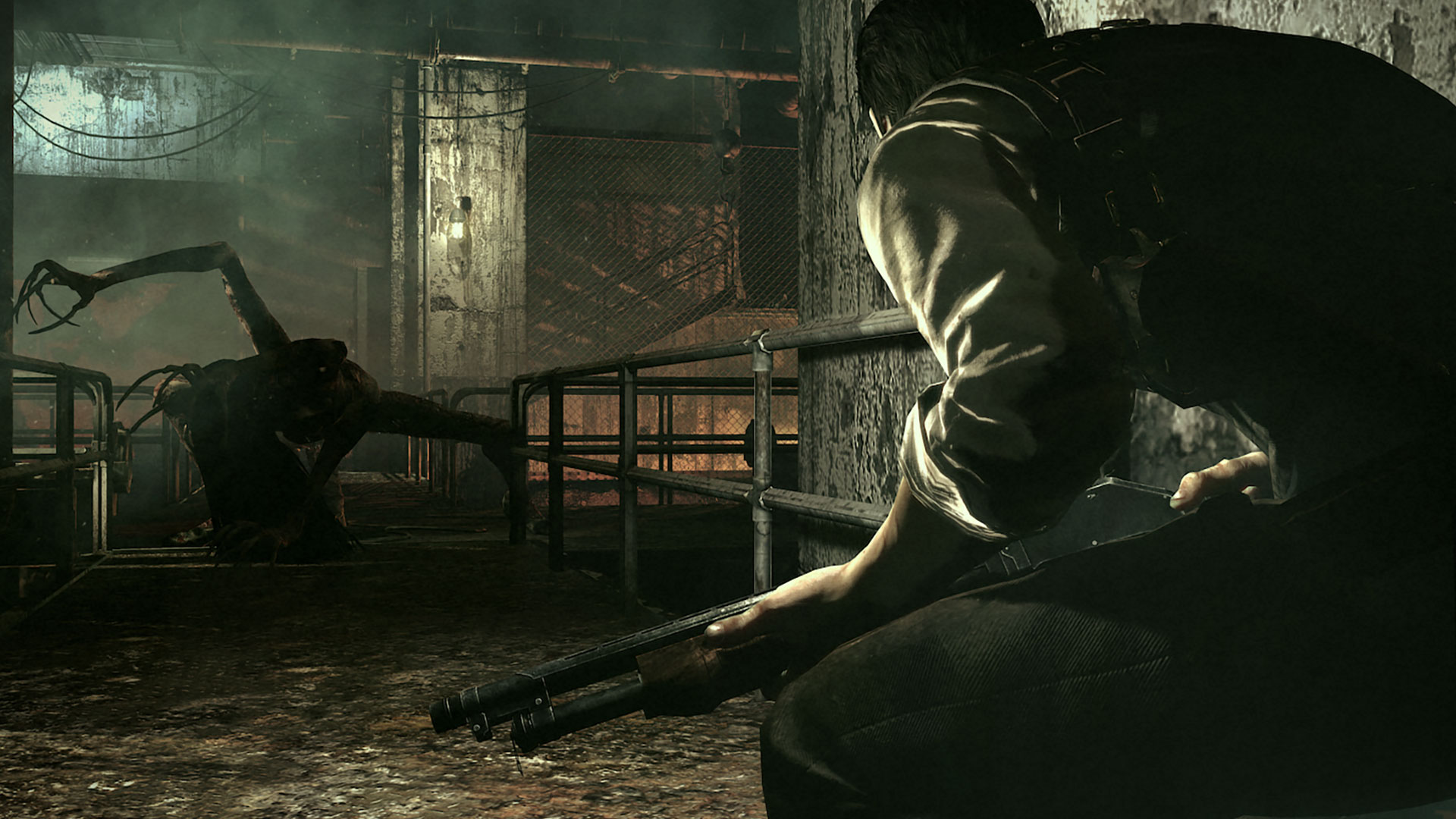
The moment-to-moment loop combines searching, cautious movement and third-person shooting. Sebastian can walk, crouch, sprint for a limited time, aim and fire, but ammunition and healing supplies are scarce enough that fighting every threat head-on can be costly. Enemies may be stunned or knocked down, creating a short opening to escape or use a match. A bottle can distract a foe when thrown, or stun one with a head strike long enough to allow a sneak kill. Melee weapons found in the environment are single-use, so they function as urgent opportunities rather than dependable replacements for guns. The game also asks the player to watch the environment: explosive traps, wires and other hazards can injure Sebastian, but some can be disarmed or triggered against enemies. Combat therefore includes deciding whether to spend ammunition, create distance, use a nearby hazard or risk approaching a stunned opponent. The inventory and shortcut slots make selected weapons and supplies quickly available during these encounters.
The Agony Crossbow gives Sebastian a flexible tool whose ammunition is made from Trap Parts. From the inventory, the player selects a bolt type and crafts it when enough parts have been collected. The different bolts support distinct uses: electric bolts can stun, freeze bolts can hold a target, and explosive or harpoon bolts provide other ways to damage enemies or control space. The crossbow makes trap disarming useful beyond simply removing a danger, since recovered parts can become ammunition for a later encounter. Ordinary guns still matter, and the player must manage their loaded rounds and reserve ammunition while moving through each chapter. The weapon set expands as the campaign proceeds, but each new option feeds into the same scarcity problem: ammunition spent now cannot be used in a later fight. Some traps can also be deliberately activated by shooting them, turning their placement into part of the encounter rather than treating every hazard as something to bypass. These systems reward attention to surroundings and measured use of the inventory.
Green Gel is the main resource for improving Sebastian. It is found throughout the game, and upgrades can be purchased at intervals as the campaign advances. The upgrade menu separates different improvement types, letting the player direct the collected Gel toward skills and weapon-related capabilities rather than applying a single automatic increase. That creates a persistent progression layer beneath the chapter structure: resources gathered during dangerous sections can make later sections more manageable, but spending on one improvement means delaying another. Sebastian’s health and stamina, weapon handling and carrying capacity can all shape how a run through an encounter feels, so upgrades affect both survivability and preparation. Saving and upgrading are tied to the game’s asylum hub and Nurse Tatiana, which acts as a pause between stretches of danger. Goddess Statues found in chapters can be broken to obtain Locker Keys; those keys open lockers in the asylum for supplies. The hub therefore connects exploration rewards to equipment and character development without replacing the need to conserve what is carried into the next chapter.
Progress follows a sequence of named chapters that changes the setting, immediate objective and threats. Sebastian searches rooms and corridors for ammunition, healing items, keys, documents and useful routes, while puzzles interrupt the combat rhythm and ask for attention to visual clues. The campaign’s supporting cast can become separated or reappear as the situation changes, so the narrative uses encounters with Joseph and Kidman to develop the investigation without turning them into freely controlled party members. Chapter transitions also change the kinds of pressure placed on the player: a narrow passage, a room with an active hazard and a larger encounter each ask for different movement and resource choices. Safe moments are limited, and searching every corner may provide useful materials but can also expose Sebastian to danger. This makes forward progress a balance between pursuing the current objective and taking time to inspect the immediate area. Documents and environmental details add context to the mystery, while the central route remains legible through its chapter goals and story scenes.
Difficulty can be lowered from the Options menu during a playthrough, but the change restarts the current chapter; the manual also notes that difficulty cannot then be raised during that run. This makes difficulty a campaign-level decision with a concrete cost to changing it, rather than a toggle applied in the middle of a fight. The game’s survival systems are built around reading threats, rationing ammunition and accepting that a retreat or a single-use tool may be safer than a direct attack. Stamina limits how long Sebastian can sprint, so running is most useful as a planned escape or repositioning move rather than constant travel. Puzzles can require scanning the room for clues, and the manual specifically encourages looking around when their solution is unclear.
- Developer
- Tango Gameworks
- Genre
- Survival horror