
About The Eternal Cylinder
The Eternal Cylinder follows a migrating family of small alien creatures called Trebhum as a colossal rolling structure destroys their world behind them. Survival depends on growing the herd, eating resources that trigger useful mutations, finding shelter beside ancient towers and crossing increasingly strange biomes before the landscape disappears.
The Eternal Cylinder begins with a severe difference in scale. A Trebhum is a small creature with a trunk, a rounded body and limited means of defending itself; the Cylinder is an ancient structure stretching across the horizon, rolling forward and flattening the world in real time. Rather than play a lone hero who can defeat that threat with weapons, the player guides a vulnerable group ahead of it. The Trebhum can gather food and materials, change their bodies and bring other members into the family. Their immediate task is to survive the next stretch of ground; the wider story asks what this huge machine is and whether the destruction can be stopped. That question unfolds through travel, encounters and discoveries rather than a static quest hub. The premise shapes the entire survival design. A permanent base would soon be crushed, so useful capacities have to move with the family. A safer place is always temporary, and the terrain left behind can cease to exist. The player therefore learns to think about a herd, its changing abilities and the distance to the next refuge, not about constructing an enduring home in a map that will remain available indefinitely.
Travel alternates between urgent flights and periods in which the alien landscape can be examined. Anchor towers, built by earlier generations of Trebhum, interrupt the Cylinder's advance and shelter the surrounding area for a time. Within their protection, the herd can forage, observe other creatures and tackle the ruins or puzzles placed nearby. Beyond that boundary, the rolling structure resumes its approach and the question becomes how to reach another tower before it catches up. The danger has several readable signals: its lighting can turn a fiery red when it moves faster, while the music changes with its motion. The pressure is also complicated by creatures ahead of the herd. ACE Team describes the Zooshgarg as a flying predator that patrols in front of the Cylinder, preventing a simple escape by racing as far forward as possible. That places the family between dangers rather than on an empty straight road. The world has room for detours and investigation, but those decisions are framed by the temporary safety of the tower and by the herd's ability to withstand whatever waits outside it.
The Trebhum's diet is a means of transformation rather than only a hunger meter. Eating a resource can produce a mutation that changes a body part and gives that individual a practical ability. One member may become a larger carrier, storing objects in its belly; another can process minerals or discourage a predator. Other changes help with jumping, gliding, weather, object detection or a particular environmental obstacle. The current Steam listing describes more than fifty mutations, but their value lies in the different problems they solve, not in collecting a numerical set. The body of a Trebhum becomes a movable piece of equipment, and the group can contain several specialists at once. This is why adding family members matters mechanically: a larger, varied herd can carry more resources and combine useful traits as the terrain changes. Resources are not merely stacked in a distant chest. They travel inside the creatures that collected them and may have to be moved between members. As the herd grows, choosing whom to control, what to carry and which ability is needed at a given obstacle becomes part of ordinary navigation.
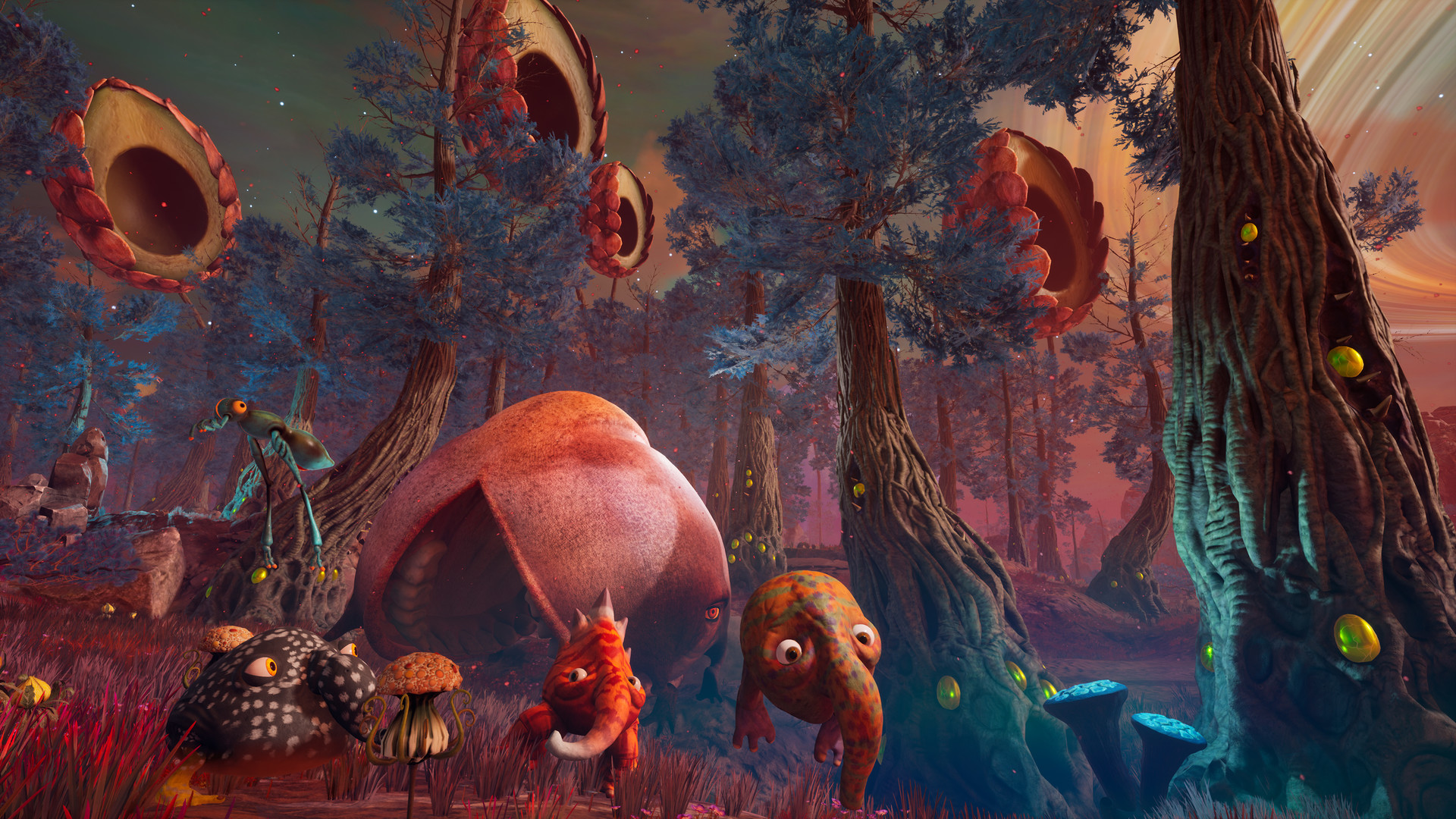
The planet is organized into four major biomes with different visual identities, wildlife and hazards. A frozen region is not simply a familiar white landscape: red, bridge-like structures make it look alien, while later dry environments create different demands for finding and carrying resources. Some transitions blend neighboring regions, so a change in ecology can be gradual rather than a clean level boundary. The setting contains creatures that appear spectacular or dangerous at first glance, and their relationships can matter when deciding whether to approach, avoid or use the environment around them. The Trebhum begin near the bottom of that food chain. Their small size makes a larger creature's movement consequential, and not every obstacle should be treated as an enemy to attack. Foraging is therefore also observation: a plant or animal may provide a useful mutation, be food for another species or signal a route through unfamiliar terrain. The Cylinder changes the meaning of all these discoveries by destroying places behind the player. A grove that offered a resource and a sheltered route is not necessarily available after the family leaves it, making each pause for study an opportunity with an end point.
Ancient sanctuaries add another rhythm to the journey. Their puzzles protect knowledge left by earlier Trebhum generations, so progress can depend on finding an appropriate bodily adaptation or understanding how several creatures and objects relate. A mutation that seems useful only for travel may also provide the shape, reach or grip needed in a ruin. The game mixes these puzzle spaces with open exploration and story fragments rather than presenting one uninterrupted sequence of chase scenes. The towers make that mixture possible: without moments of safety, there would be little reason to investigate a structure or test a strange new trait. At the same time, the presence of the Cylinder prevents the refuges from becoming permanent towns. Once the herd moves beyond an anchor tower, the protection it offered eventually gives way. Puzzles and discoveries thus belong to a moving route through history. The older Trebhum built ways to resist or delay the machine, and the present family can learn from what remains while facing the possibility that even those remnants will be crushed. The broader mystery stays in the background without requiring a late-story explanation in this overview.
The servants of the Cylinder bring a more targeted threat than the machine's broad advance. These artificial creatures move through the natural world and can strip mutations from a Trebhum caught in their searchlight. Losing an adaptation may affect the very ability the family needs for a nearby hazard or puzzle. Predators pose a different problem: their behavior and size can make avoidance, a deterrent mutation or a fast route more important than direct confrontation. A Trebhum can roll, spray water and collect objects even before the herd acquires more specialized traits, but it does not turn into a conventional armed fighter. Survival is about keeping the family together and adapting to a series of spaces with different risks. The player can shift attention between members, and a group with several transformed bodies offers more possible responses than one highly specialized creature. These systems connect the story's idea of family to the moment-to-moment work of crossing the world. Bringing in another Trebhum is not just an increase to a counter: it is another vulnerable body to protect and another place where a useful capability can live.
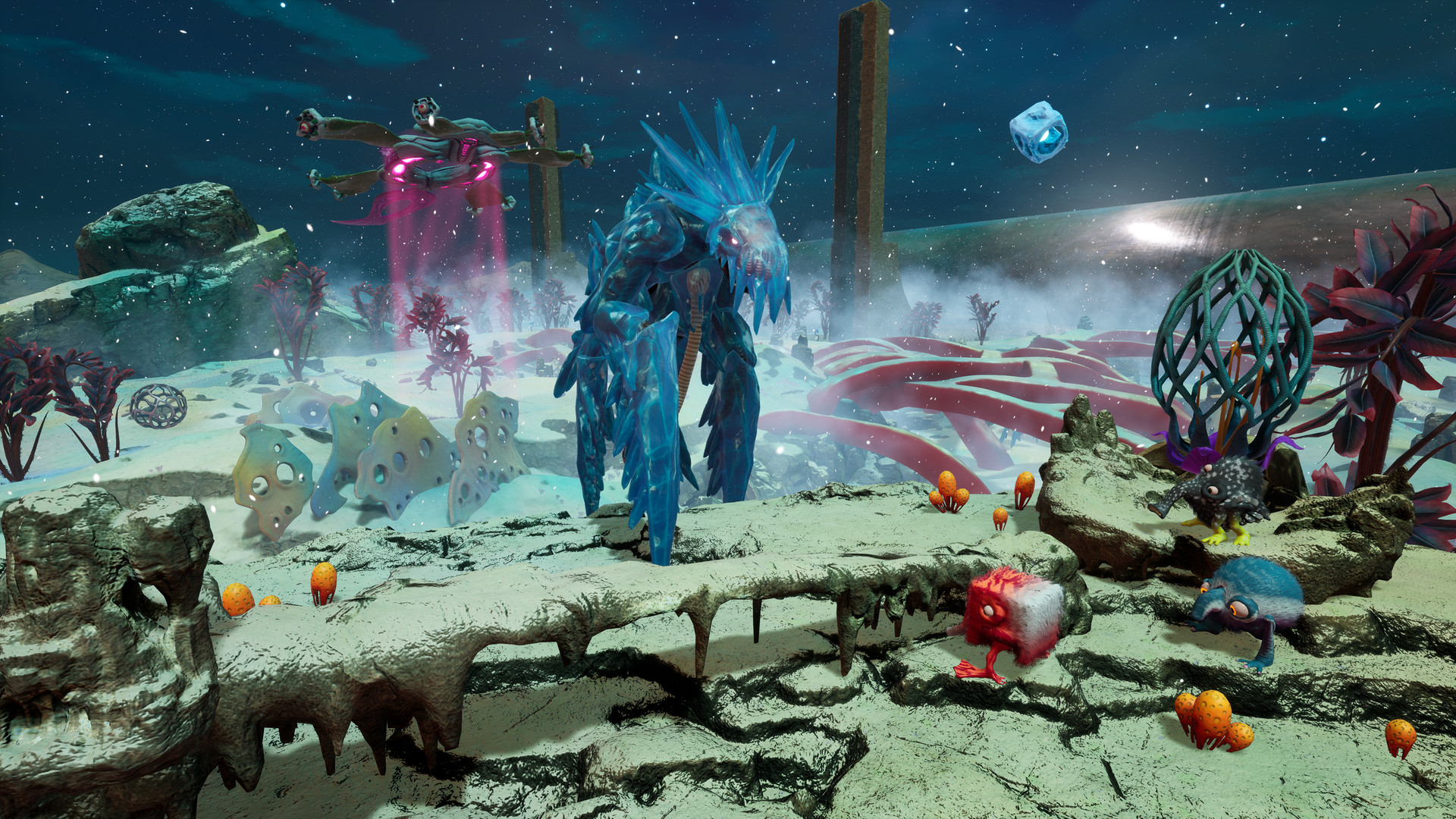
Presentation reinforces the difference between the Trebhum's fragile scale and the extravagant planet around them. The creatures are deliberately rounded and expressive, while the biomes contain unfamiliar shapes, colors and animal silhouettes rather than a straightforward replica of Earth's ecosystems. When the Cylinder moves, its passage changes the terrain: trees fall, hills are flattened and the view behind the herd becomes evidence of what has been lost. The Steam-listed Anniversary Update adds two creatures, a fire-breathing mutation and additional graphics options; those are later additions to the current listed edition, not features that should be assumed to have been present at the original console launch. Beneath the spectacle, the game's defining structure remains a sequence of choices about travel and adaptation. A tower can provide breathing room, a resource can transform a member of the family, and a distant route can become urgent as the red glow advances. The Eternal Cylinder uses those repeating decisions to make a story about survival in a changing world tangible through the bodies the player carries forward.
- Developer
- ACE Team
- Genre
- Third-person survival and exploration adventure