
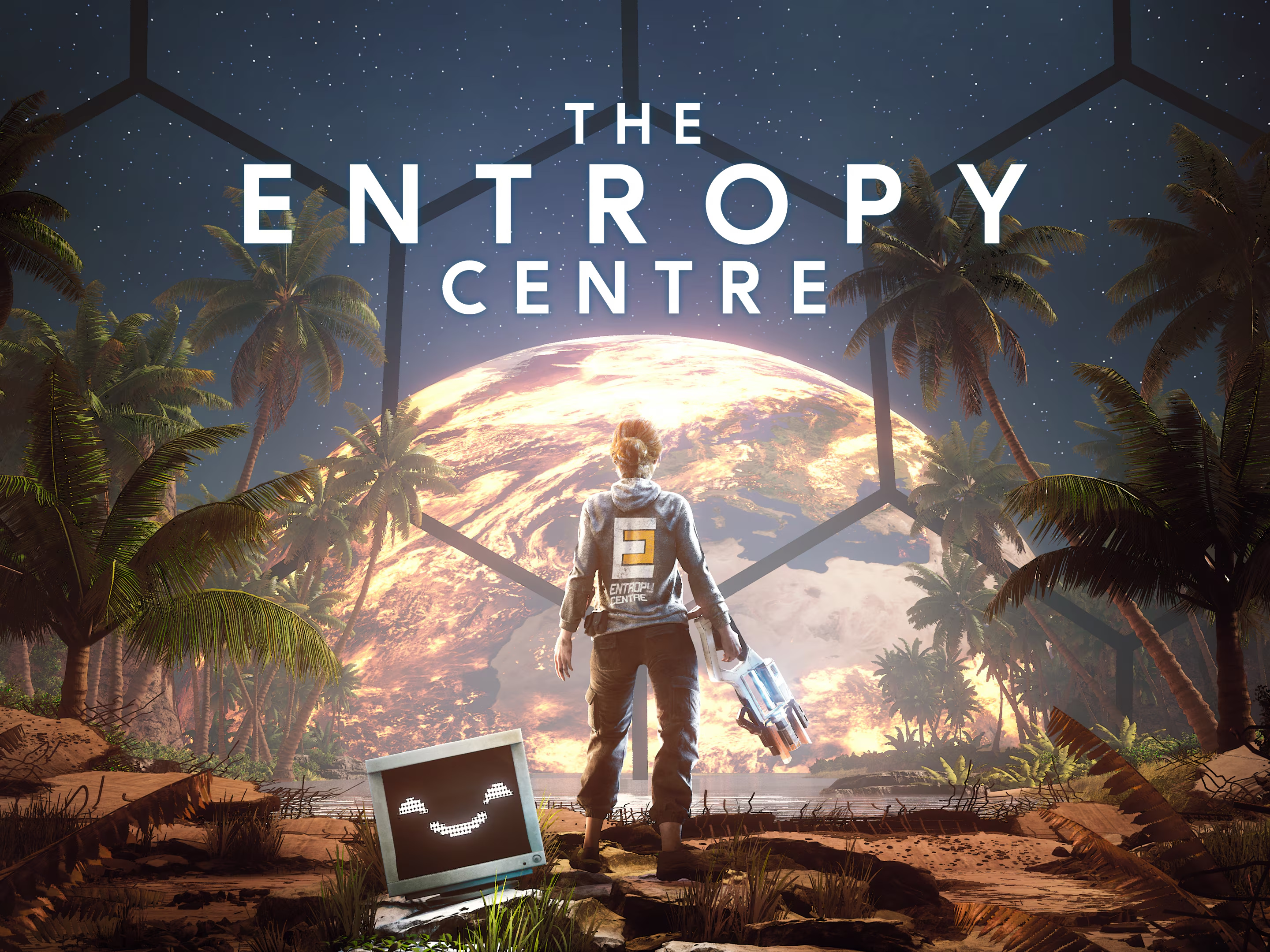
About The Entropy Centre
Aria wakes alone inside an abandoned orbital station as an extinction-level crisis engulfs Earth. With ASTRA, a talking handheld device that rewinds objects through time, she solves puzzle chambers and follows the centre’s records toward its core. Each puzzle asks her to plan in reverse, then use cubes and station machinery to make the sequence work.
The Entropy Centre begins with Aria waking inside a remote facility above Earth, with little immediate explanation for the station’s condition or the catastrophe unfolding below. An extinction-level event has set the world ablaze, and the centre presents itself as humanity’s last chance. Aria’s role is tied to the station’s puzzle chambers: solving them generates the energy needed by the facility, while progress through the complex brings her closer to its core. The campaign frames these rooms as part of a damaged research operation rather than as disconnected riddles. The abandoned corridors, signs of collapse and scattered records gradually supply context for why the centre exists and what happened to its staff. Aria’s route is therefore both practical and investigative: she has to get through the facility’s physical obstacles while piecing together the purpose of the work she has been asked to do. ASTRA, a talking handheld device developed at the station, is her main companion through that process. Their conversations add a personal thread to an otherwise empty environment, while information found on station computers expands the larger crisis. The story’s central question concerns the relationship between the centre’s work, Earth’s peril and the repeated act of solving its tests.
ASTRA is a handheld entropy device that can scan an object’s spacetime chronology and send it backwards along that recorded history. Aria can pick up and move suitable objects, then rewind them so they retrace earlier positions and actions. The effect is different from simply reversing the whole room: ASTRA manipulates individual objects, allowing a cube or other mechanism to travel back through its own recent sequence while the surrounding chamber remains in its current state. This makes ordinary actions useful as puzzle material. Carrying a cube, dropping it onto a switch or letting it move through a space can create the history that Aria later needs to replay in reverse. The device’s interface shows an object’s recorded path, making its past movement part of the information the player can inspect. ASTRA cannot affect living things, and it has limits on what it can manipulate, so the rewind tool does not function as an unrestricted way to undo every event. The challenge is to understand what the device has recorded and how a reversed object will interact with the room. Aria and ASTRA’s exchanges accompany this central tool, giving the player a voiced presence to return to between tests as the station’s story develops.
Each test chamber is built around cause, order and destination. A familiar example is a cube that must weigh down a pressure pad to open a door or activate a lift, but later puzzles ask the same object to serve at several points in a sequence. The player first works out the final arrangement needed to reach the exit, then reasons backwards: which object must be where, what must happen before that, and what actions can create the required rewind trail? In play, those steps still have to be carried out forwards. Aria positions and moves the objects, records their paths with ASTRA, and then rewinds them at the right point so a previous movement places them where the next part of the plan needs them. The rewind can be stopped at a chosen moment, so the object need not return to the very beginning of its recorded history. This creates a distinctive rhythm: inspect the chamber, test a possible chain of actions, read the path the tool displays, and adjust the setup if the object’s timing or position does not fit. Solving the puzzle means arranging a workable chronology, not merely finding a hidden key or activating one switch.
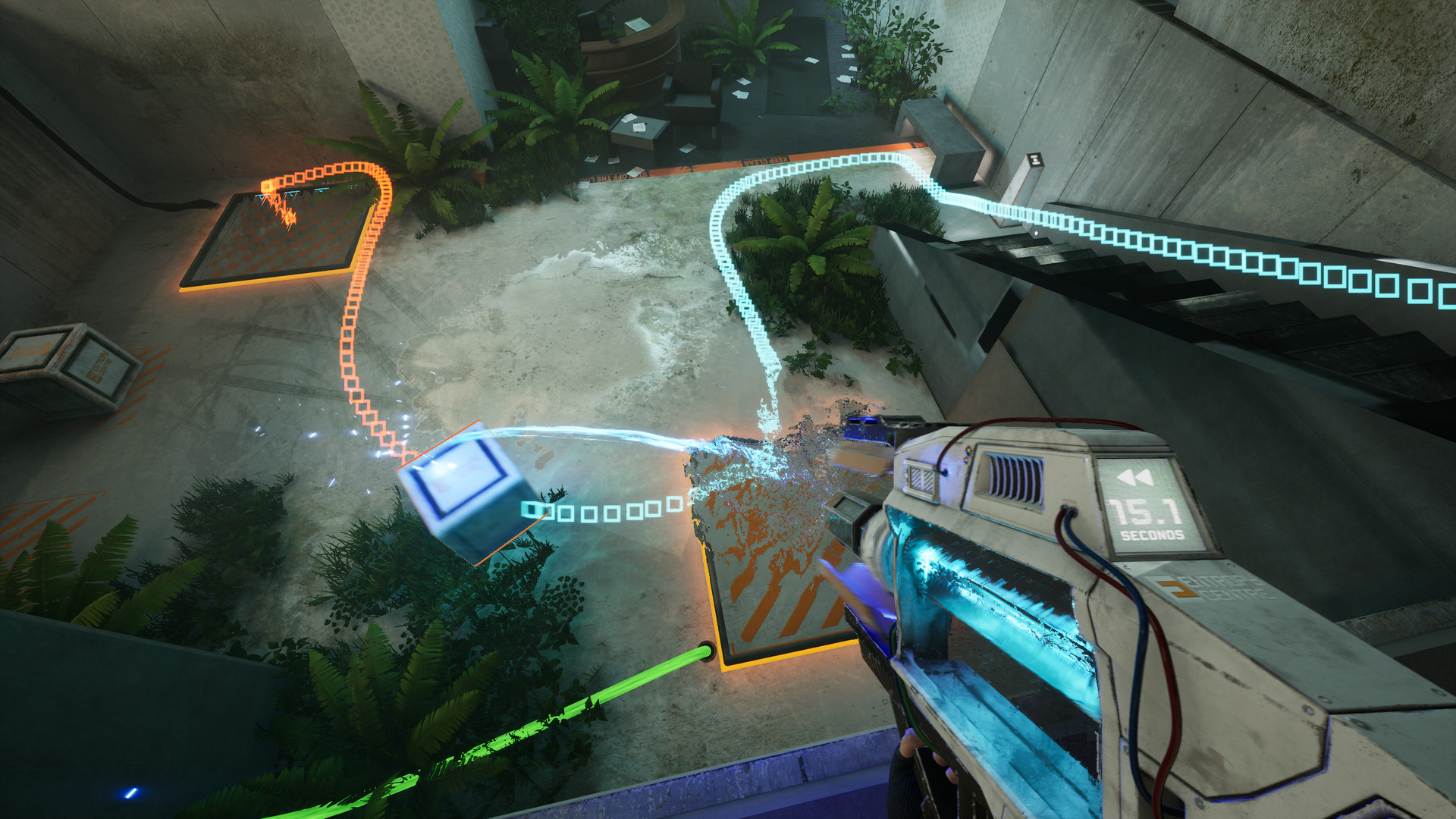
The campaign adds new cube functions and environmental devices over time, then asks the player to combine them with the rewind rules already learned. Basic cubes can act as weights on switches; other types provide a bounce, project a bridge across a gap or direct a laser beam. Their roles change what a room asks the player to plan. A jump cube can help Aria or another object reach a higher platform, while a bridge-producing cube can make a route possible only while it is powered or positioned correctly. As the chamber layouts become more involved, height, gaps, doors and barriers become part of the chronology problem. Some barriers erase an object’s rewind data or destroy cubes that pass through them, requiring Aria to plan where an object’s history must begin and end. New elements are introduced within the campaign and then mixed with earlier ones, so later rooms test whether the player can use several functions at once. The growing complexity comes from coordinating these pieces and their recorded movements across a room, rather than from a separate character-upgrade tree or a collection of weapons. ASTRA’s rewind remains the central rule even as the space around Aria supplies more ways to use it.
Movement through the centre is viewed from a first-person perspective. Between chambers, Aria follows the station’s corridors and connected areas, and within tests she navigates platforms, lifts, gaps and changing machinery. Cubes affect traversal as well as switches: bouncing surfaces can send Aria upward, and rewindable structures can restore a route that has collapsed or shifted out of reach. The player needs to judge where Aria can stand, where a cube will travel and whether a route will remain open after its supporting object is moved. In that way, movement is linked directly to puzzle planning. A cube may need to be carried to a raised ledge, moved across a chasm or passed around a gate before its rewind can complete the route. The station itself also supplies hazards and moments when the environment is unstable, making observation important before committing to a path. The campaign’s exploration is concentrated in this single large facility: laboratories, corridors and chambers all belong to the same crisis-bound complex, with computer records offering optional context alongside the physical route. There is no separate open-world map or unrelated travel system; progress comes from advancing through the centre and learning how its spaces and devices connect.
Most of the campaign’s pressure comes from working out a room’s object sequence, but some sections introduce hostile maintenance or assistant robots and immediate environmental danger. ASTRA can rewind projectiles fired by the rogue bots, turning the same time-manipulation idea toward survival. These encounters require Aria to pay attention to incoming attacks and the position of nearby switches or machinery while still using the device to make progress. Other sequences ask her to move quickly through a collapsing or flooding area, which changes the pace from careful experimentation to escape. These are brief variations within a puzzle adventure rather than a sustained combat system: the game’s main structure remains a chain of chambers where objects, pathways and recorded movement must be understood. The ordinary puzzle rooms generally allow time to observe and retry, while the more urgent sequences make the immediate environment itself the problem. Together, these sections show how the centre’s rewind technology can be used in more than one kind of obstacle, without turning Aria into a conventional armed action hero. Her defining tool still alters the history of objects, and the danger comes from how that ability can be applied under pressure.
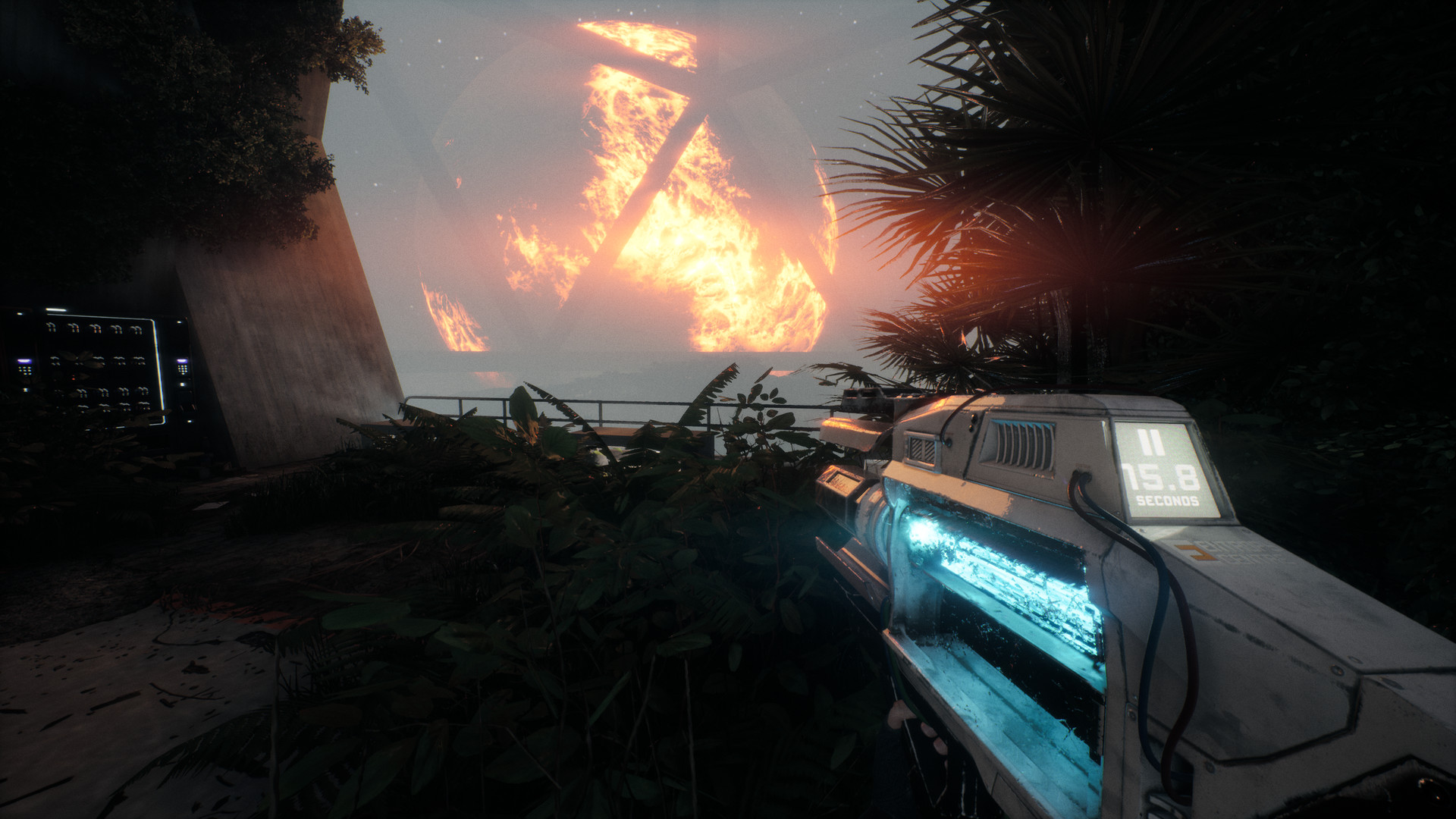
The base campaign follows Aria’s story through the station and its increasingly layered puzzle rooms, with environmental details and computer messages adding to the account of the centre’s purpose. Its visual language makes the devices and their recorded paths legible: colour, motion trails and the placement of cubes help communicate what has happened and what could happen if an object is rewound. ASTRA’s presence supplies commentary during the journey, while the station’s automated announcements and records give the setting additional voices and traces of its former operation. A separate level editor arrived later as a free update for PC players. It provides tools for building and sharing custom chambers using the game’s level-design assets, extending the puzzle format beyond the authored campaign. These community-made levels are user creations and do not form additional chapters in Aria’s story. The distinction matters because the editor changes who can assemble the puzzle spaces and what configurations can be shared, while the base game remains the narrative journey through the orbital centre. The campaign’s progression, character exchanges and Earth-bound crisis belong to that authored route; the editor is a separate creative mode built around the same time-reversal puzzle vocabulary.
- Developer
- Stubby Games
- Genre
- First-person puzzle adventure