
About The Drifter
Mick Carter returns toward his Australian hometown by freight train, witnesses a killing and is murdered himself, only to awaken moments before death. The Drifter follows his investigation into the people and forces behind the attack through brisk point-and-click puzzles, tense set pieces, and a conspiracy entangled with his past.
Mick Carter has spent years drifting between jobs and places, and the journey back toward his old Australian hometown begins with a freight train rather than a settled return. On the way, he witnesses a brutal killing, attracts the attention of technologically equipped pursuers, and is thrown into a reservoir to drown. His consciousness then returns to his body seconds before death, an impossible reprieve that becomes the central disturbance in the story. The immediate problem is survival and the murder for which he is blamed; the wider mystery draws him into a conspiracy involving shadowy corporate power and a man’s thousand-year obsession. Mick’s estrangement from home and his unresolved history make the investigation personal as well as dangerous. The plot moves through thriller, science-fiction and horror territory, but its premise is delivered through Mick’s practical viewpoint and a darkly comic tone. New information repeatedly changes the meaning of the danger around him, so the narrative advances in sharp turns rather than through a detached lore dossier. The story’s scale grows from a witness being hunted into a question about why Mick can return from death and what the people pursuing him want.
Mick is not a trained detective with a specialist toolkit; he is a resourceful drifter who notices things and makes do with objects at hand. That practical characterization shapes how scenes are solved. Conversations can identify a person, place or device that matters, while examining the environment helps turn an apparent obstacle into a sequence of workable actions. The cast includes people caught up in the events and figures who know more than they initially reveal. The game’s description identifies a corrupt neurosurgeon and a journalist among the encounters that complicate Mick’s route, and dialogue is often a necessary part of finding a useful next step. Mick’s voice and reactions keep the story grounded even when its threats become extreme. The player is asked to listen for implications, return to a subject with new evidence, and use a clue in the right context rather than selecting dialogue as a simple morality test. Exchanges contribute to investigation and characterization at once. The focus remains on following Mick’s circumstances and the shifting relationships around him; conversation works as a clue-finding and scene-progression tool.
The Drifter is a two-dimensional point-and-click adventure built to keep movement between story beats brisk. On a mouse, the player identifies points of interest and directs Mick through illustrated spaces; with a controller, the game uses a twin-stick scheme designed for the same kind of room-scale exploration. It is a single-player experience whose main loop is to scan a scene, inspect people and objects, collect useful items, and connect them to a problem. The interface supports noticing what can be interacted with, while character animation makes actions legible: Mick’s posture, movement and responses carry information about what he is doing. Rather than ask the player to roam an enormous map, the game moves between tightly authored situations. A clue or completed task opens the next location or beat, and the pacing narrows the time spent wandering without purpose. The twin-stick control is an alternative way to perform point-and-click interaction, not a separate action mode. This allows the game to stage moments of urgency inside an adventure structure while retaining observation and object use as the core means of progress.
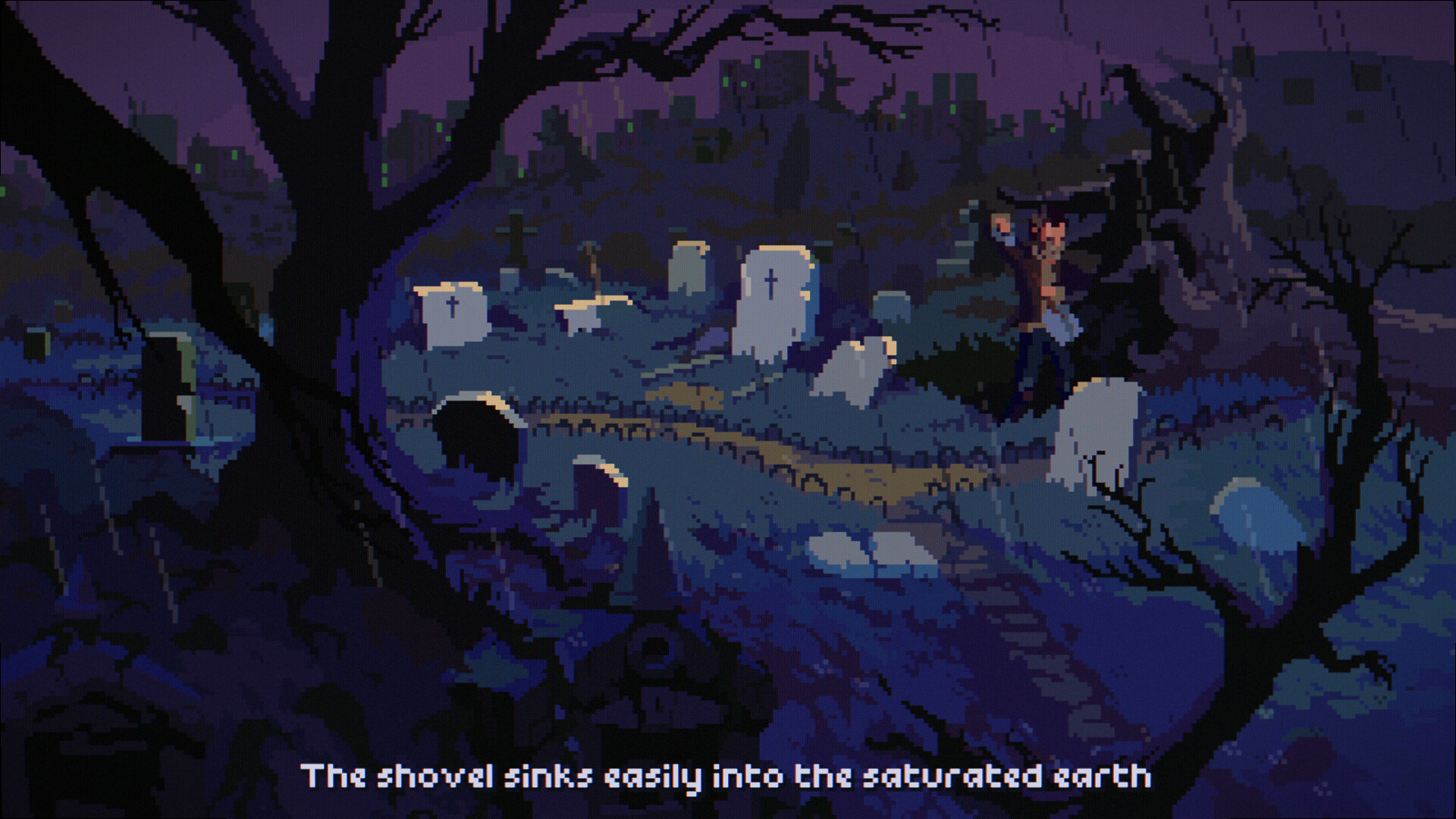
Puzzle solving centers on practical, contextual actions. The player examines objects, picks up tools or materials and uses them on environmental obstacles; some solutions require assembling an improvised device from ordinary components. The developer frames Mick as a practical person and the puzzles as grounded rather than arbitrary, and the store description gives examples such as making a firebomb from a bottle of strong rum. These actions sit alongside information gathering: questioning a suspicious person, finding what a location conceals, or using one discovery to make another interaction possible. The puzzles are organized around the current situation, so progress usually depends on understanding the local problem instead of carrying an inventory full of unrelated objects across a large world. That design helps the story move quickly from one predicament to another. A solution may also act as a transition into a more dangerous scene, blending adventure-game reasoning with thriller staging. The central loop stays with observation, conversation and practical improvisation, with Mick solving a predicament through what he finds and learns in the scene.
The return-from-death premise is also a structural device for escalation. Mick’s first reprieve does not make him invulnerable in a conventional combat sense; it establishes a mystery and lets the story place him in perilous circumstances without removing the threat. The developer describes the plot as a fast-moving chain of conspiracy, murder and an ancient obsession, while the store text emphasizes that Mick is repeatedly pulled from one crisis into another. The adventure is divided into connected dramatic situations in which solving the immediate obstacle reveals a fresh question. Exploration is therefore focused and purposeful: search the space for an actionable detail, talk to the person who can contextualize it, then use the result to proceed. This is not presented as an open-world investigation or a branching role-playing campaign. The player’s progression is primarily narrative and puzzle-based, with new scenes and revelations supplying the sense of advancement. The source of the larger threat remains a question as Mick moves between crises, and his inexplicable return from death keeps the conspiracy tied to his own fate.
The presentation combines raw, sharply defined pixel art with high-impact animation, professional voice performances and a dark synth score. These elements serve a pulp-thriller rhythm: still scenes allow the player to inspect a place, while animated gestures and sudden events give danger a physical presence. The pixel scale does not mean the characters are static; movement and expression are central to how Mick’s predicament is communicated. Audio adds another layer through voiced dialogue and a cinematic musical bed, supporting both conversational investigation and tense transitions. The art and sound also let the game move between grim situations and dry humor without changing its basic visual language. The Melbourne studio Powerhoof identifies The Drifter as a single-player point-and-click adventure and offers mouse and controller interaction, including its distinctive twin-stick control. Those facts define the profile’s mechanical scope. The story includes horror themes, pixelated violence and mature subject matter; some dialogue is wry, but the overall presentation remains a dark thriller. Its presentation is authored around Mick’s increasingly strange circumstances and the pace of his investigation.
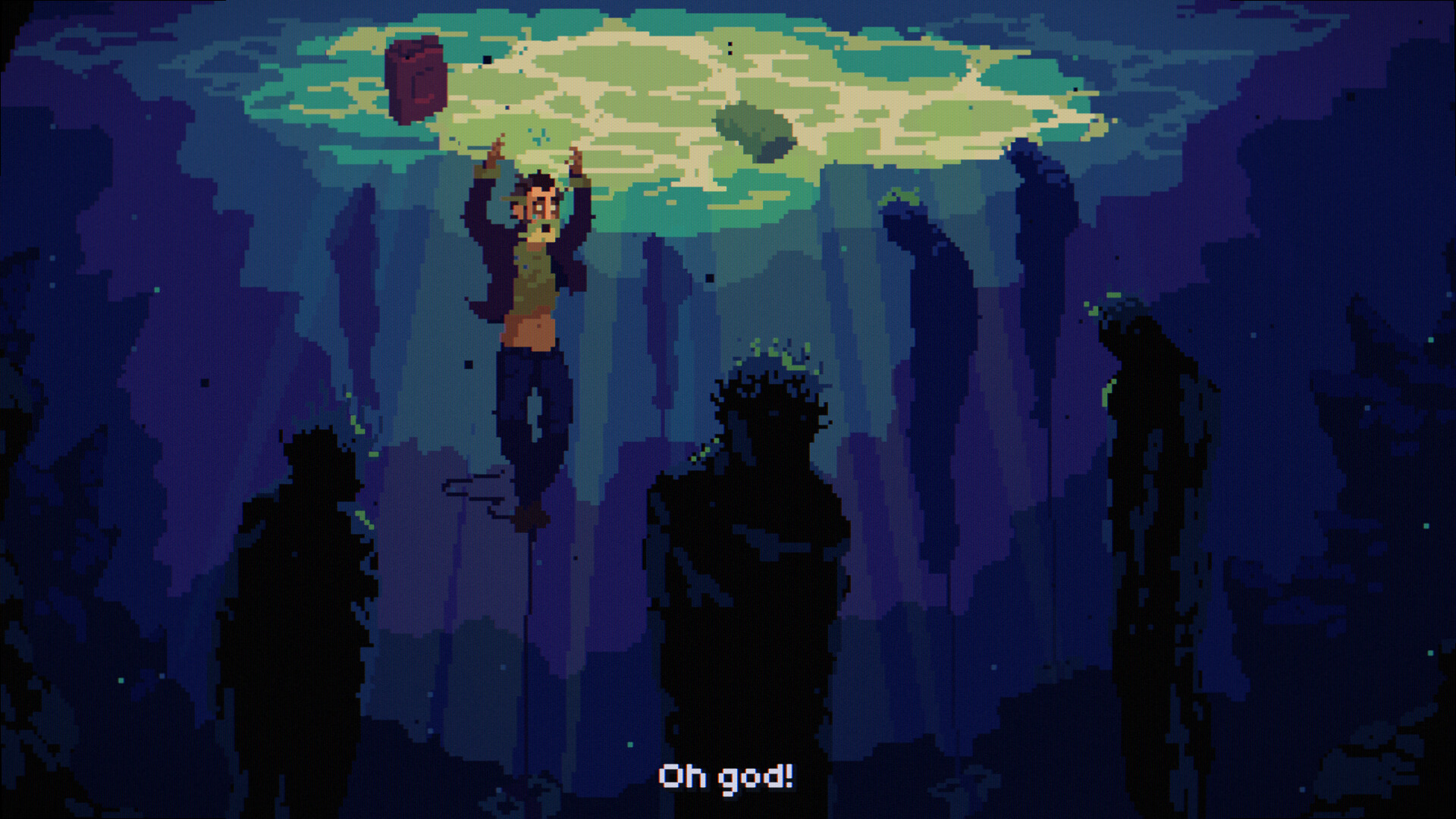
Powerhoof developed and published The Drifter for Windows, macOS and Linux, with later Nintendo Switch and Switch 2 releases also listed by the Melbourne studio. Mouse-driven point-and-click play and the controller’s twin-stick scheme serve the same single-player thriller rather than separate campaigns. Mick’s practical problem solving remains constant as the game moves from the freight train and reservoir into further scenes of pursuit and investigation. Each new location poses a local obstacle, and its answer opens another part of the mystery surrounding the killing and his impossible survival. Voice performances, detailed pixel animation and a dark synth score keep that movement immediate: a conversation can deliver a lead, a small object can become an improvised solution, and a sudden event can change the stakes of the next scene. The premise offers the return from death as a question for Mick to investigate, giving the brisk adventure its continuing thread without disclosing the conspiracy’s resolution.
- Developer
- Powerhoof
- Genre
- Single-player point-and-click pulp thriller adventure