
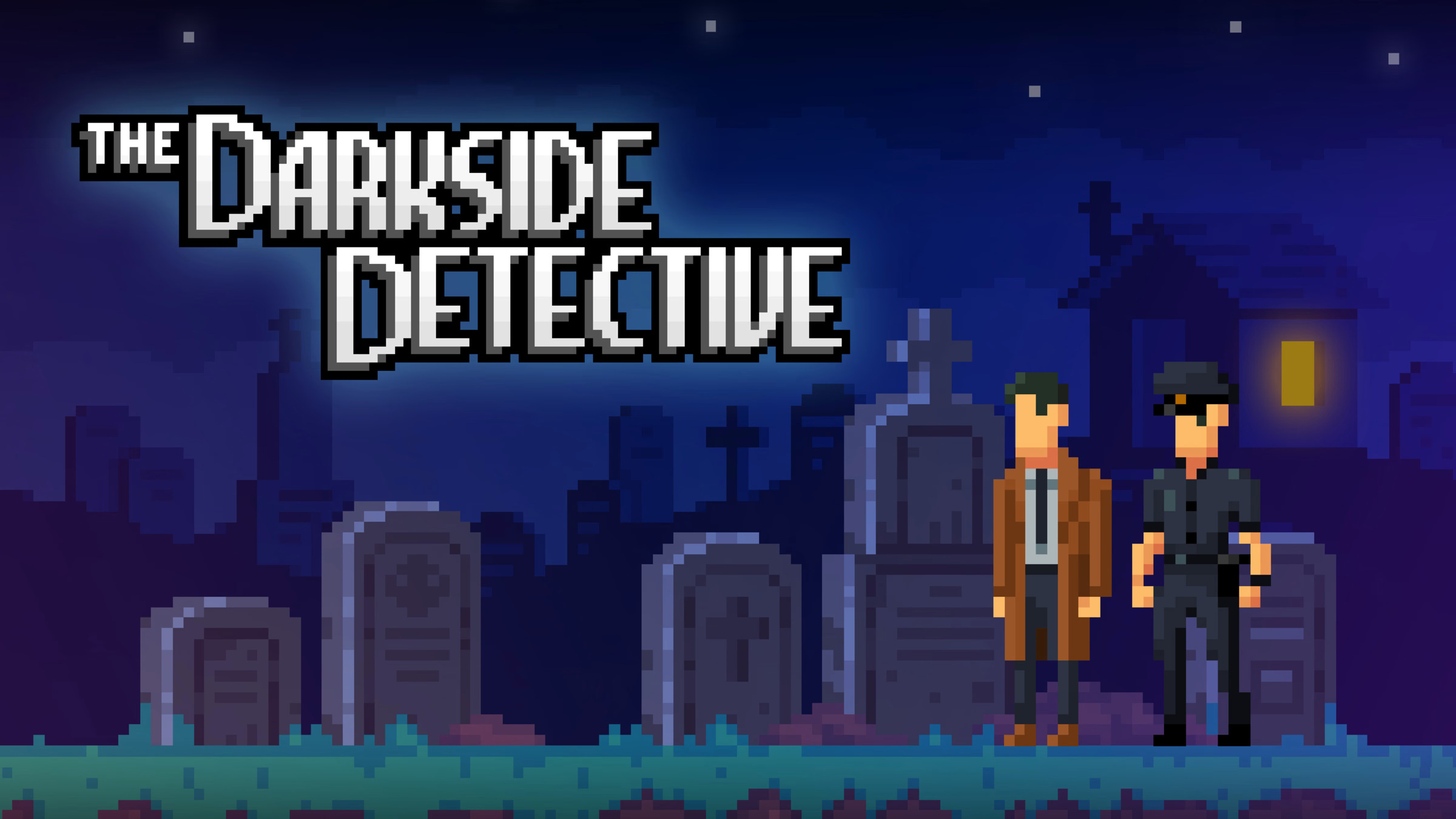
About The Darkside Detective
In Twin Lakes, Detective Francis McQueen leads the underfunded Darkside Division, investigating occult disturbances that range from dangerous entities to inexplicable everyday oddities. With Officer Patrick Dooley alongside him, McQueen examines locations, questions residents and combines clues across a sequence of compact point-and-click cases. Each case pairs supernatural mysteries with the city’s mundane routines and comic sensibility.
Twin Lakes is a recognizably ordinary city with an unreasonable number of occult interruptions. Francis McQueen heads its poorly funded Darkside Division, a small police unit assigned the incidents that sit outside routine law enforcement: strange creatures, cursed objects, suspicious gatherings and disturbances that most residents either overlook or explain away. Officer Patrick Dooley accompanies McQueen through much of this work. Their partnership gives the cases a steady two-person frame: McQueen is the investigator who takes the assignment seriously, while Dooley’s presence supplies a second voice and an often unhelpful angle on what they see. The setting is not a continuous open world or a single escalating conspiracy. Instead, the game treats Twin Lakes as a town whose different corners can briefly become sites of supernatural trouble. A case might begin with a local report and move through a handful of relevant places before its immediate problem is settled. That structure lets the paranormal sit beside ordinary civic life—shops, public buildings and familiar city spaces—rather than replacing it with a remote fantasy realm. The result is a serial mystery built around local incidents and the detectives who keep being called to them.
The investigation is organized as a collection of short, self-contained cases. Each gives McQueen a defined problem to look into, with its own locations, characters and supernatural premise; the cases do not require one long crime narrative to make their basic situations understandable. The Steam edition presents the complete first-season collection and includes a Christmas special among its nine paranormal micro-cases. That episodic format affects how the player approaches the story: a new case resets attention around a fresh situation, while recurring figures and the familiar city establish continuity across the set. Dooley is a regular companion, but residents and other people encountered in a case have their own reactions to the odd events, and conversations help establish what has happened and what remains unexplained. The humor comes through the gap between the seriousness of police procedure and the bizarre things the division is asked to investigate. Even when a case involves occult danger, the characters continue to treat it as an awkward piece of local work. Each episode therefore balances a compact mystery with the continuing relationship between the two detectives and the city they serve.
Play takes place on illustrated, mostly fixed scenes. The player moves a cursor around a location, selects people and objects, reads dialogue, and follows exits to connected screens. Searching is the basic form of exploration: inspect the visible details, speak with anyone who can clarify the situation, collect useful objects and test those objects against the environment. The scenes are deliberately bounded, so the task is to understand the small space currently under investigation rather than roam a large map. Items collected during a case can be examined and used on people or environmental hotspots, and some puzzles depend on recognizing which object belongs with which obstacle. Dialogue is not merely decoration around the object puzzles; it can reveal context, introduce a new lead or make an otherwise ordinary detail meaningful. The interface keeps attention on the scene and its clickable elements, with no separate character-control traversal system to master. The player’s movement between rooms is handled through scene exits, and the investigation’s progress comes from connecting details inside the current case. This makes close observation and trying plausible interactions the main tools for advancing.
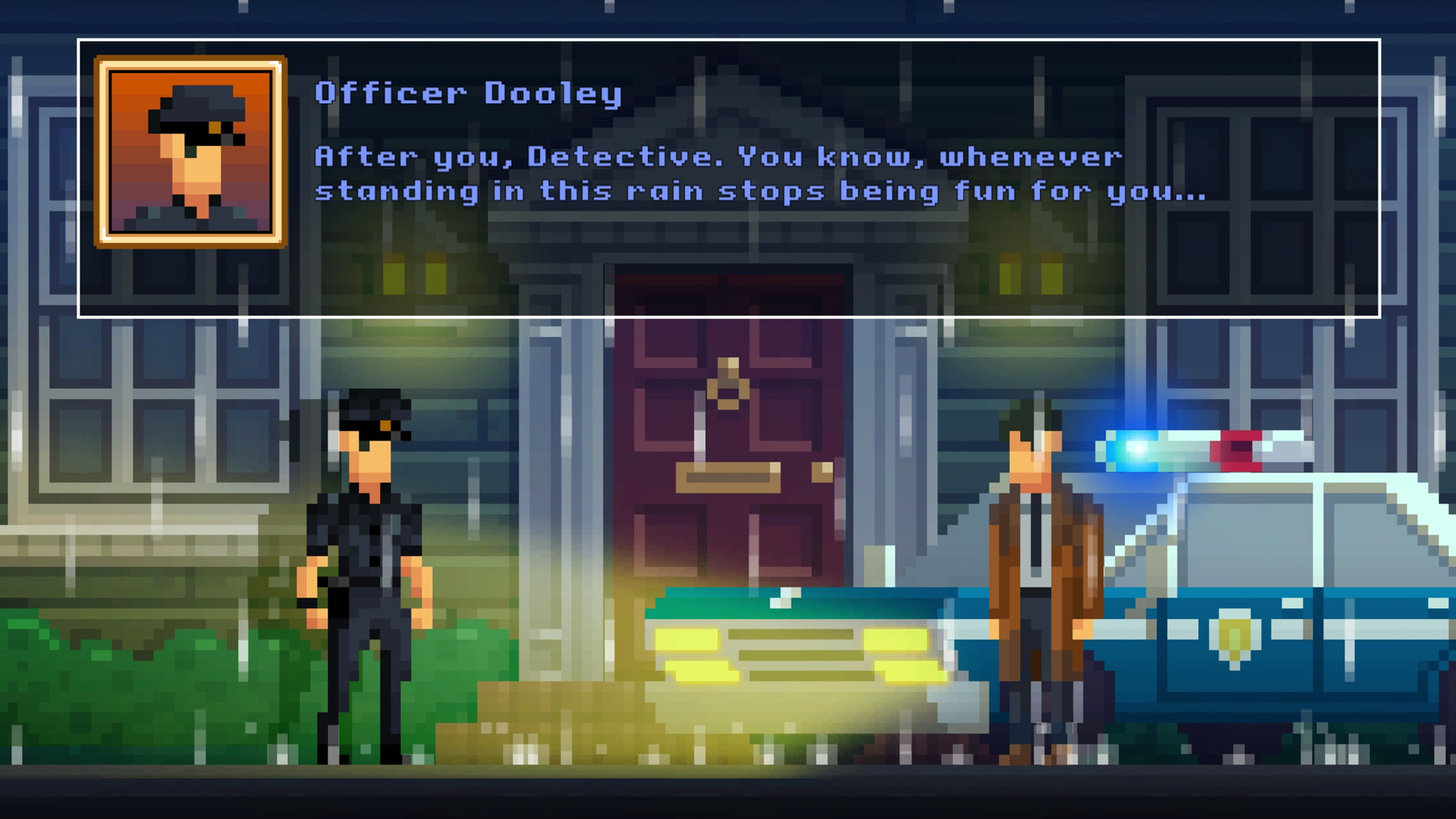
The puzzle loop links observation, conversation and inventory use. A clue may be a prop that can be picked up, an environmental feature that changes what can be done in the room, or a person whose dialogue supplies a missing piece of context. Combining or applying an item can open another interaction, and the resulting response often signals how the case has changed. The short scope of each investigation keeps the inventory and current objectives tied to its immediate problem, rather than asking the player to carry a large set of unrelated objects across an entire campaign. McQueen and Dooley’s comments also form part of this feedback: their reactions can point toward a possibility or underline the absurdity of a situation without turning the game into a formal evidence-board deduction system. There is no weapon-focused combat loop, character build, or conventional leveling track. The challenge is principally to notice what matters and infer a workable interaction from the scene and the people in it. Case completion moves the player to the next episode in the collection; the available material describes progression through investigations rather than equipment upgrades or a branching skill tree. A later case may broaden the scale or strangeness of the problem, but each remains a discrete detective assignment.
The supernatural incidents supply variety while the familiar case format gives the player a stable way to approach them. Twin Lakes can contain occult entities, bizarre objects or situations that would be impossible in an ordinary police report, yet the player still investigates by entering a scene, checking its objects, speaking to witnesses and solving a local puzzle. The design does not ask the player to control McQueen through action sequences or fight enemies in real time. Instead, the strange threat becomes a reason to look more carefully at a room and work out what its inhabitants have missed. Some episodes include small interactive variations or unusual set pieces, but these sit within the point-and-click case structure. The city itself serves as connective tissue: the detectives move between a range of civic and domestic environments, and the repeated return to the Darkside Division gives the collection a loose home base. This rhythm makes the game’s supernatural premise legible without turning every case into a mechanically different genre. The mysteries are primarily solved by investigation and interaction, with the paranormal content changing what must be understood rather than introducing a separate combat system.
The visual presentation uses low-resolution pixel art and fixed compositions, with objects and characters placed so that each screen reads as a compact stage for the current exchange or puzzle. The limited scale of the imagery is part of the game’s identity: a room can be understood quickly, while its pixel details still give the world a retro adventure-game texture. Dialogue boxes and character portraits carry much of the characterization, which suits a game where conversations are central to learning about a case. The writing places dry exchanges and pop-culture-aware humor alongside monsters, ghosts and other occult material. That contrast is structural as well as tonal: the supernatural may be serious within a case, but McQueen and Dooley remain recognizably local detectives rather than epic fantasy heroes. The score is by Ben Prunty, whose music is identified on the Steam page as part of the game’s feature set. The combination of restrained pixel scenes, text-led interaction and a composed soundtrack keeps attention on the cases, their comic dialogue and the odd details embedded in Twin Lakes. It does not rely on a cinematic camera or realistic movement to make its locations distinct.
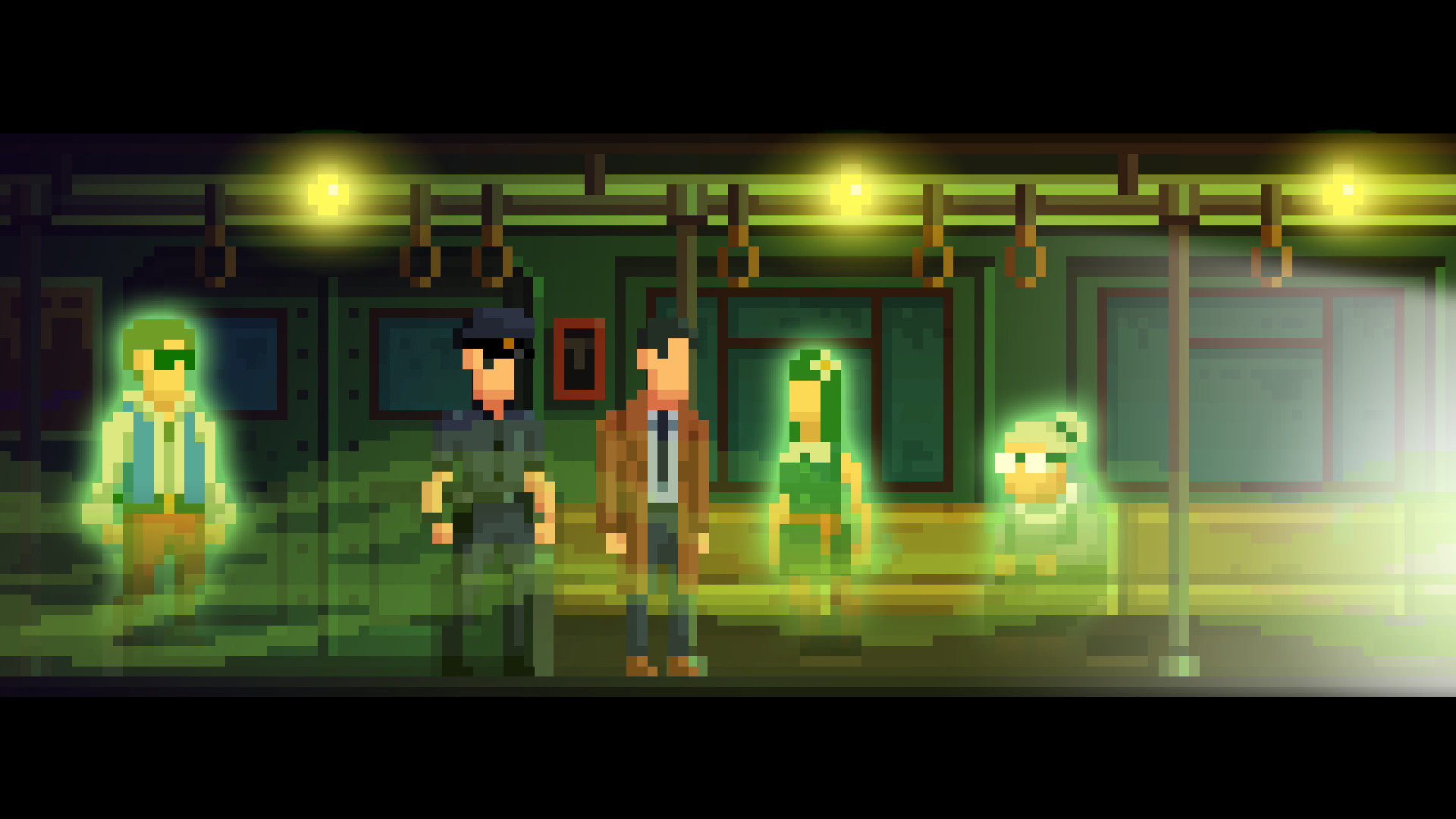
Nine short cases give Twin Lakes room to change without losing the detectives who make it familiar. McQueen and Dooley can step from a routine call into a confrontation with something absurd or frightening, then return to the practical business of interviewing people and making sense of objects in a room. The Christmas special belongs to this first-season collection; the sequel, A Fumble in the Dark, tells further cases separately. That boundary is useful because the original game has its own rhythm: a mystery starts, the city supplies a fresh set of suspects and jokes, and a compact chain of observations and object puzzles brings the case to a close. The player is asked to notice details and follow conversations, while the detectives' working relationship gives each odd report a recognizable point of view. The supernatural is a continuing problem for Twin Lakes, but the immediate pleasure of the first game lies in treating each new disturbance as another case worth investigating.
- Developer
- Spooky Doorway
- Genre
- Point-and-click supernatural adventure