

About The Crimson Diamond
The Crimson Diamond sends Nancy Maple, an aspiring geologist working at a Toronto museum, to investigate a huge diamond claim near an abandoned Ontario mining town. At Crimson Lodge, observation, conversation, typed commands and careful listening matter more than speed. Its sixteen-colour mystery asks what the guests know, what the rock might prove and whose interests the discovery would serve.
Nancy Maple is working as a clerk at the Royal Canadian Museum, but she wants to study geology and mineralogy. A report of a huge diamond found near Crimson, an almost deserted mining town in northern Ontario, gives her a chance to prove she belongs in the field. The assignment sends her away from Toronto and into a place with a past: Crimson once depended on mineral extraction, but most of its people have gone. The remaining lodge and its visitors are suddenly important because a valuable claim could change who owns the land, who stands to gain and who is believed. Nancy arrives as a novice investigator with a scientific question, then finds herself drawn into the human questions surrounding it. The Crimson Diamond is a mystery adventure in which the first task is to understand the setting and the people occupying it. Its title promises a stone, but the game is equally interested in the reactions that a rumour of such a stone produces. A former mining town makes that rumour consequential. The possibility of renewed wealth is not abstract to people whose livelihoods and family history are tied to the place. Nancy's own need to demonstrate her competence also colours the investigation. She is not a detached detective who has wandered into a case by chance; the answer could affect her future as well as the future of Crimson.
Most of that inquiry happens around Crimson Lodge and its surrounding wilderness. Rooms offer places to search, objects to inspect and people to question, while the relationships among the guests give ordinary details a second meaning. Eavesdropping can reveal a side of a conversation that someone would not share directly with Nancy. A character who seems merely hospitable, guarded or distracted may be responding to an older conflict about the lodge or to the new possibility of a diamond. The player has to listen, connect details and return to subjects once more information is available. This is not structured as a succession of action scenes that announce each discovery with a burst of spectacle. The store description emphasizes reading and engagement with the story, and the detective work is built around noticing what a person says, what they avoid saying and what the physical surroundings suggest. Hidden areas and items broaden the investigation beyond a single interview room. Nancy's scientific reason for visiting is never far away, but a claim about a mineral is also a claim made by particular people in a particular place. Looking at the lodge carefully can clarify what a guest may have to lose even before the truth of the diamond is known.
The interface asks the player to use words as investigative tools. The Crimson Diamond draws from the old text-parser adventure tradition: instead of selecting every action from a fixed row of on-screen icons, the player types commands to look, ask, use and examine. The official store describes the result as an EGA text-parser mystery. An early developer manual details the distinction between looking around and examining a particular thing, as well as a notebook that tracks what Nancy still needs to understand. Its demo-era control notes also describe keyboard movement and a click-to-walk option. Those notes are useful for understanding the game's intended approach, though the earlier manual should not be treated as a guarantee that every control or room remained identical in the completed release. What matters to the overview is the interaction model: the player must decide what deserves attention and put that idea into a command. Trying a different question can be as meaningful as finding a different key. The parser makes investigation feel less like checking every available hotspot and more like articulating a suspicion. It can reward curiosity about a small detail because asking about that detail is itself an action.
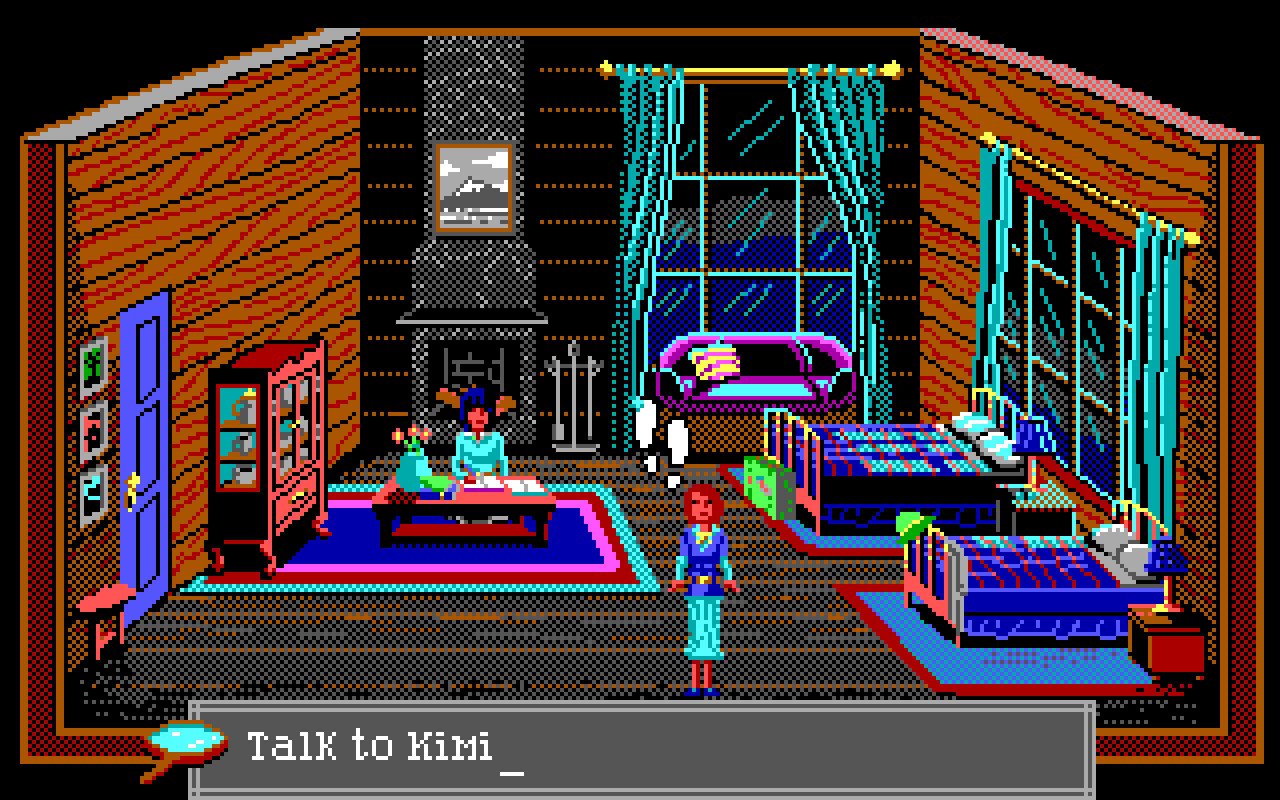
Nancy's situation gives those actions a purpose beyond solving a contained puzzle. She is a woman seeking further study in a field whose gatekeepers have not been eager to accept her. The chance to examine an extraordinary claim offers a possible route to recognition, yet the lodge is full of people who may underestimate a young museum clerk. She must earn information through observation rather than rely on an official title to compel cooperation. The older manual frames her as observant and inquisitive, with a desire for proof strong enough to stand up to doubt. The full game's store description carries forward her ambition to study geology and mineralogy. The writing can therefore place her scientific interest beside her detective instincts without pretending the diamond is only a plot device. Mineral claims can invite hopeful speculation, expert authority, family dispute and opportunism. Nancy's questions about what was found cannot be separated from questions about who found it and why their account should be trusted. The game lets her piece together an understanding of that social field through talk and exploration. The player is not required to know advanced geology before entering the lodge, but the subject gives Nancy a credible reason to keep examining the evidence.
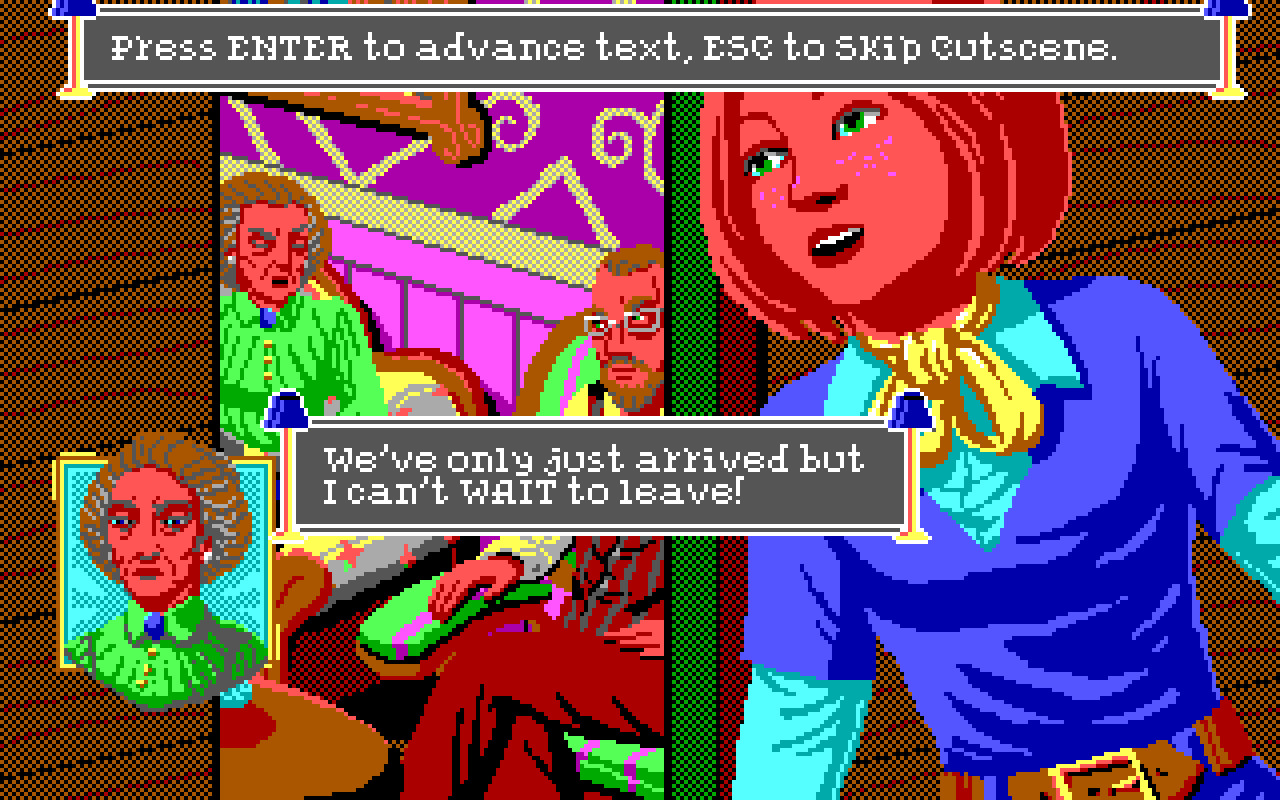
Its visual identity is deliberately drawn from sixteen-colour EGA computer games. Bright, sharply limited colours describe rooms and characters with the compact precision of an older graphic adventure. Julia Minamata has said the project began with her wish to recreate the pixel-art look of the Sierra games she loved. She first made rooms; those spaces became Crimson Lodge, and only then did she work out who might live there, who would visit and what conflicts would follow. The developer also drew on mineralogy, Ontario history and mystery fiction while giving the lodge a believable reason to exist beyond the immediate case. That process helps explain why the setting feels integral to the premise rather than a backdrop placed behind a generic whodunit. The period style is carried by the music as well. Dan Policar composed the score, which Minamata describes as selective rather than a constant layer under every conversation. Quieter stretches give the player room to read and think, while musical cues can mark a shift in tone. The result is a mystery whose appearance and interface acknowledge an older game tradition, but whose particular place, scientific subject and protagonist give it its own identity.
Minamata has described the intended tone as a cozy mystery: bad things may happen and characters can be in conflict, but the game is concerned with curiosity and suspense rather than relentless shock. Its pace leaves room to explore, take notes and consider why someone might have given a particular answer. The investigation remains open enough that details beyond a bare route through the plot can matter to an understanding of the people involved. The Crimson Diamond was designed, programmed, illustrated and written by Minamata, who also published the completed game in 2024. The finished release is separate from an earlier playable demo and its manual, so this account avoids promising every detail of that preview as a final-game feature. What carries across the available material is the core invitation: go to Crimson, test the diamond claim, listen to the lodge's occupants and decide what the evidence means. Nancy begins with a professional ambition and a mineralogical puzzle, then has to read a community shaped by a depleted mine and a sudden possibility of wealth. The exact answer, and what it means for the people gathered there, belongs to the mystery itself.
- Developer
- Julia Minamata
- Genre
- EGA-style text-parser mystery adventure