
About The Cat Lady
Susan Ashworth has withdrawn from other people and lost hope for her future. The Cat Lady takes her from a crisis in her ordinary life into encounters with five dangerous strangers known as the Parasites. This psychological horror adventure moves between living and dead worlds through conversation, investigation, inventory puzzles and an unlikely friendship.
Susan Ashworth is forty and profoundly alone when The Cat Lady begins. Her neighbours know her by her cats, but that label says little about the depression and isolation that have overtaken her daily life. At the edge of suicide, she is drawn into a sequence of events involving five strangers whom the story calls the Parasites. They are not an abstract collection of obstacles for an armed hero to clear. They are dangerous people whose presence makes an already difficult return to ordinary life still more precarious. The game follows Susan over a period of weeks rather than carrying her across a vast fantasy map. A home, a street or another apparently familiar interior can become frightening through the person who occupies it or the memory attached to it. Her journey also crosses between the worlds of the living and the dead, so a scene may resist an explanation based on everyday reality alone. These two scales—the intimate difficulty of facing another day and the grotesque threat of the Parasites—remain connected. The premise does not treat Susan's suffering as a mere pretext for a monster hunt; it gives her reluctance to trust and the possibility of a new friendship space alongside the horror.
A player guides Susan through side-on scenes with the keyboard. The official manual describes the basic rhythm precisely: arrow keys move her and cycle through available choices, and Enter confirms an interaction when she stands near a highlighted person or object. She can examine what is there, talk to someone or open her inventory and try an item against something in the room. The controls matter because this is not a game of sweeping a mouse cursor across every painted surface until a hotspot lights up. Susan's position in the space determines what can be addressed, and walking into an area can itself trigger an event. Remigiusz Michalski, the game's creator, singled out that kind of region-triggered moment as a reason for choosing this interface. It allows a shift in the story to occur through movement as well as through an explicit command. The player therefore has to read the environment in two ways: as a collection of objects that may prove useful and as a place in which taking one more step might change what is happening. Conversation, looking closely and testing a connection between an item and its surroundings carry the investigation forward.
The Parasites bring a human threat into a story that also moves through uncanny places. Susan cannot simply fight them as a conventional action protagonist. The GOG account of her situation stresses that she has never used a gun and has little confidence in either other people or herself. That vulnerability shapes the puzzles: a solution is more likely to depend on noticing an opportunity, understanding another person's behaviour or combining an item with the right circumstance than on raising an attack statistic. The game still changes pace. Michalski describes passages of dialogue giving way to puzzle sections and occasional action-like scenes, including a small number of surprising quick-time events. Those interruptions should not be mistaken for a separate combat campaign. They sharpen moments of danger within a primarily narrative adventure. Nor does every encounter take place at the same emotional pitch. A conversation may give Susan information, expose a person's cruelty or offer the first possibility that someone will stay with her. The contrast between those exchanges and a sudden frightening event gives the five strangers their force without requiring their identities or later actions to be disclosed before a player meets them.
Each chapter has its own locations and narrative character, according to the creator, with sudden shifts that prevent the whole story from feeling like a single repeated corridor. The movement between living and dead worlds is part of that change of ground. A place Susan might recognize can lead toward imagery that belongs more naturally to a nightmare, while an otherworldly passage can throw an ordinary human relationship into sharper relief. The progression is authored, but the player has to participate in making sense of it. Interactions may require taking stock of what Susan carries, returning to someone with new information or recognizing that a detail encountered earlier has acquired another use. The manual's simple inventory system supports this without asking the player to manage weight limits, equipment tiers or crafting materials. Open the inventory, cycle through items and try a selected object near something highlighted. Saving and loading are available through the options menu, so a player can preserve a point before continuing through a difficult scene. These systems keep attention on Susan's circumstances: her tasks are to navigate situations, understand people and survive what her journey places in front of her, not to develop a combat build.
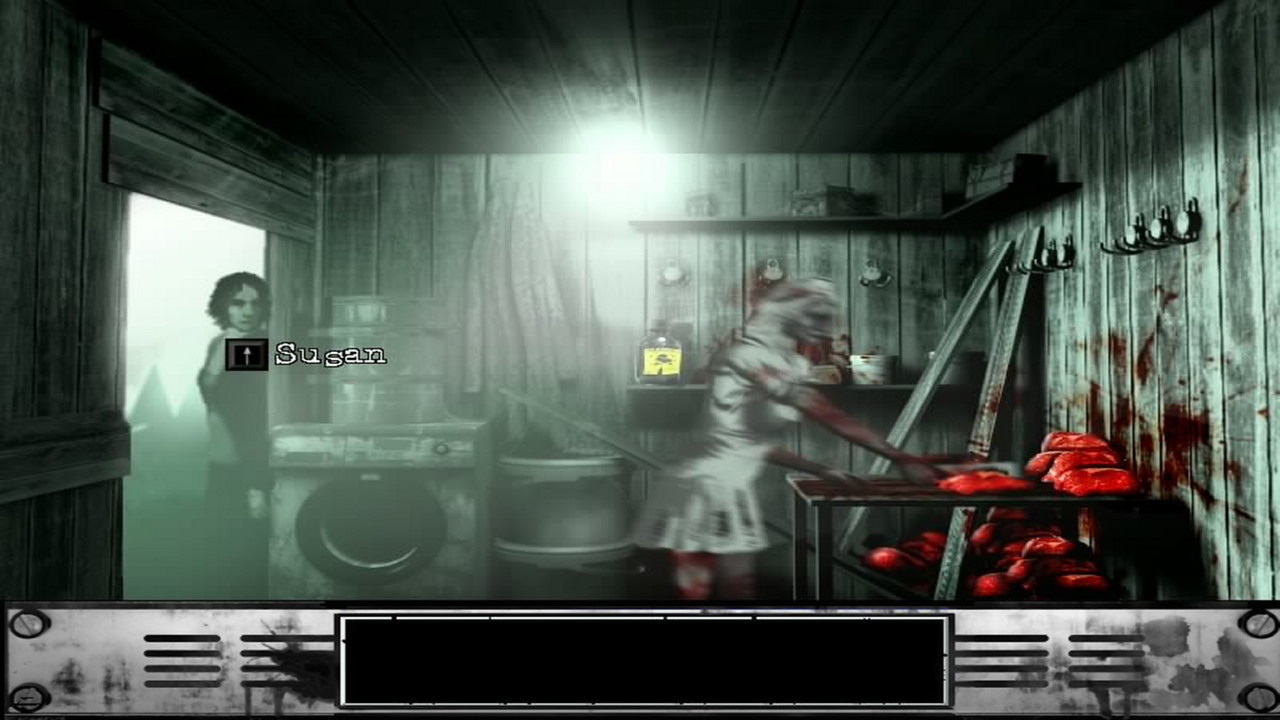
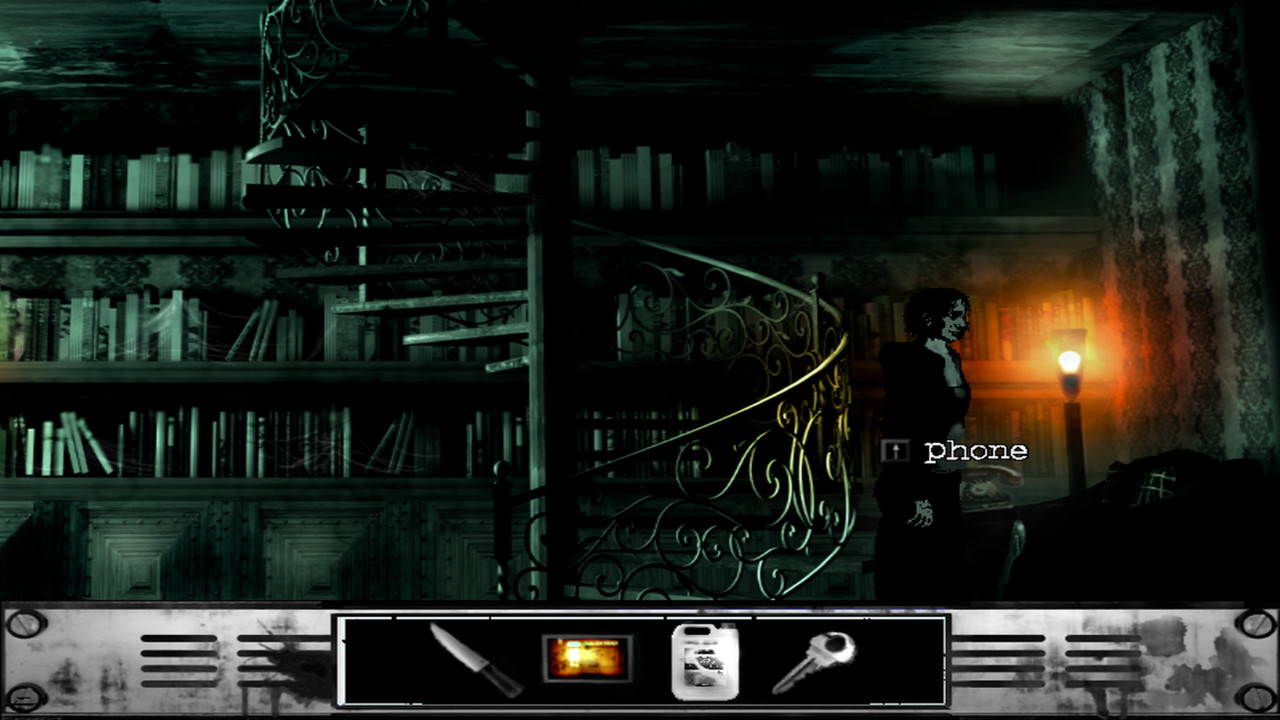
The visual world is sharply stylized. A room can have the recognizable furniture of an ordinary home and still look strained by harsh contrast or a colour that draws the eye toward something wrong. The two official screenshots here show that range: one depicts a grisly interior, another a dim stairway and a small figure near a lit wall. Neither image alone can explain the game's movement between daily life and horror, but together they show why its spaces are part of the telling rather than interchangeable backdrops. The audio has similar weight. The Steam listing credits English voice acting and a substantial score by micAmic, with featured music from Warmer, 5iah and Tears of Mars. Susan has words and silences of her own; the player is not supplied with an empty avatar into which any attitude can be placed. Music and performance accompany the changes from conversation to discovery and from a familiar room to an oppressive one. The game's presentation remains recognizably that of a small, authored adventure rather than a spectacle built around many mechanical systems. Its particular images and voices give the journey texture as the chapters shift location and tone.
The horror is inseparable from the subject of depression, but the creator has described friendship and hope as essential parts of the work too. Michalski has spoken about drawing on the experience of seeing someone close to him live with depression, and about wanting a story that did more than leave its central character in despair. That intention does not make the journey gentle. The developer's own notices identify graphic violence, gore, strong language and nudity; the manual also warns about flashing imagery. Suicide is present in the premise. The content information is worth knowing before entering because the story repeatedly places Susan's inner state alongside acts of cruelty and surreal horror. It would be misleading to describe the Parasites as a set of literal medical symbols or to promise that the game offers a treatment lesson. They are threatening figures in Susan's story, while her relationships and decisions give that story a human centre. A new connection can matter as much as an answer to a puzzle, and the possibility of one is a reason to keep following a character who begins with so little expectation of being helped.
The Cat Lady is the first title in the Steam bundle called Devil Came Through Here, alongside Downfall and Lorelai. They are separate games with their own protagonists and purchases; the bundle name describes a grouping of related works by Harvester Games rather than extra chapters hidden inside Susan's original release. The Cat Lady itself was created by Remigiusz Michalski and published by Screen 7. Its available PC editions preserve a single-player, keyboard-led horror adventure, with GOG offering a downloadable offline version. The presence of an album on Steam is music content, not another part of the story. Those distinctions are useful because a catalogue can put a soundtrack, a bundle and another title from the same creator near the base game. Someone beginning Susan's journey needs The Cat Lady itself. The game asks them to approach it as an authored sequence of conversations, close inspection, inventory use and unsettling transitions between places, rather than a series of interchangeable cases. Its small geographical scale is part of its design: the person Susan may come to trust, the ordinary room that turns hostile and the five people threatening her life all have room to matter within a few weeks of one woman's story.
- Developer
- Harvester Games / Remigiusz Michalski
- Genre
- Psychological horror adventure