
About The Case of the Golden Idol
In this 18th-century detective puzzle, twelve strange deaths unfold across five decades, tied by a mysterious Golden Idol and the people who seek it. Inspect frozen crime scenes, collect names and clues, then fit them into reports that explain who acted, what happened and why. Each solved case adds context to the wider mystery.
The Case of the Golden Idol casts the player as an investigator following a chain of twelve unusual deaths in an imagined 18th-century world. The incidents span roughly fifty years, so the central mystery grows through separate episodes rather than one continuous crime scene. A murder, an accident, or another suspicious event becomes a self-contained problem: who was present, what led to the moment shown, and which explanation fits the physical and written evidence? The cases accumulate into a larger account of a cursed aristocratic family, a valuable golden artefact, and the ambitions that gather around it. Its historical setting appears through estates, ships, documents, social roles, and period objects, while the strange object at the centre gives the story a supernatural edge. The game introduces a broad conspiracy gradually, leaving players to assemble connections from details that first appear local and incidental.
Each investigation presents a fixed, illustrated tableau at or just after a death. The figures do not move through a simulated world; instead, the player examines the captured instant by selecting people, objects, papers, and points of interest. Close inspection can expose a note, a name, an injury, a weapon, a personal possession, or some small relationship between items in the room. Characters may also have inspectable pockets or belongings, making the scene more than a flat picture of the obvious action. The visual arrangement itself carries evidence: positions, gestures, nearby objects, and the direction of someone's attention can help explain what happened. Some useful details are tucked among distractions, so identifying the decisive clue requires comparing the whole scene rather than clicking only on the body. The evidence does not change while the player thinks, allowing a return to the same tableau to test a new theory against its details.
Investigating turns discoveries into a finite bank of words, usually names and terms found in objects or documents. A letter can reveal a person's name; an object can supply a possible weapon or action; a clue can identify a place or relationship. Switching to the thinking view lets the player drag these collected words into blank statements about the event. The report asks for a structured explanation: which person acted, who was affected, where it happened, and how the act was carried out. These slots make deduction tangible because every proposed word must fit both the grammar of the sentence and the evidence gathered in the scene. A word may be correct but belong in a different part of the account, while a plausible sentence can still conflict with another clue. The game checks the completed account and allows further investigation or revisions until the case is correctly reconstructed.
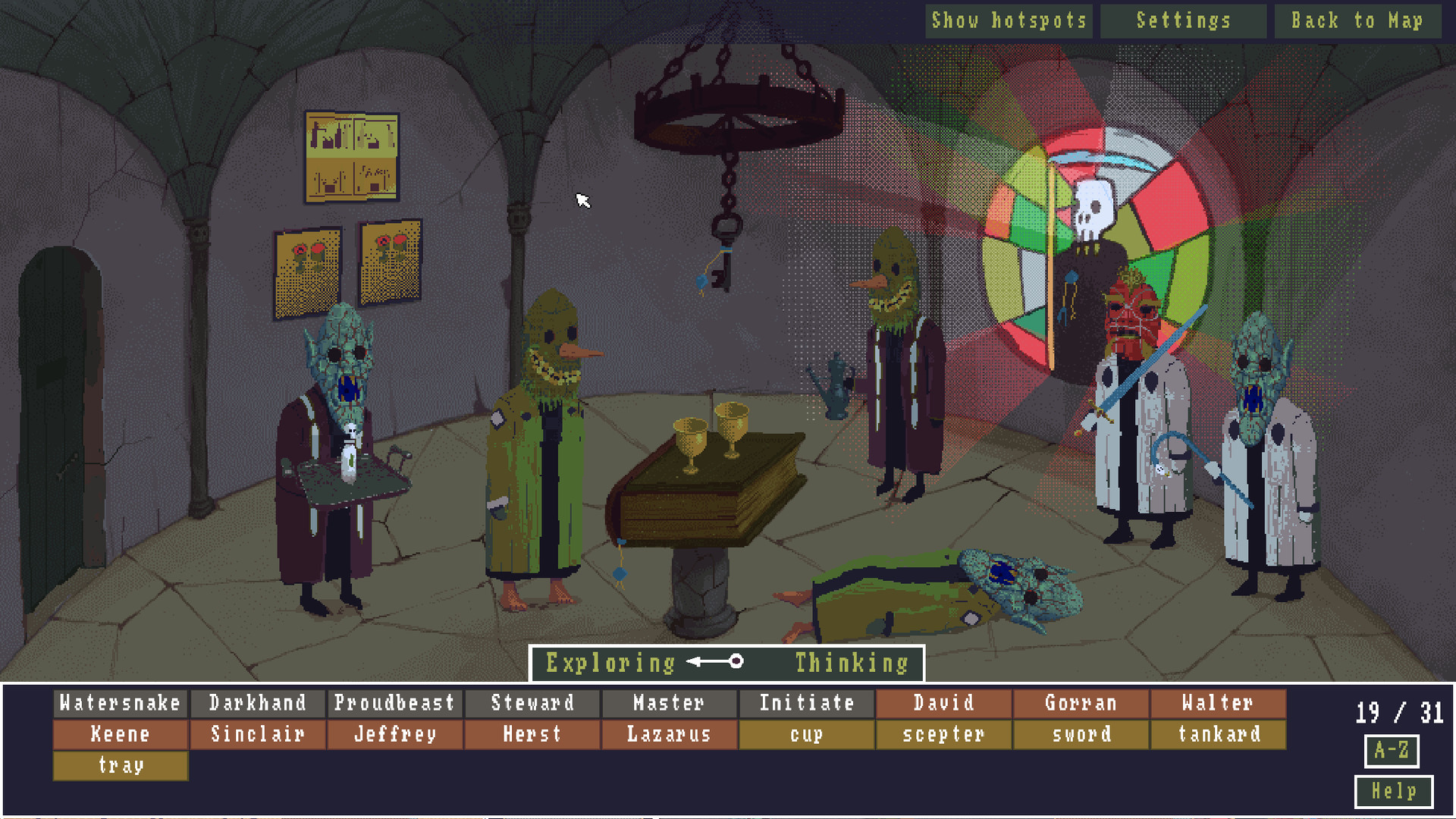
The report is only one layer of a case. An identity panel asks players to connect discovered names with the faces in the scene, and later investigations can include additional questions about relationships, positions, or other event details. These tasks reward a careful inventory of people as much as a solution to the central death. A surname on correspondence, an initial on a possession, or a room associated with a character can help distinguish people who initially look alike or seem unrelated. Some characters return in later episodes, so identifying them accurately gives context to new evidence and turns a previously solved scene into useful background. There is no separate conversation system in which the player interviews witnesses and selects dialogue; the testimony and context are embedded in the tableaux, papers, and written clues. Progress depends on interpreting those fixed records and matching them across cases.
Across the cases, the Golden Idol supplies the connective question. The official premise links the deaths to the mysterious artefact and to those who covet it, while the wider story follows a family whose fortunes and secrets change over time. The object is not merely a treasure that happens to appear in each mystery: its nature and capabilities become part of what the player is trying to understand. That larger thread brings motives such as greed, status, and influence into the same evidence-based process as the immediate crime. The story is revealed in fragments rather than through long stretches of conventional dialogue, so a detail noticed in one case can alter the meaning of a later one. Its supernatural and conspiratorial elements remain grounded in concrete questions about ownership, access, motive, and opportunity.
The base game advances by solving its sequence of twelve cases, each with its own scene and report, while the clues build toward an overarching explanation. The opening investigation establishes how to inspect a tableau and use the word bank; subsequent cases expand the number of people, documents, relationships, and details a player must keep in mind. Completion comes from correctly resolving the case material, not from defeating enemies, upgrading a character, or managing resources. This makes the main activity a repeated cycle of observation, collection, comparison, and revision, with the narrative providing reasons to reconsider evidence from earlier episodes. The two Golden Idol Mysteries releases, The Spider of Lanka and The Lemurian Vampire, are separate downloadable additions that require the base game and introduce their own scenarios; they are not part of these twelve base-game cases. The original story therefore has a defined beginning and progression of its own, with the expansions available as additional investigations.

- Developer
- Color Gray Games
- Genre
- Narrative detective puzzle adventure