
About The Callisto Protocol
Set in 2320 on Jupiter’s moon Callisto, The Callisto Protocol follows freight transporter Jacob Lee after he is imprisoned at Black Iron Prison during a biophage outbreak. Its third-person survival-horror campaign combines close-range baton fighting, directional dodging, firearms, the guards’ gravity device, scavenging and weapon upgrades as Jacob seeks a way out.
The Callisto Protocol is a third-person survival-horror game set in 2320, on Callisto, one of Jupiter’s moons. Jacob Lee works as a freight transporter for the United Jupiter Company, moving cargo between the moon and Europa. After events surrounding one of his trips, he is held at Black Iron Prison, a maximum-security penitentiary operated by the same corporation. An outbreak transforms inmates and guards into biophage creatures, turning the prison into a maze of disrupted routines, sealed routes and immediate threats. The central objective is to survive the outbreak and find a route to safety, while the circumstances that produced the crisis gradually connect the prison to wider corporate secrets on Callisto.
The campaign remains close to Jacob as he moves through Black Iron’s cells, service passages, industrial spaces and exposed lunar terrain. The prison’s original function is present in its surveillance, controlled access and equipment. Doors and corridors direct movement, while security systems and guard devices become part of the danger. As the crisis spreads, familiar institutional spaces take on new purposes as routes between encounters and places to search for supplies. The world is presented through what Jacob can reach and inspect as he advances, rather than through an open map or a separate base-building layer. Optional audio logs and environmental details add fragments about the people and organisations tied to the facility, while the main route keeps the immediate problem—getting through the next dangerous area—in view.
Biophages make close encounters a regular part of that movement. Jacob carries a stun baton for melee attacks and later finds firearms, so combat can shift between striking at arm’s length and creating distance for a shot. The directional dodge system is tied to movement: steering left or right as an opponent swings lets Jacob evade, then answer with a counterattack. Blocking is also available, but it costs health, making it a costly way to absorb pressure. The rhythm asks the player to watch a creature’s approach, move out of the line of an attack and choose whether to follow with baton strikes or a firearm. Encounters therefore involve timing and positioning as well as aiming, and the close camera keeps Jacob’s health and the threats around him central to each exchange.
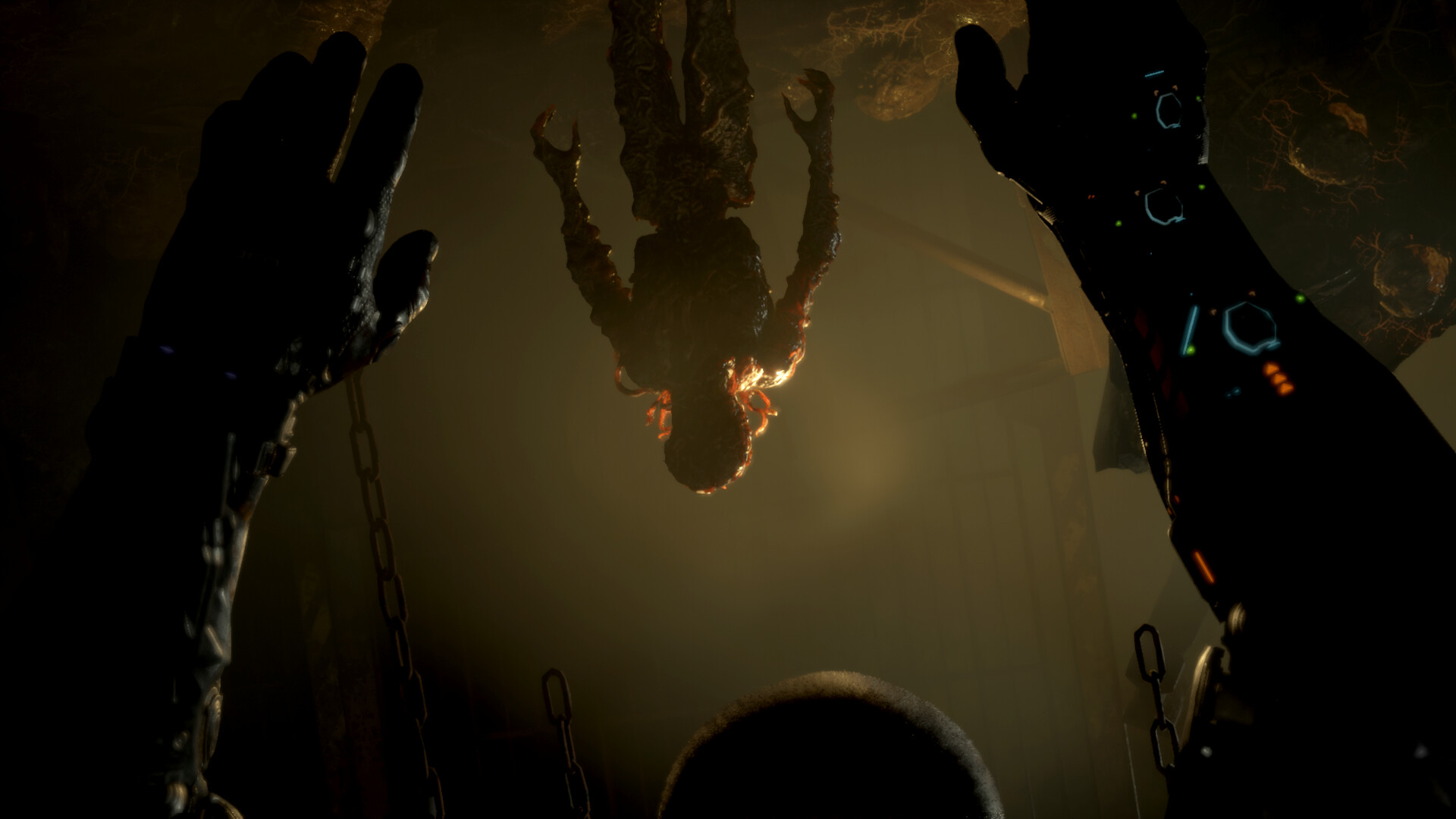
Firearms extend the combat loop as the campaign reveals blueprints and fabrication stations. Schematics let Jacob produce weapons through Black Iron’s 3D printers, turning exploration into a way to expand the tools available for later confrontations. Ranged attacks can interrupt the pattern of a melee exchange: consecutive baton hits can leave an enemy briefly vulnerable, opening a chance to aim for a more precise shot. Targeted damage can remove limbs, reducing what a biophage can do even if it continues to move. The result is a practical choice between continuing to strike, taking a moment to line up a shot, or using another tool to create space. Ammunition and health remain resources to monitor, so firing at every threat is not presented as the only answer to an encounter.
The GRP, a gravity-manipulating device formerly used by Black Iron guards to control prisoners, gives Jacob another way to change a fight. It can lift a biophage and throw it across the room, including into environmental dangers such as blades or spike-lined surfaces. That makes the layout of a combat space useful: a hazard can become a weapon, and moving an enemy may create breathing room when several creatures are nearby. The GRP also has a limited charge, so using it repeatedly depends on maintaining its energy rather than treating it as an unlimited replacement for melee or guns. As Jacob acquires the device and other equipment, the player has more ways to combine a dodge, a strike, a shot and a gravity-powered throw within the same encounter.
Scavenging connects exploration to preparation. The player searches the route for supplies, ammunition and weapon blueprints, then uses fabrication points to turn discovered plans into usable firearms. At printer workstations, surplus ammunition and health supplies can be sold for credits, which Jacob can spend on firearm and GRP upgrades or other abilities. These systems make side spaces worth checking because what is found there can affect how much flexibility Jacob has later. The route is still built around forward movement through the story, rather than a broad crafting sandbox: upgrades feed into the next stretch of the prison and the fights encountered along it. Deciding whether to improve a familiar weapon or strengthen another tool is part of keeping the loadout useful as the biophage threat changes.
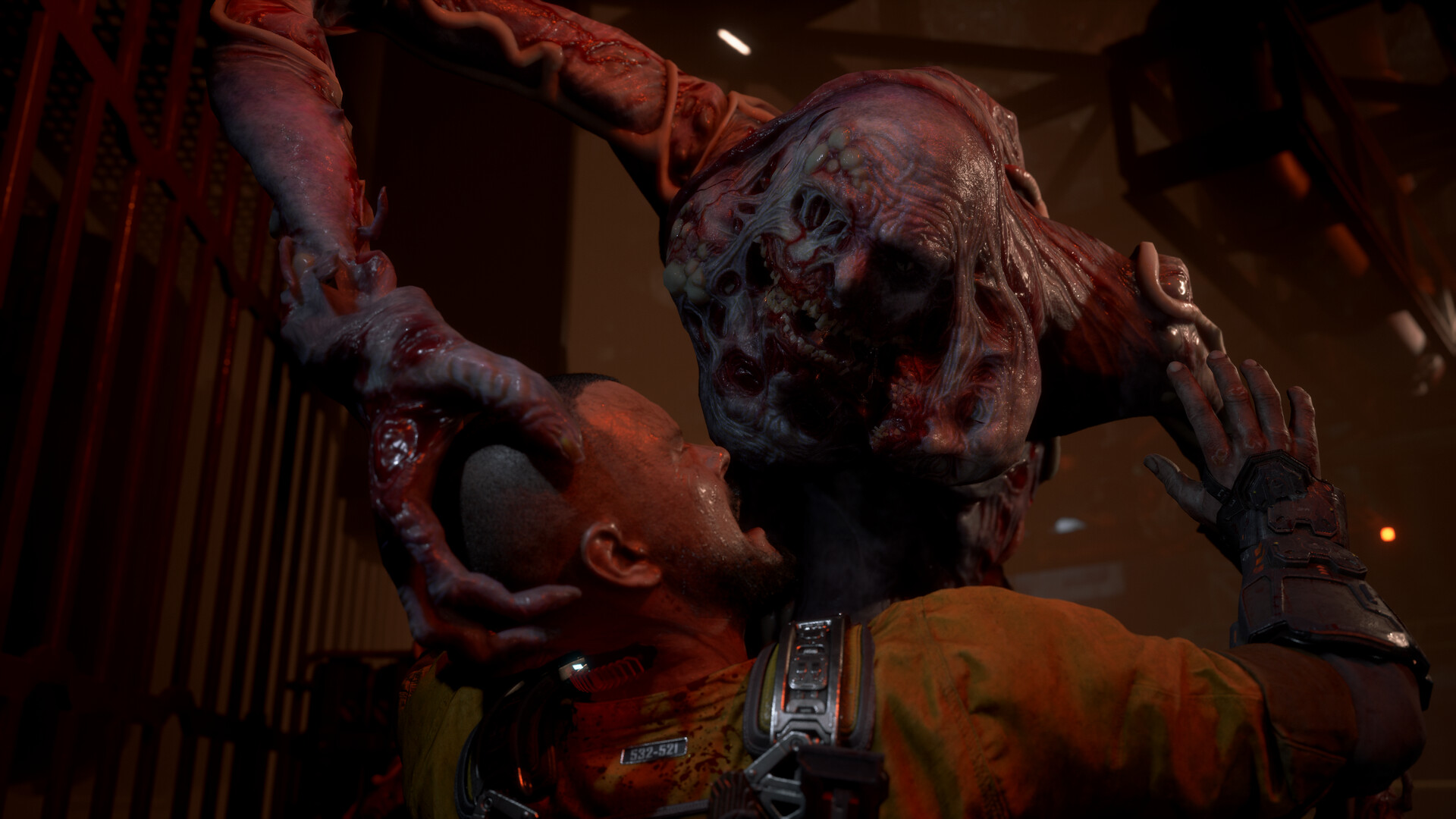
The game’s interface also ties survival information to Jacob’s equipment. His health is shown on the life-support implant at the back of his neck, and ammunition is displayed on the weapon he is holding, keeping those readings within the scene rather than in a conventional persistent screen overlay. This presentation places status checks alongside movement and aiming, but it also means the player must make room to glance at those indicators while threats are active. Together with scavenged supplies, fabricated weapons and the GRP’s limited energy, those visible readings define a compact resource loop: assess Jacob’s condition, choose how to approach the next encounter, and use what the prison’s remains provide to continue toward escape.
- Developer
- Striking Distance Studios
- Genre
- Third-person survival horror