

About The Big Con
In The Big Con, high-schooler Ali leaves band camp to help save her mother Linda’s video-rental store from loan sharks. With grifter Ted as her tutor, she travels across a cartoon-styled 1990s America, choosing between pickpocketing, disguises, lockpicking, eavesdropping, and larger scams to raise money while meeting people she can help or hustle.
Ali’s trip begins with a family problem that she cannot solve by staying behind the counter. Linda runs a video-rental shop, and loan sharks are threatening the business; Ali decides to raise the money herself, even after her mother tells her not to take responsibility for the debt. She skips band camp and teams up with Ted, a passing grifter who sees that she can learn the trade. Their route leads away from home and toward Las Venganza, a fictional city with the scale and promise of a gambling destination. The plan gives Ali a practical target—earn enough cash to help the store—and gives the story its road-trip shape. Along the way, she still has to deal with Linda, whose calls home bring their disagreement back into the journey. The comedy comes from the mismatch between Ali’s teenage life and the serious crime she is trying to pull off, while their strained mother-daughter relationship keeps the store’s fate personal.
The journey moves through compact, illustrated places rather than a seamless open map. Ali can walk around each area, talk with its residents, inspect objects, and follow clues toward tasks or money-making opportunities. The settings include her hometown of Lisbon, stops on the trip such as a train, a shopping mall, and the destination of Las Venganza; each space turns the 1990s frame into things to interact with. A mall’s shops and crowds create a different set of errands from a train carriage or a neighborhood street. People often have small wants that connect to other people or objects, so a conversation can point Ali toward a new errand, while an item found nearby may solve it. The notebook helps keep track of current objectives and information about marks, and a fanny pack holds the items she is carrying. Exploring therefore feeds several parts of play at once: it can reveal a lead, a disguise, cash, a pawnable object, or a hidden code, rather than simply adding scenery between story scenes.
Movement and observation are the groundwork for Ali’s scams. The game uses a tilted, isometric view over hand-drawn scenes, with Ali moving on foot through each area and interacting with characters and objects at close range. When a mark carries cash, approaching from behind puts pickpocketing within reach; slipping through spaces and choosing when to act matters because a failed attempt draws attention. Other opportunities ask Ali to listen in on conversations or watch people without being noticed. Eavesdropping can reveal how a mark thinks or what they want, giving her useful context before she chooses an approach. Disguises found around the environment can be equipped from her bag, and they change how she can return to a target after being caught. This loop ties movement to social information: Ali surveys a busy space, spots an opening, gathers details, and then gets into position. The controls are straightforward directional movement and contextual interactions, so the challenge comes from reading a scene and following its clues rather than mastering combat or platforming. There is no conventional combat system described for this adventure; its risks are being noticed, losing a pickpocket attempt, or solving a puzzle incorrectly.
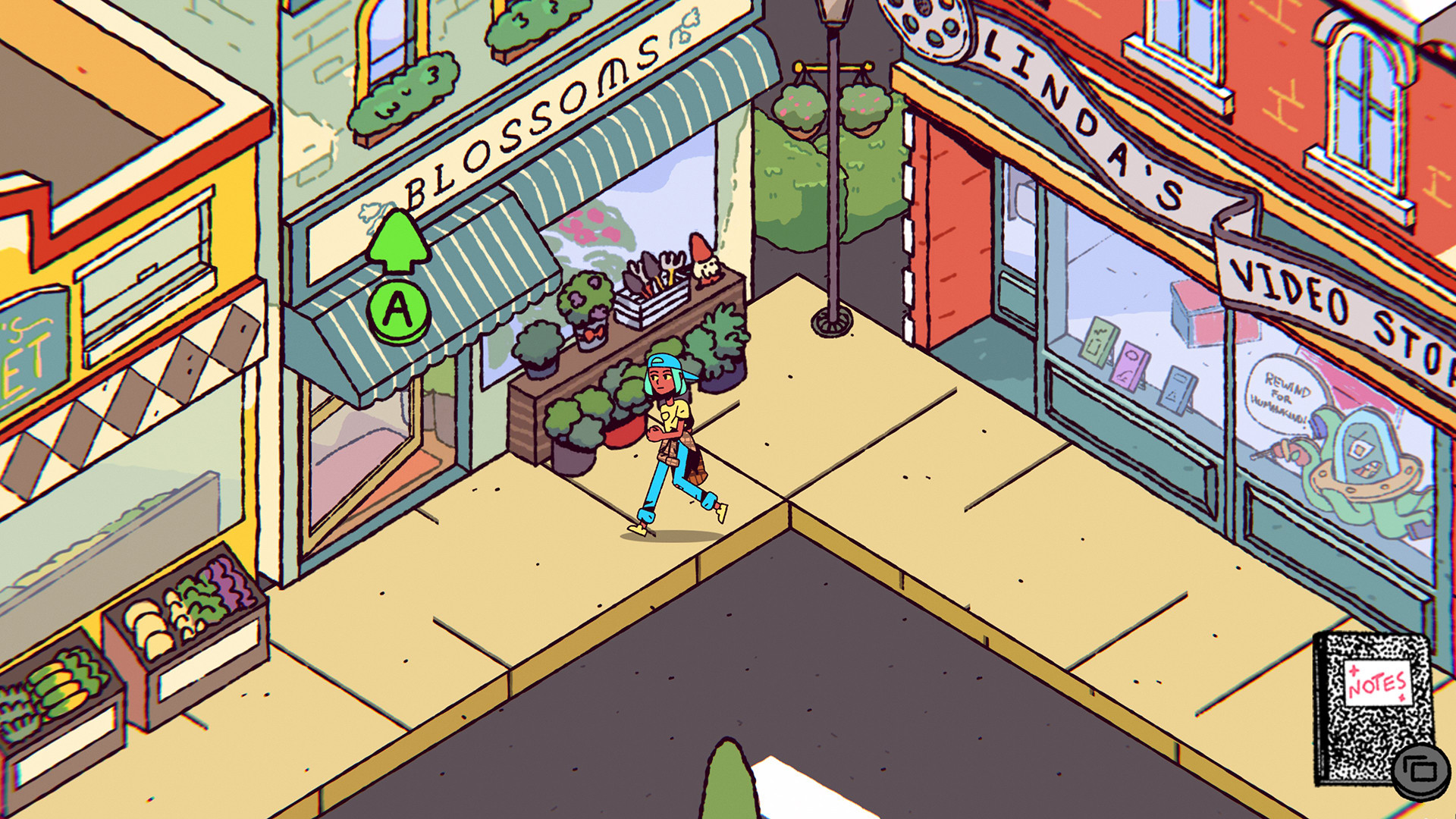
Pickpocketing is the repeatable way to take cash from people in the areas Ali visits. Marks show how much money they carry as she gets close, letting the player weigh a quick attempt against searching for a larger opportunity. The standard action uses a timing minigame: a moving needle crosses a target area, and holding the input controls when Ali tries to take the wallet. The interaction is designed around positioning behind someone, then reading the timing prompt. If Ali is caught, she cannot simply try that same person again unchanged; a disguise lets her make another attempt. The pickpocket minigame can be turned off in the settings, reducing the action to a button press; simplified quick-time-event options are also available in the later edition. Getting caught repeatedly triggers a VHS-rewinding task, a deliberately mundane punishment that fits Ali’s world of video stores. That sequence returns the lost money when completed, so the consequence is a short interruption rather than a permanent loss. Pickpocketing is useful, but the game also presents other ways to earn money and solve the area’s problems, so the player can decide how much to rely on it.
The larger cons ask Ali to combine social clues with practical actions. Cons can involve disguises, sneaking, eavesdropping, breaking and entering, smooth talking, or lockpicking to approach different marks. In a more involved grift, a target’s routines or conversation can point toward a route inside a restricted place; Ali may need to move without being seen, open a lock, and use the right line of dialogue to get what she wants. These are puzzle-like sequences rather than combat encounters. The point is to work out what a person will respond to and what parts of a scene can help create that opening. Conversations can lead to deals, affection, or trouble, and the same characters may also have ordinary requests that Ali can choose to fulfill. A disguise is not just a costume collectible: it can support a new attempt after a failed theft and help Ali pass through situations that call for a different look. The mechanics connect through information and access—listen first, identify the need, then decide whether to sneak, talk, pick a lock, or take a simpler opportunity. That range lets the game shift from quick wallet theft to planned scams without changing Ali’s basic goal.
Each area sets a cash goal that Ali must meet before the trip can move on. Pickpocketing contributes small amounts, while themed objects scattered around a place can be sold to the pawnbroker when they match what he wants. That creates a reason to check bins, corners, rooms, and side paths, then compare what is worth selling with what might be useful elsewhere. Optional requests from residents add another layer: helping someone can send Ali across a level to find an item or solve a small problem, sometimes after she has already stolen from that person. PINs and padlocks also reward careful searches, since their codes are hidden in the surrounding scenes. These activities are not all required to clear the money target, but they make a location more than a row of marks to rob. Once the amount is reached, Ali can continue poking around or tell Ted that she is ready to leave. That choice makes the pace flexible: a player can move on after meeting the requirement or stay longer to chase remaining clues, side tasks, and sellable finds. The money threshold gives each stop a clear purpose, while the optional content makes the route through it less fixed.

The Big Con builds its 1990s setting from everyday objects and cartoon exaggeration: video-store VHS tapes, payphones, malls, plaid clothes, and collectible plush toys sit alongside fake brands and jokes about the era. The scenes use broad colors, sketchy outlines, and expressive character designs, with the visual language of a television cartoon rather than a recreation of an older game. Music also changes with place: a shared area theme can be rearranged for individual interiors, so a shop or lobby has its own version of the surrounding neighborhood’s sound. Dialogue carries much of the story, and Ali can call home to speak with Linda as the trip continues. The game’s tone is a coming-of-age comedy, but it does not turn every character into a mark; residents have problems and relationships beyond what Ali can steal from them. The Steam release is listed as The Big Con, developed by Mighty Yell and published by Skybound Games. Mighty Yell later released Grift of the Year Edition as a free update for Steam and other platforms, adding more puzzles, dialogue, collectibles, quests, and the Rad Skater arcade game. Those additions expand the same road trip with extra activities and conversations.
- Developer
- Mighty Yell
- Genre
- Single-player narrative adventure with puzzles, exploration, and stealth/grifting mechanics