

About The Beginner's Guide
The Beginner's Guide is a short first-person narrative in which a voice identified as Davey Wreden leads the player through experimental games attributed to an elusive creator called Coda. Walking through these unfinished spaces, and listening to the explanations layered over them, raises questions about what a work can reveal about its maker and who gets to interpret it.
The Beginner's Guide opens as though someone has invited the player into an archive of unfinished games. A voice introducing itself as Davey Wreden presents a series of small works attributed to a developer called Coda, with the apparent aim of understanding why their creator stopped making them. The player does not select a mission from a map or build a character. They enter one experimental space, hear what the guide believes it means, and then move to the next. That simple structure makes the framing voice as important as any level. An odd corridor or a missing objective might look like an abandoned design decision on its own; under narration it becomes possible evidence about the person who built it. The more confidently the guide explains such details, the more the player has to consider the difference between a feature that is visibly there and an interpretation imposed upon it. The game is short, around ninety minutes by the creator's description, but its sequence of small environments gives that question several different forms instead of relying on a single illustrative puzzle.
The opening experiment resembles a rough Counter-Strike map, stripped of the expected battle. There are no opponents to fight and no tactical purpose to its strange details, so the player can look at the place as a piece of design rather than as a competitive arena. The experience then moves through other prototypes and scenes, some of them closer to a simple movement exercise than to a finished commercial game. A science-fiction space contains a gun without the expected shooting encounter; elsewhere the guide draws attention to places the player cannot freely reach. These are concrete examples of how The Beginner's Guide uses familiar game grammar while withholding the usual reward. An object can exist without fulfilling the function suggested by its shape. A corridor can be interesting because it seems to lead somewhere, even when the tour does not permit a full exploration. The player's practical task is largely to walk and observe, but observation becomes active work when the guide's account is only one possible way to understand an incomplete scene. The science-fiction gun is a particularly sharp example: the object evokes a familiar purpose, yet the absence of enemies makes that purpose irrelevant. The player is left to consider why it was placed there, while the narrator offers an explanation that may reveal as much about his own expectations as about the creator of the room.
The first-person controls are deliberately modest. Moving through a room and interacting with the few available elements are enough to carry the story, and there are no conventional goals to complete for points or equipment. The narrator loads new works, sometimes moving the player past a section that would otherwise be long or obstructive. This gives the journey a curated pace. It also changes the relationship between player and game: the player is not simply examining Coda's supposed creations independently, because another person is deciding which creations appear and how much of each can be seen. A space that might have been left unfinished for any number of reasons is presented within a story about its maker. The game never needs a large mechanical system to make that mediation visible. Walking through a level while someone explains what its architecture reveals invites a silent comparison between the environment in front of the player and the claim being made over it. That comparison is where much of the interaction takes place. A guide who shortens an inaccessible stretch can seem helpful, but the edited journey is no longer the same as entering the original environment alone. The player learns Coda's work through someone else's sequencing, and the act of being shown becomes part of the story rather than a neutral interface.
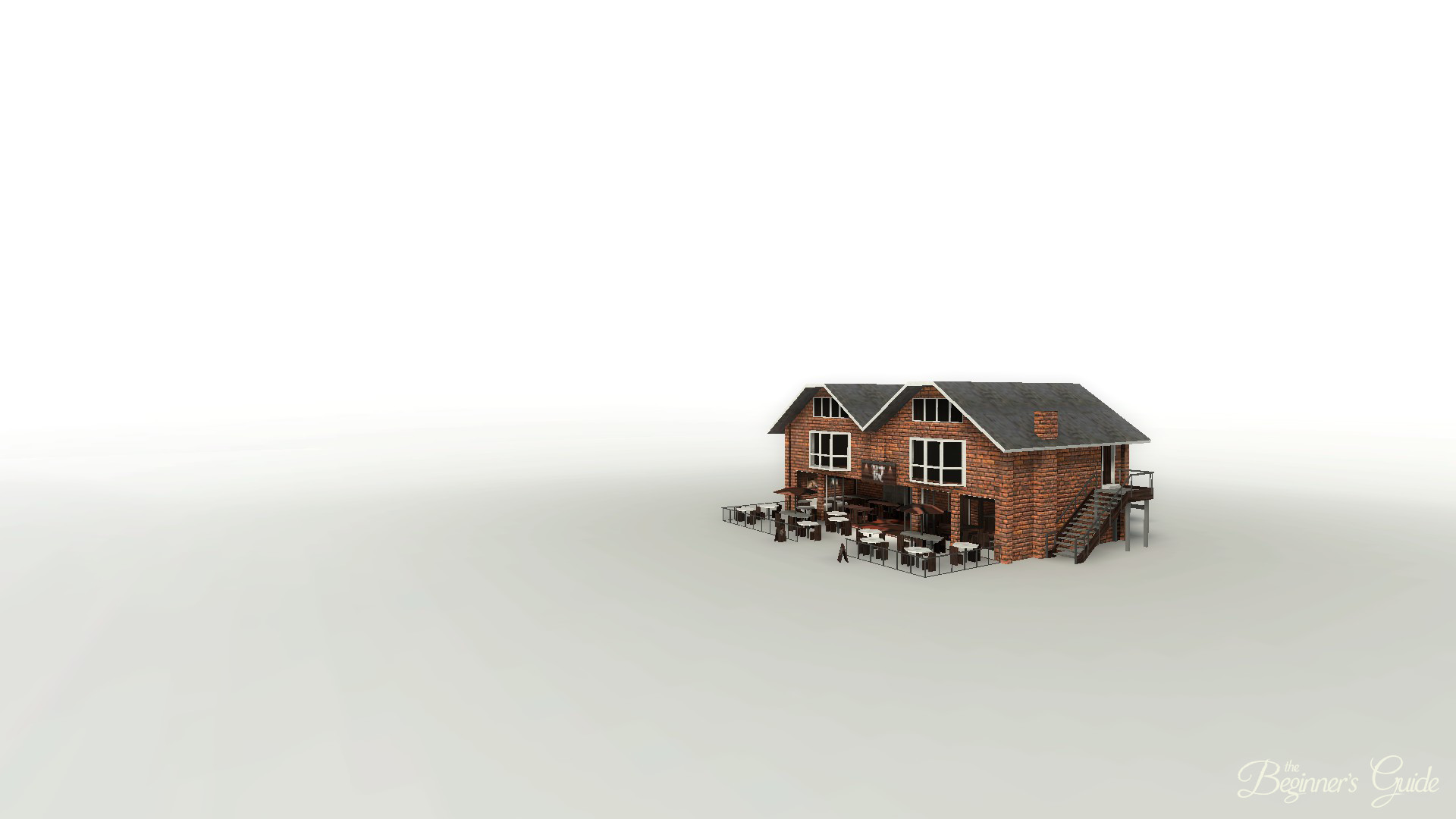
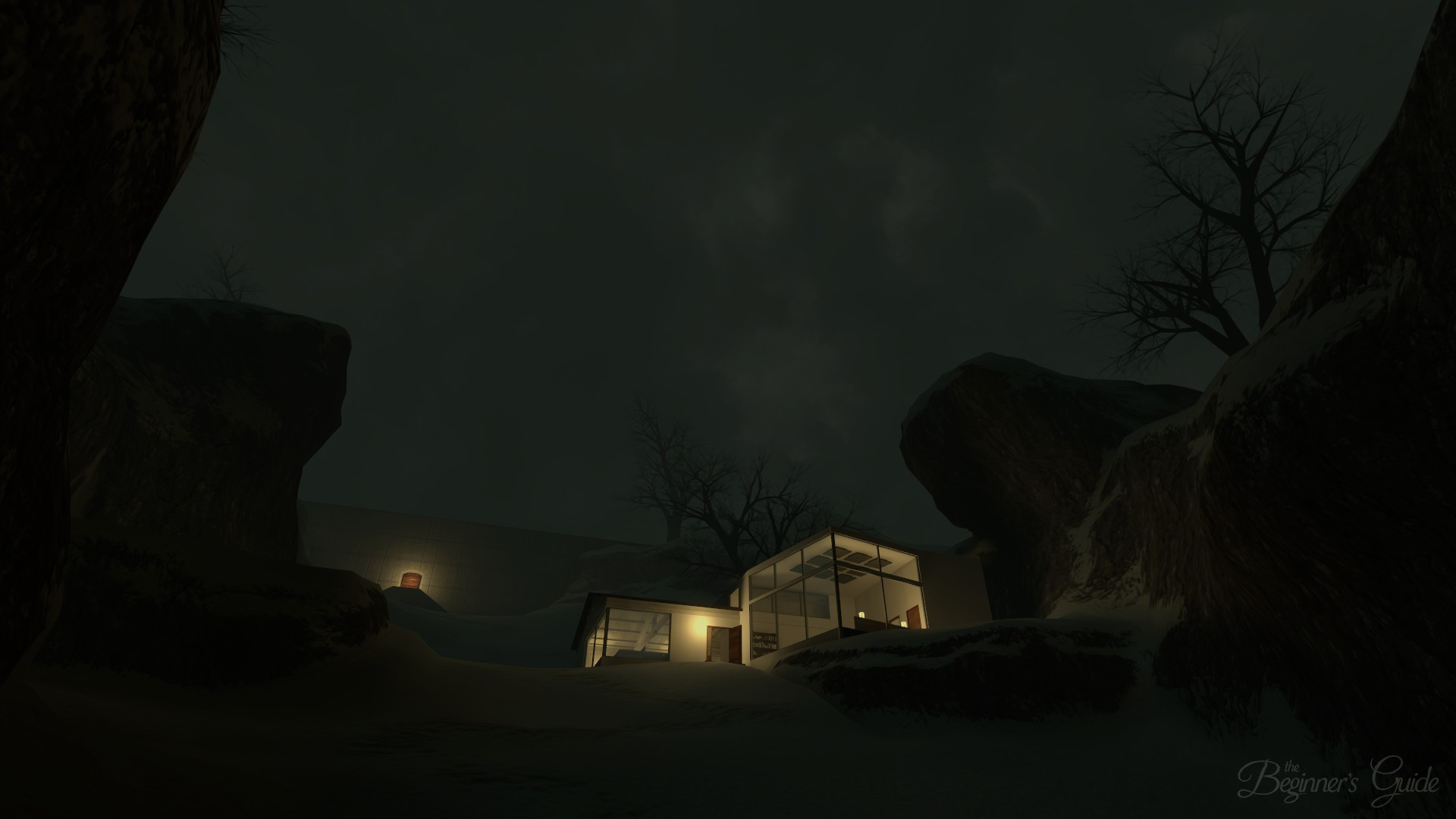
The visual range of the small games is part of their appeal. One piece may use the spare language of an early shooter map; another replaces ordinary spatial expectations with a strange, almost theatrical setting. Their roughness is intentional to the overall presentation. They resemble experiments a developer might make to test an idea without finishing the ordinary systems that would surround it. The variety also prevents the tour from becoming a single visual metaphor repeated room after room. Each new place asks a slightly different question about intention. What does a strangely placed object suggest? Does a design that keeps the player at a distance reveal anything about the person who made it? Can a narrator's story make an incomplete mechanic feel personal? The Beginner's Guide does not require the player to answer these questions at the pace of an examination. It gives them physical spaces to cross while the questions accumulate. The contrast between simple movement and increasingly complicated interpretation lets a tiny prototype occupy more attention than its visible features alone might seem to justify.
The narrator's identity makes the frame unusually slippery. Davey Wreden is the actual creator associated with the game and with The Stanley Parable, and the speaking guide uses that name while presenting an intimate account of another developer's work. This does not make every statement a documentary fact. It is part of how the fiction uses a real maker's public identity to make a guided tour seem trustworthy. Coda's portfolio is presented in chronological order, and the voice repeatedly tries to connect design choices with a human being who remains difficult to know directly. The player receives Coda primarily through environments and through another person's descriptions of them. There is no separate interview in which Coda can confirm each interpretation as the levels appear. The gap matters more than a twist for its own sake: it asks whether an artwork can be treated as a reliable biography of its maker, and whether a person who wants to understand it can also change its meaning by selecting and explaining it for an audience.
Everything Unlimited Ltd. released The Beginner's Guide in 2015 as a short narrative game for computer platforms, with its Steam listing naming Davey Wreden and describing the absence of traditional mechanics, objectives and goals. Its relationship to The Stanley Parable is best understood as a connection through its creator rather than as a sequel. Both use a disembodied voice and first-person space, but this tour is built around a purported collection of someone else's experiments rather than an office worker's branching routine. The presentation is quiet enough for the voice to carry much of the emotional weight, while the sparse levels leave room for the player to doubt or accept what it says. Someone looking for a conventional puzzle chain will find little of one. The more specific invitation is to walk through these fragments, listen carefully to the story placed over them, and notice how quickly a plausible explanation can become more certain than the evidence on screen. The ultimate account of Coda and the guide's motives belongs to the work itself, not to a premise summary. The opening promise of a personal explanation is therefore a useful way into the game, though it should be heard as an invitation to investigate rather than a guarantee of certainty. Its strongest questions arise while the player can still hold the narrator's words beside a visible, sometimes contradictory space.
- Developer
- Everything Unlimited Ltd. / Davey Wreden
- Genre
- Short first-person narrative