
About The Banner Saga
The Banner Saga follows a caravan crossing a Norse-inspired fantasy world as an ancient threat drives humans and varl from their homes. Travel decisions, conversations and tactical battles shape the journey, while supplies, morale and the lives of the people in the caravan make each day on the road consequential.
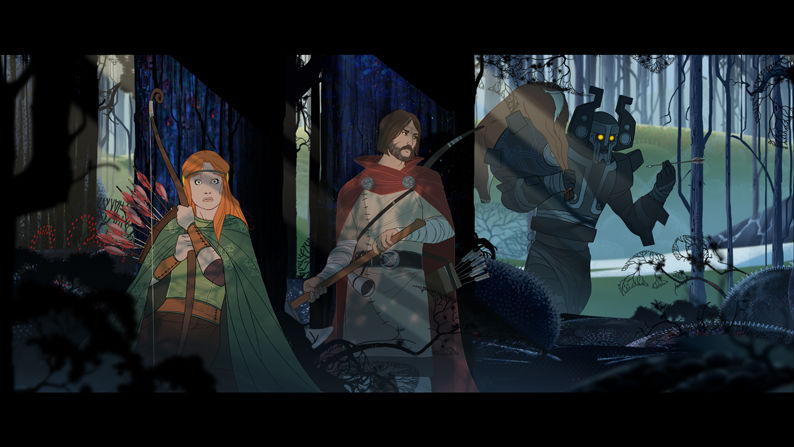
The Banner Saga is a story-driven tactical role-playing game set in a world inspired by Norse mythology and rendered as a hand-painted landscape. The sun has stopped moving, and the return of the dredge, an armoured race long believed to be a threat from the past, unsettles human settlements and varl communities alike. The varl are a horned, long-lived people who once fought beside humans; their strength and political standing make them both allies and a source of tension. The story follows several travelling groups rather than a single uninterrupted march. Early on, the player guides Rook and his daughter Alette from the village of Skogr, while other chapters follow the varl leader Hakon and his company. These intersecting journeys bring leaders, fighters and ordinary caravan members into a growing crisis, with conversations and choices affecting who remains with the group and how it moves forward.
Between battles, travel becomes a management layer with immediate costs. The caravan carries clansmen, fighters and varl, and the player must keep the group moving through a frozen landscape while responding to delays, disputes, discoveries and attacks. Stopping can let people recover and events unfold, but travel consumes provisions and time; pushing onward avoids some costs while leaving people tired or unsettled. At camps and towns, the player can rest, speak with companions, make decisions about the group or spend Renown on supplies and equipment. The population is not decorative: dwindling provisions put pressure on the journey, and morale influences the Willpower available at the beginning of battles. Choices may recruit people, change troop numbers, delay the caravan or alter a relationship. The game does not reduce these moments to a single right answer; the player weighs what is known against immediate needs and accepts that the next leg of travel may be affected.
Combat takes place on a square, two-dimensional grid, with a sequence bar showing the order in which allied and enemy units act. Before a fight, the player selects and positions a party from the available heroes. Human fighters occupy one tile, while varl and some large dredge take up a two-by-two space, changing movement lanes and where allies can stand. A unit moves and then chooses an attack against either an enemy’s Strength or Armor, or uses its class ability. Strength is both a character’s attack power and ability to remain standing; Armor reduces incoming Strength damage, while Armor Break attacks lower that protection. This creates a target-priority puzzle: damaging an enemy’s Armor can prepare it for a later heavy hit, while reducing Strength removes its ability to fight effectively. The same pressure applies to the player’s side, so a powerful unit with weakened Strength becomes easier to incapacitate even if it still has high Armor.
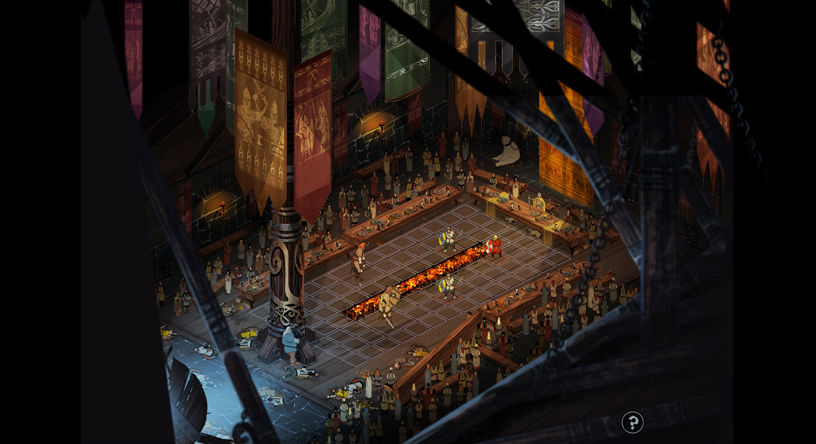
Willpower adds a flexible resource to each turn. A hero can spend it to move an additional tile, add damage to an attack, or activate an ability, with Exertion limiting how much can boost a single attack. The player therefore chooses whether to spend Willpower for immediate reach or damage, reserve it for a special move, or leave a hero inactive to regain a point. Some heroes’ abilities can strike several targets, protect allies, reposition enemies or change the conditions of a fight; their usefulness depends on placement, turn order and the current state of the opposing line. Once the last enemy has been reduced to a single survivor, Pillage mode changes the rhythm: the remaining units take turns without the earlier one-for-one alternation. That shift can give the player an opening to finish a weakened opponent or force a decision about whether to leave it standing while completing other actions. Battles reward attention to both the initiative order and the changing Strength and Armor values displayed for each unit.
Victories and kills award Renown, which connects tactical success to longer-term development. At camp, Renown can be spent to promote heroes, improving selected attributes and raising the level of abilities; in towns it can also buy provisions and items. This means the same reward supports competing needs. Investing in the heroes who fight most often can make later encounters more manageable, while buying food helps keep a large caravan moving. Heroes who fall in combat are generally wounded rather than permanently lost; resting reduces the wound penalty over time, which makes recovery a travel decision as well as a combat concern. The player builds a roster across distinct classes and two peoples, balancing ranged attacks, armour-breaking, support abilities and the footprint of larger varl on the battlefield. Equipment provides another way to shape a hero, but Renown spent on one purpose cannot also be used for the others.
Large-scale wars add a different kind of battle later in the journey. Before committing heroes, the player receives information about the opposing force and their own troops, then chooses an approach for the army. That decision affects the difficulty of the heroes’ ensuing fight and the number of troop losses, connecting tactical command to the caravan’s wider strength. Regular encounters ask the player to use a small group of named heroes on a compact grid; a war makes the surrounding fighters and the condition of the group part of the calculation. Between those set pieces, the story continues through conversations and events on the road, where choices can alter troop composition, supplies, morale or who is available to help. The result is a campaign in which battles, travel and dialogue feed into one another: preserving a hero may matter in a later fight, but the group may pay for extra rest or supplies along the way. The Banner Saga opens a larger story as its first chapter, following the caravan through a crisis that threatens both humans and varl.
- Developer
- Stoic
- Genre
- Tactical role-playing game and turn-based strategy