
About The Ascent
The Ascent is a solo or cooperative action RPG set on Veles, where the corporate-run arcology that owns the player’s worker character suddenly collapses. Explore the stacked city, take on missions, and fight through the upheaval with firearms, tactical equipment, cyberware abilities, and a build shaped by skill points and loot.
The Ascent takes place on Veles, a densely populated world organized around the Ascent Group’s enormous arcology. The player character is an Indent, a worker whose life and labor are controlled by the corporation. When the company abruptly shuts down, the systems that held the district together fail and the people below it face an uncertain future. The Indent is drawn into a chain of missions to discover what happened and protect their own prospects. The central conflict grows from that collapse: corporate power does not disappear with its headquarters, and local groups, security forces, and residents all respond to the sudden change in authority. Mission work therefore sits between private survival and public instability, giving the Indent reasons to deal with people whose interests do not automatically align.
The arcology is a vertical city whose districts range from crowded lower levels to wealthier spaces higher above them. Moving between these areas puts industrial infrastructure, commercial streets, residential spaces, and corporate environments alongside one another. The game presents hubs and connected combat spaces rather than a featureless battlefield: missions send the Indent across the city, while residents and vendors occupy safe or transitional areas between fights. Characters encountered on the way supply objectives and context, and the company itself remains the defining faction even after its shutdown. The contrast between the districts gives the story a concrete social geography, with access, resources, and danger changing as the player moves through Veles. Since the arcology spans distinct strata, the route itself communicates who has access to space, services, and security.
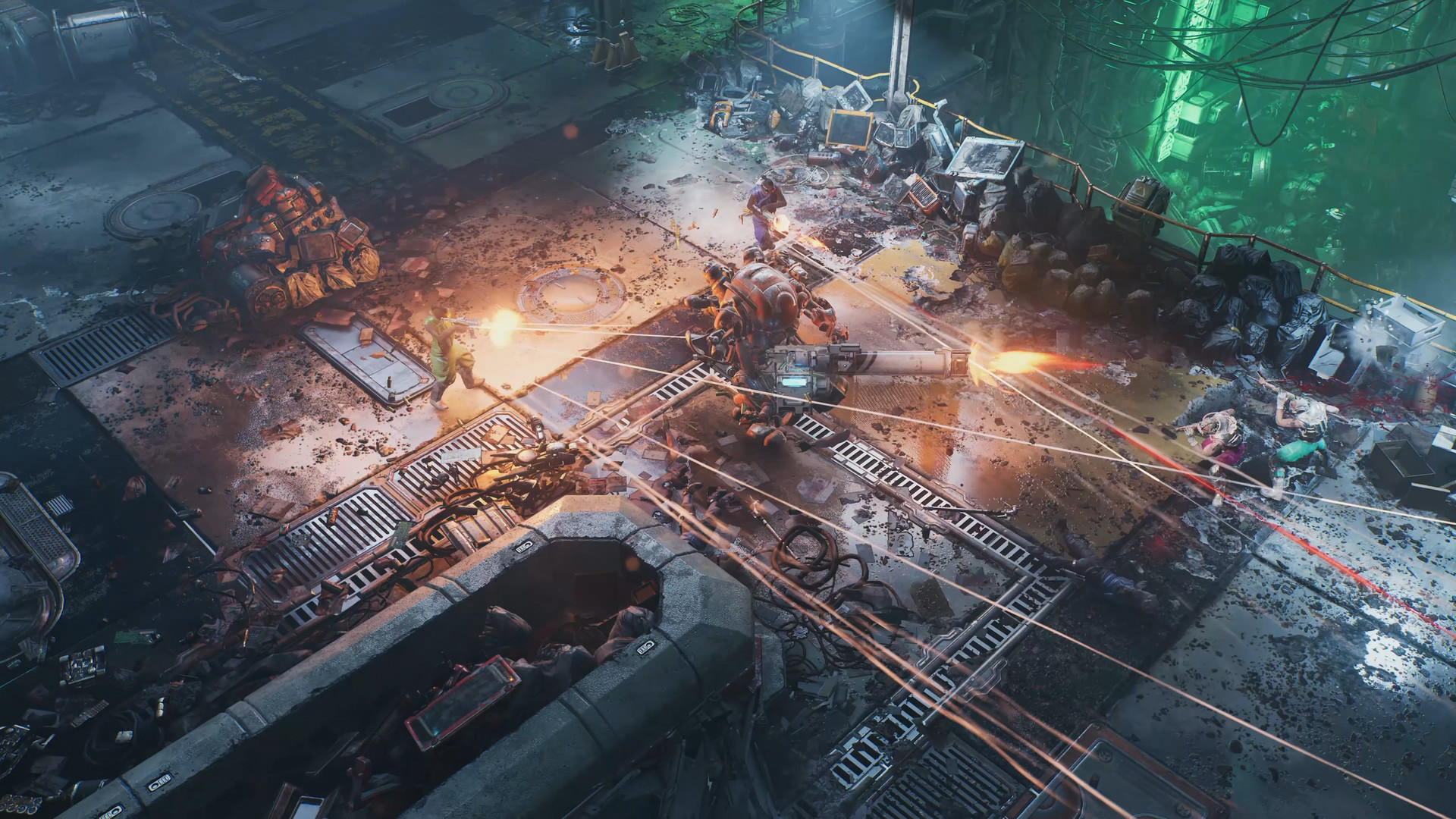
Combat uses an angled, twin-stick shooter view and asks the player to manage distance, cover, and elevation while fighting groups of human and mechanical opponents. The Indent can aim at different heights: firing from a low stance lets shots pass over some barriers, while raising a weapon can reach elevated targets or enemies behind cover. Those options make the environment part of the encounter. Dodging can break away from an encirclement or close distance, and destructible scenery changes as weapons and explosions strike it. Firearms cover different ranges and damage profiles, so swapping the equipped pair as enemy types and arena layouts change is central to the moment-to-moment loop. A shield-bearing enemy can force a change in angle or a dodge toward an opening, while exposed machinery and explosive objects make positioning consequential.
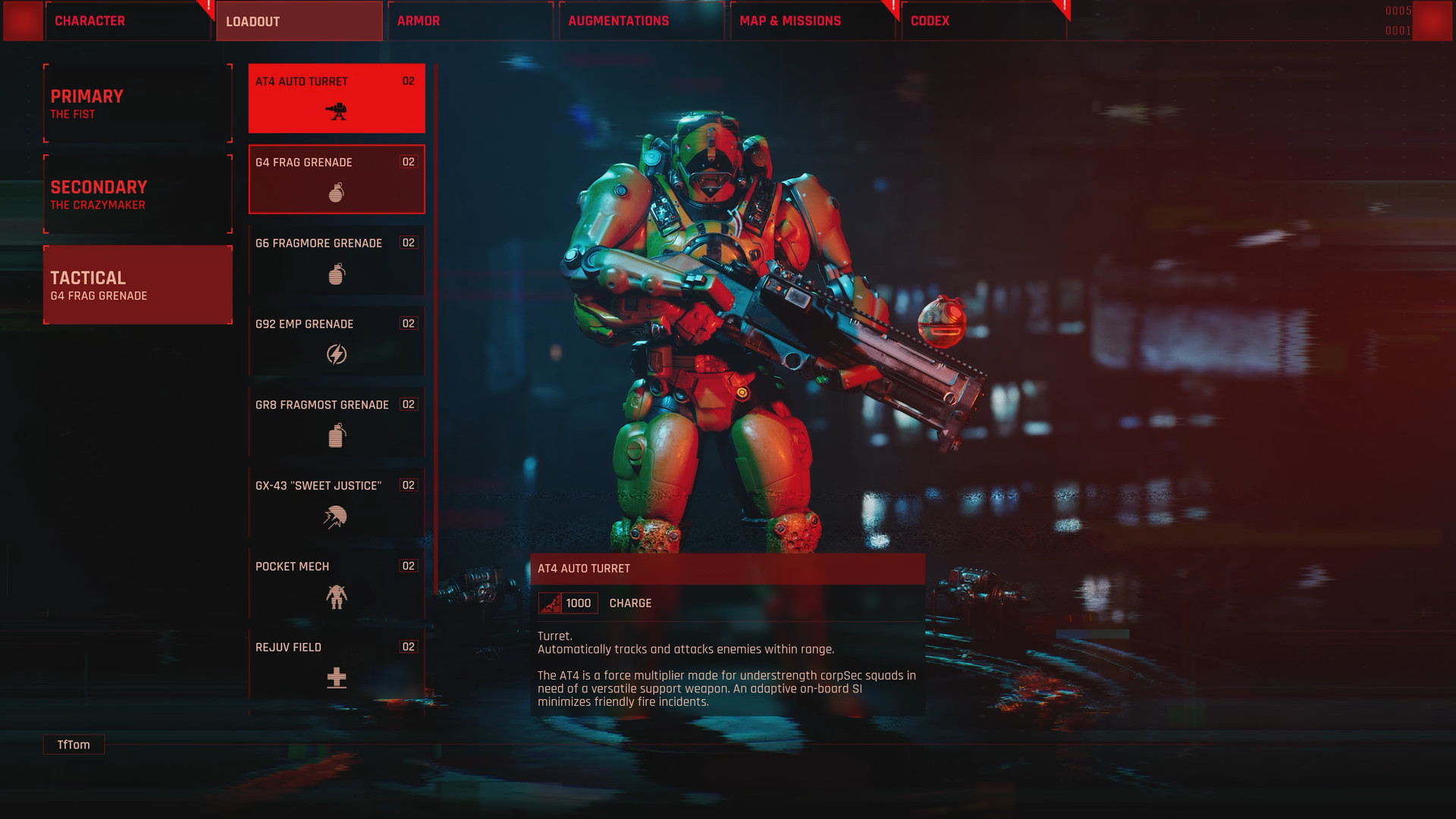
Weapons are only one part of the combat loadout. A tactical slot holds equipment such as grenades or deployable turrets; using it consumes tactical charge, which builds as the Indent deals damage and can also be replenished with yellow pickups. Two augmentation slots hold cyberware abilities, from direct attacks such as Hydraulic Slam to a summoned combat helper such as Mono Ranger. Augmentations draw from an energy reserve and have individual cooldowns, so they work as deliberate bursts rather than unlimited attacks. Blue pickups restore energy, while skill investment in Body Battery increases the reserve available for those abilities. Tactical charge and augmentation energy are separate resources, so a grenade or turret does not consume the same reserve as a cyberware attack.
Character development connects eight skills to four broader attributes. Level-ups provide points for skills such as Vital Signs, Weapon Handling, Aiming, Evasion, Tactical Sense, Critical Hit Rate, Balance, and Body Battery. These choices affect survivability, weapon use, movement, tactical charge, or the power of augmentations associated with an attribute. Gear adds another layer: armor occupies head, torso, and leg slots, and its resistances can matter against particular threats. Weapons can be upgraded with components found while exploring or earned through combat, improving a chosen firearm without replacing the other decisions made through skills and equipment. The attributes are Biometrics, Cybernetics, Motorics, and Frame, each grouping a pair of skills and influencing corresponding augmentations.
Exploration and combat continually feed into one another. Missions establish the main route through the corporate crisis, while side activities, containers, and detours provide credits, equipment, crafting components, and additional encounters. The player can visit vendors to buy gear and supplies, then return to the city with a changed loadout. Discovering enemies also adds information to the journal, including vulnerabilities that can guide later weapon choices. This makes preparation practical: a loadout can be adjusted around likely damage types, a preferred augmentation combination, and the amount of energy or tactical charge those tools require. Enemy entries are created through encounters, turning earlier fights into useful reference points rather than a detached collection system.
The full base game can be played alone or with up to three players in local or online cooperative play. In co-op, participants share the same action spaces and can combine weapons and abilities while advancing through missions together. Cyber Heist is a separate expansion with additional missions and content. Ballistic, energy, digital, and fire damage affect enemies differently; after an enemy type has been encountered, its journal entry can help guide later weapon choices. Character appearance can also be customized, while the ability to share a campaign keeps its progression focused on the same base-game mission chain.
- Developer
- Neon Giant
- Genre
- Action-shooter RPG