
About The Artful Escape
On the eve of his first concert, teenage guitarist Francis Vendetti leaves the expectations surrounding his late folk-musician uncle for a psychedelic journey across the Cosmic Extraordinary. He shapes a new stage persona, meets strange inhabitants and plays guitar as sound and scenery move together.
Francis Vendetti has a first performance approaching, but the young guitarist is already being measured against a family legacy. His uncle, a celebrated folk musician who has died, left a reputation that hangs over Francis and the quiet town where he grew up. The Artful Escape turns that pressure into the starting point for a trip through Francis’s imagination. He heads beyond familiar surroundings in search of a stage identity that feels like his own. The journey moves through stolen opera houses, melodic alien landscapes and the vast region called the Cosmic Extraordinary. Its central question is not whether Francis can reproduce his uncle’s music; it is what he might become when he stops treating that inheritance as a script.
The route is deliberately stranger than a tour from one realistic venue to another. Francis travels through a psychedelic, multidimensional landscape populated by alien life and enormous beings, with each new place widening the scale of the journey. The scenery is built around music: the game describes its paths as landscapes made of sound, shaped by the player’s movement. That connection makes travel part of the performance rather than a pause between songs. Francis does not simply arrive at a stage and play a set. He moves through environments that seem to respond to the same musical imagination that is pulling him away from his hometown and the folk identity attached to his family.
Francis carries a holographic guitar, and playing it is woven into movement through the world. The instrument is available at any point, with recorded guitar phrases arranged so a player can trigger them over the music without following a fixed note chart. The result is closer to improvising a gesture inside a composed track than passing a conventional rhythm test. A phrase can rise over the backing arrangement, answer it, or appear to meet one of its musical turns. The soundtrack keeps moving while Francis adds his own bursts of guitar. This lets the player act like a performer in the scene, even when the surrounding music and landscapes are carefully composed.
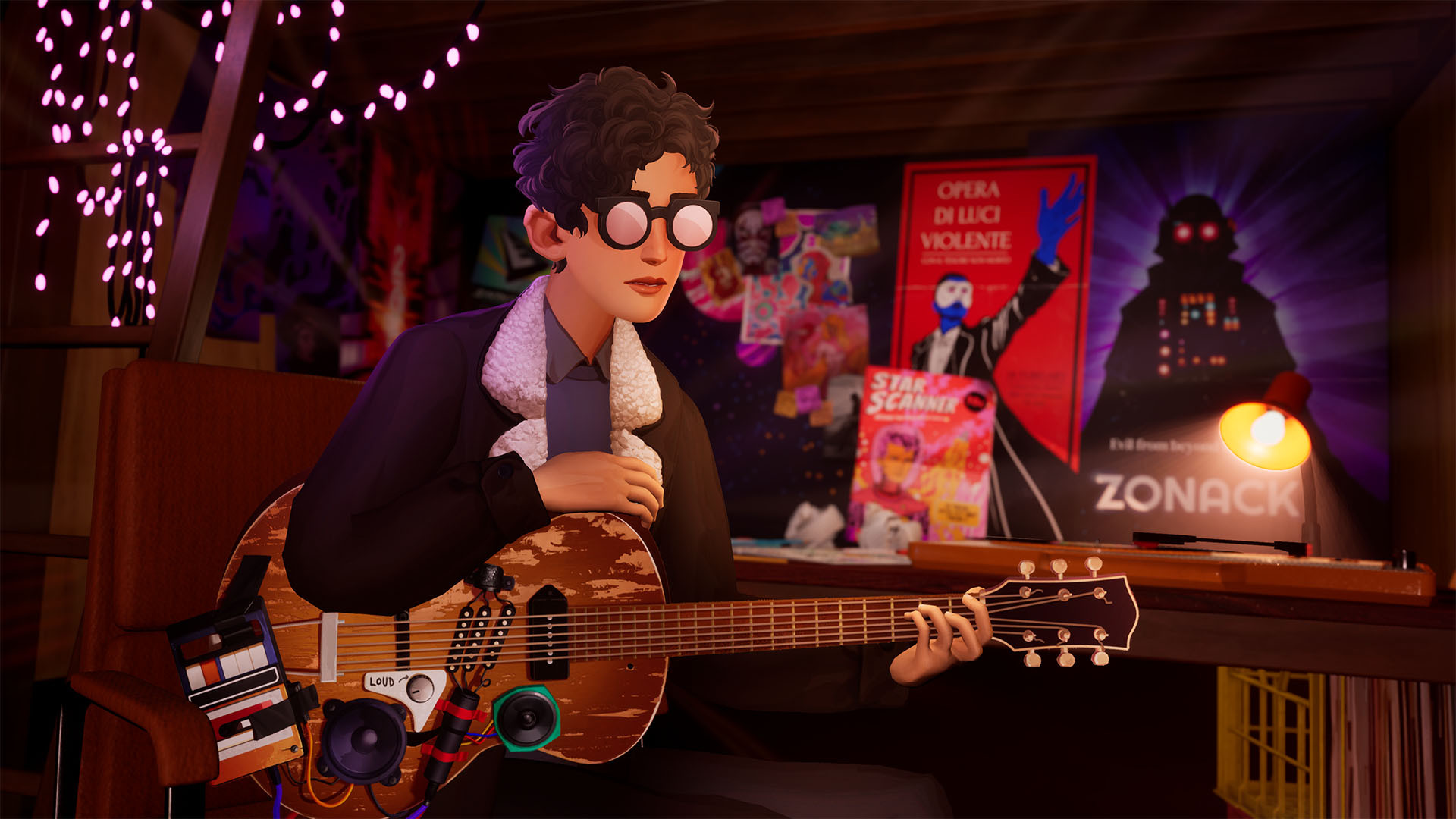
That guitar also helps define the game’s pace. Traversal, scenery and music are designed to flow together, and the journey moves like a long tracking shot with details that can pass quickly if the player keeps moving. There is room to slow down and look across a vista rather than treat every stretch as a test of speed. The tone is exploratory and theatrical: Francis travels through vivid, unusual places, plays when he wants to and continues toward the performance that first set the story in motion. The journey can feel like an album unfolding in chapters, with quieter stretches making space for the louder guitar passages and shifts in scenery.
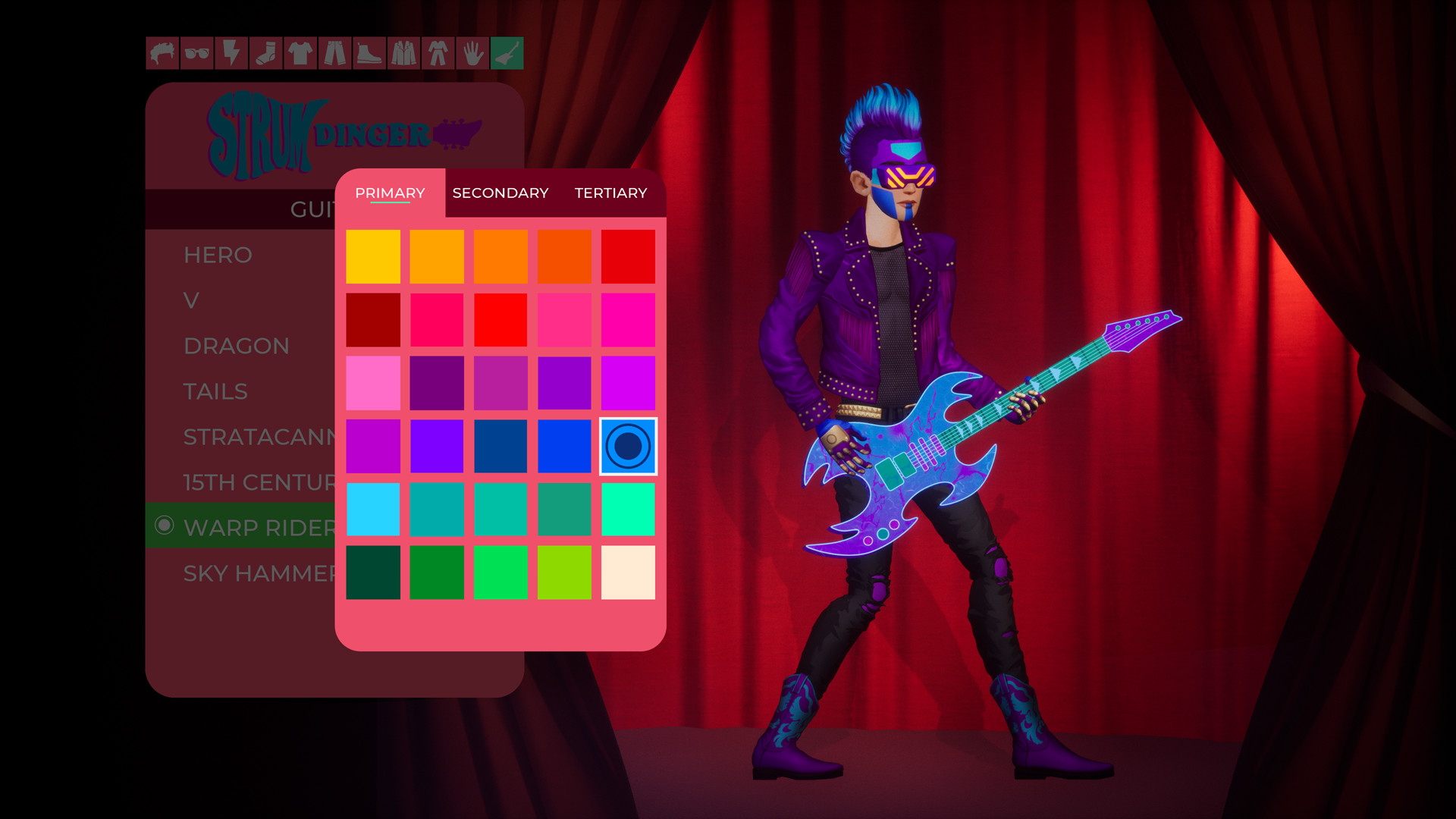
Building a stage persona is another part of Francis’s search. The game lets the player shape elements of his backstory and appearance, down to details such as the trim on his moonboots. Those choices give the otherwise abstract idea of becoming someone new a visible form. They sit alongside the guitar rather than replacing the story: Francis is experimenting with the image he will take to the stage while travelling farther from the small-town identity he inherited. The game frames that transformation with humour and a knowingly grand sci-fi vocabulary, but the underlying concern is recognisable. A person can admire the work of someone who came before them and still decide that their own voice needs a different shape.
The people and creatures Francis meets keep the trip from becoming a sequence of empty backdrops. The cast includes disenchanted publicans, nostalgic villagers, lumbering alien wildlife and beings large enough to challenge ordinary ideas of scale. Francis can talk with these inhabitants and learn how they fit into the odd worlds around him. Their presence gives each location a social texture as well as a visual one: some are familiar in their routines, while others belong to landscapes made from strange materials and sounds. The game’s story and encounters are carried by a voice cast that includes Michael Johnston as Francis, alongside Caroline Kinley, Lena Headey, Jason Schwartzman, Mark Strong and Carl Weathers.
The game also gives some phrases a more defined musical endpoint. Some passages end with “jewel notes” that finish musical progressions: when Francis reaches and plays one, the player closes the musical loop. That moment differs from freely adding a guitar phrase at any time. One action lets the player layer a burst of sound into a track; the other supplies a point of resolution. It gives the guitar a role in both improvisation and cadence, so the instrument can punctuate a sequence as well as colour its ongoing soundtrack. This distinction helps explain why the guitar is part of how Francis moves through the Cosmic Extraordinary, not merely a prop he carries between conversations.
- Developer
- Beethoven & Dinosaur
- Genre
- Psychedelic narrative adventure with platforming and interactive guitar performance