

About Teacup
Teacup is a narrative adventure about a shy young frog preparing to host a tea party in Little Pond. When she discovers her pantry is empty, she consults a botanical journal and searches for herbs and other ingredients. Neighbors trade help for favors, and ingredient errands can be pursued in different orders.
Teacup begins with a domestic problem that sends its quiet protagonist outdoors. Teacup, a young frog who enjoys tea and reading, is due to host her friends the following day, but she has run out of the ingredients for the gathering. Her search takes place across Little Pond, a woodland community of animal residents, rather than on a journey to a distant land. A map and a botanical journal give her a way to organize the errand: the map connects the places she can visit, while the journal identifies the teas and ingredients she is trying to recover. The small deadline gives the trip a clear purpose, and the tea party ties the separate conversations and errands back to a single event. The story’s focus remains on this local preparation and the people Teacup encounters while she gets ready. The setup also shapes the scale of the adventure: a missing pantry supply becomes a reason to cross familiar parts of town and reconnect with neighbors. Her shyness is part of the premise, but the game moves her into conversations through practical requests and shared activities, giving her a reason to engage without changing the central goal into a larger crisis.
Little Pond is explored as a connected set of locations, including wooded paths, open fields, a market area and places beside the water. Teacup moves through these spaces on foot, speaking with residents and checking objects or points of interest as she comes across them. The map helps her move between areas, and the journal keeps the ingredient search legible without turning the game into a resource-management simulation. The search is non-linear in a specific sense: the list of ingredients can be tackled in different orders, so the player can choose which available lead or destination to pursue next. Some residents provide information about an ingredient, while others may offer one directly after Teacup helps them. This creates a gentle loop between exploring, listening, deciding where to go and returning to the broader search; it does not require combat, equipment upgrades or a branching build. Exploration therefore rewards attention to dialogue as much as movement: a conversation can point toward another area or explain why a resident might be willing to share. The flexible order gives the player room to follow those leads as they arise. The map gives each errand a place in the wider community, while the conversations make a visit feel like more than a search through scenery. Returning to a familiar area with a new lead can change the purpose of the trip.
The inhabitants of Little Pond are not simply signposts for the next ingredient. The official descriptions distinguish between residents who are talkative and those who are grumpy, and the encounters give Teacup reasons to pause and listen before moving on. A conversation can reveal a useful lead, introduce a small personal problem or open a favor that connects the character to the wider ingredient hunt. The favors give the errands their structure: Teacup helps someone with a practical task, and that neighbor may respond with information or something from their own supplies. The market stall is one such activity, where its unusually shaped layout becomes part of the task rather than a generic fetch objective. Another encounter takes her to the pond for an underwater race. These exchanges make progress depend on participation in the community, not on defeating opponents or collecting currency. Even the more reserved or irritable residents belong to the same reciprocal pattern: they have their own immediate concerns, and Teacup's willingness to lend a hand creates an opening for cooperation. The structure keeps the social encounters connected to the larger objective while letting each favor have its own small setting and premise. It also makes the journey feel communal; ingredients are found through relationships and help, rather than harvested through a separate gathering mechanic.
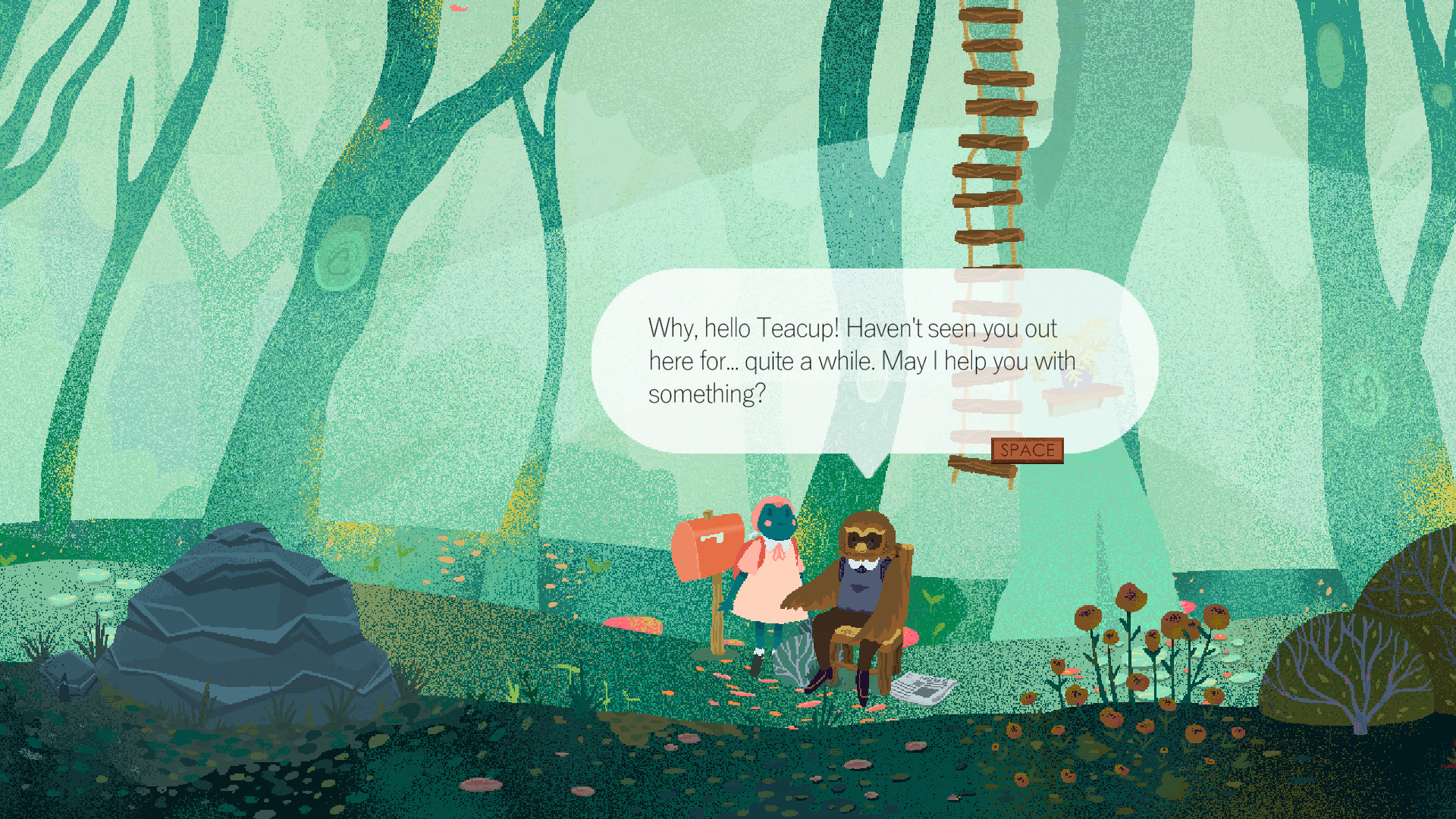
Favors are expressed through short puzzles and minigames that change what Teacup is doing from one encounter to the next. The activities described in the game’s official materials include arranging a market stall and competing in a swimming race; other play descriptions document memory-style sequences, retrieving items from water, finding objects and solving simple spatial puzzles. Their role is to give a neighbor’s request a playable form, then return the player to the conversation and the search. The variety comes from the task’s context and interaction, rather than from a deep combat or skill system. There are no battles to master: Teacup’s movement, dialogue and interaction with people and objects are the core actions. That means progression is social and task-based. A successful favor can yield an ingredient or a clue, while the ingredient list provides the longer thread that links these brief activities together. In practical terms, the minigames interrupt walking and talking with a focused action tied to a character or place; the official overview emphasizes playful games and puzzles rather than specifying a single dominant challenge type. The examples show how the same broad favor structure can support different interactions, from organizing objects to timing or sequencing inputs. They remain episodes within the narrative adventure, not a separate arcade mode or a competitive multiplayer feature.
The botanical journal is the practical anchor for the collection goal. Teacup consults it to learn which ingredients she needs and to connect the tea-making premise with a reason to visit different parts of town. The list includes distinct teas and additions rather than a single undifferentiated herb counter: the game’s ingredient trail includes mint, honey, hibiscus, jasmine, lemon verbena, chamomile and rooibos, as well as Dream Tea and several familiar tea varieties. Each name gives the gathering a more precise aim than simply finding tea leaves, while the journal connects those plants and additions to Teacup’s plans for her guests. The journal also supplies botanical information and recipes, so its function is more than a checklist: it frames each find as part of the tea party Teacup is preparing. Rather than selling produce or experimenting with free-form recipes, Teacup works through particular requests and keeps track of what the party still needs. The journal’s recipes connect the plants and pantry items to the event Teacup is preparing, giving the search a small encyclopedic dimension. The journal, map and conversations complement one another: the journal defines what is missing, the map provides the spatial frame, and residents help turn the list into actionable errands. Once an ingredient is found, the list shrinks and the remaining leads provide the next reason to cross Little Pond. The journal makes that progress visible without a stockpile to manage.
Teacup’s presentation supports the scale and pace of its neighborhood story. Whitethorn describes the setting as a watercolor world, while the developer and publisher frame it as a forest inhabited by woodland animals. The scenes move between natural spaces and communal spots such as the market and pond, giving the search changes of setting without leaving Little Pond. The characters are illustrated animals, and the interactions center on dialogue and brief activities. On Steam, Teacup is listed as a single-player adventure developed by Smarto Club and published by Whitethorn Games; the game released in 2021. Its illustrated spaces and small-scale favors give the journey a storybook rhythm: Teacup’s next stop is usually another resident, another request or another corner of the woods rather than a distant destination. The shift between conversations and brief games keeps the ingredient search active without making a single puzzle type carry the entire adventure. The result is a trip through a specific neighborhood, where the coming tea party gives each encounter a shared reason to matter.

- Developer
- Smarto Club
- Genre
- Narrative adventure; Steam categories Adventure, Casual, Indie