
About Tales of Vesperia: Definitive Edition
A stolen blastia core cuts the water supply to Yuri Lowell's neighborhood in Zaphias. The former Imperial Knight sets out to recover it, then follows a much larger conflict over the technology on which Terca Lumireis depends. Tales of Vesperia: Definitive Edition adds playable Patty and Flynn, expanded story content and HD presentation to the party-based action RPG.
Yuri Lowell has a reason to leave Zaphias that begins close to home. Someone has stolen a blastia core used to regulate the Lower Quarter's water supply, and the people who live there must bear the consequences. Yuri once served as an Imperial Knight, but now his loyalty sits with the neighborhood rather than the institution that used to employ him. Retrieving one piece of technology seems like a small, direct task. It draws him beyond the walls of the capital and into a dispute over the Empire's control of blastia, devices on which much of this civilization depends. A missing core matters to a few streets; the system of power around such cores reaches across Terca Lumireis. The game's opening makes that expansion understandable. Yuri does not begin by setting out to save a world he barely knows. He starts with a practical failure affecting people he knows, and the search gradually forces him to see how that failure relates to a much wider political and technological order. The question of justice follows him because the officials with authority to act are not always the people who must live with the delay or the result.
The growing party gives that question several viewpoints. Estelle is a young noblewoman whose place in society differs sharply from Yuri's Lower Quarter upbringing. Karol is searching for a guild to belong to, while Rita approaches the world as a scholar. Raven is an archer, Judith a dragoon, and Repede is a dog who travels with Yuri rather than a silent emblem on a menu. Their backgrounds give a journey through distant locations more than one reason to matter. Flynn Scifo, Yuri's friend and rival, remains an Imperial Knight; his presence makes it impossible to treat Yuri's departure from the order as the only credible way of helping others. Patty Fleur, a pirate searching for treasure, adventure and her lost memories, adds another person whose immediate purpose does not perfectly match Yuri's. The Definitive Edition makes both Flynn and Patty playable for Western audiences and includes further scenarios and places not released in the original Western version. They are not simply character portraits added to a familiar party screen. They change who can stand in the active group during a fight and widen the range of voices accompanying Yuri as the stolen-core case grows into something less local.
Blastia gives the world a shared material problem, rather than acting only as a word for mysterious power. One core governs water in the Lower Quarter, while the Empire's broader command of blastia creates a political advantage. As the party travels, the importance of that technology shifts from the needs of one neighborhood to the survival of the wider world. The journey crosses a field map that connects towns and dungeons, with a separate local map for each place the party enters. The game's manual distinguishes those spaces and gives different controls for moving through them. It also documents a navigation map, skits that can be opened as conversations, and the Sorcerer's Ring as a tool used on local maps. The field map can be zoomed and oriented toward north, giving travel between named destinations a clear spatial frame. Ba'ul later becomes callable on the field, changing travel without making every scene an undifferentiated stretch of terrain. These details help explain the game's rhythm: crossing broad distances, entering a particular settlement or dungeon, talking with companions and then returning to the wider route. The world is large enough for Yuri's mission to lose its original simplicity, yet its towns and party exchanges continually bring the consequences back to named people.

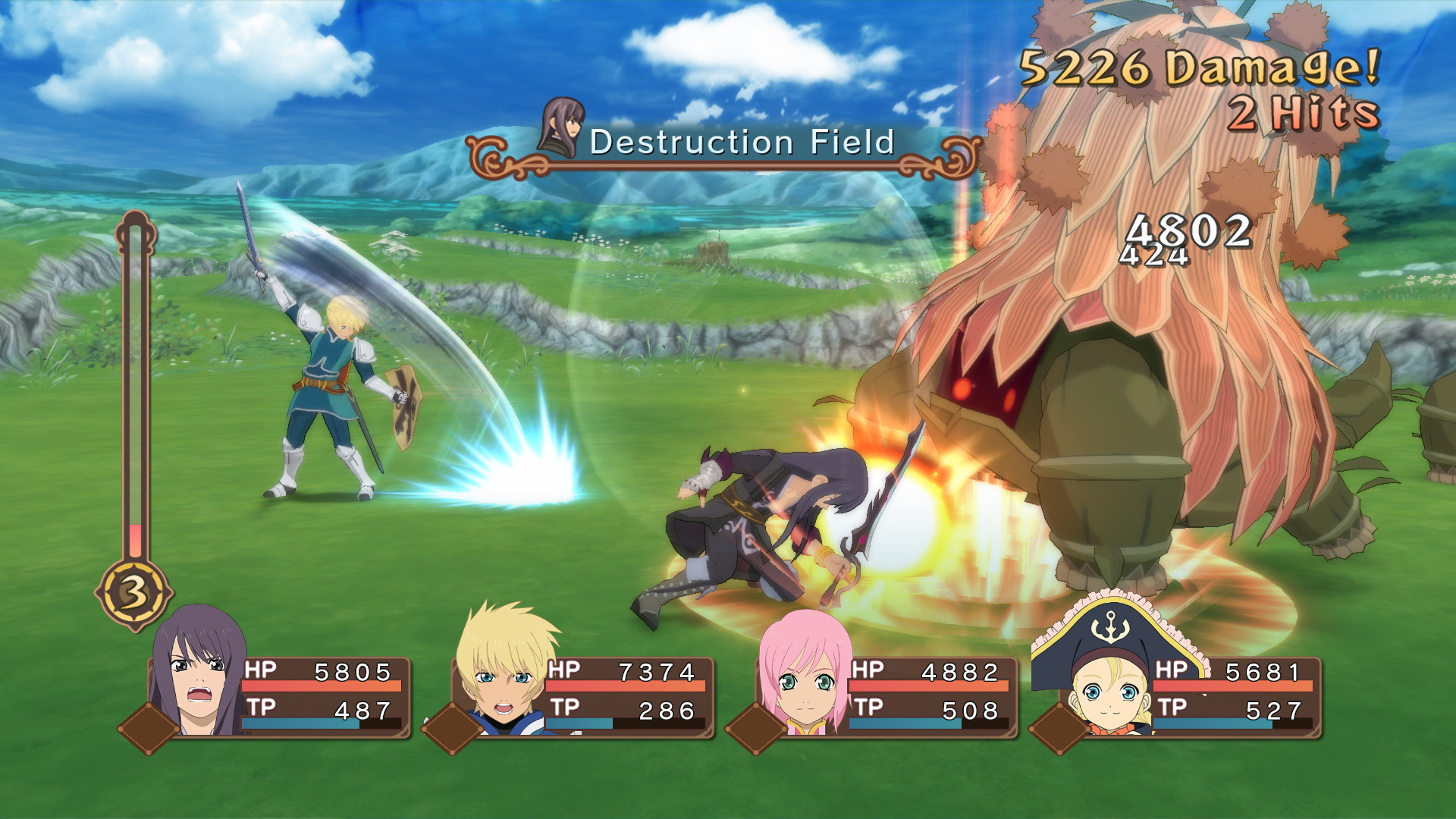
Fights use a specialized Linear Motion Battle System rather than a detached turn list. The player directly controls one member of a four-person active group in real time, while the other three follow adjustable computer-controlled tactics. Physical attacks and artes can be combined as an enemy moves, and different party members offer different actions to control. The manual lists a regular attack, a separate arte command, guard, target selection and free run in battle. It also names Over Limit, Fatal Strike and Mystic Artes as parts of the wider combat vocabulary. The separate commands matter because defending, moving freely and choosing an arte are different responses to the same enemy. A player can change targets as positions shift, hold a guard when an attack is coming, or use free run to move around the active exchange. The important distinction for a newcomer is that the rest of the party does not disappear when Yuri is selected. They act alongside the controlled character, and changing who is in the group changes which skills and attacks are available at once. The ability to adjust their instructions lets a player shape that cooperation without having to issue every command in real time. For local multiplayer, the manual is precise: up to four people can take part during battles, while exploration remains the normal single-player journey. It is a party adventure whose cooperation happens in the fight itself, not a shared overworld expedition.
That battle structure also connects back to the cast's different reasons for traveling. Yuri may be the person who leaves Zaphias after the theft, but Estelle, Karol, Rita and the others do more than follow him in a fixed formation. Selecting another controlled fighter changes the immediate problem of distance, timing, and which arte to use, while the remaining members continue under their configured orders. A fight can move between regular attacks, guarded pauses, movement around an opponent and a more committed arte. Over Limit and Mystic Artes give the party larger bursts of action, while Fatal Strikes reward attention to a specific opening. The game does not require a reader of its story to memorize those controls before the first scene makes sense. It does mean the playable group's composition is more than a narrative choice: the companions Yuri meets along the route become possible answers to a difficult encounter. A skit or conversation can establish a character's outlook, then a later battle lets the player act through that same character's abilities. This is one of the ways the game keeps its ensemble present across story and action rather than assigning each member to only one of those roles.
The Definitive Edition is a specific 2019 version of Tales of Vesperia, not a new story with an unrelated name. It restores material that Western players did not receive with the earlier release, including playable Patty and Flynn, additional scenarios, locations, costumes and music, alongside upscaled HD visuals. The standard game and a Premium Edition also have different physical contents, so collectibles from that package should not be mistaken for events or systems inside the adventure. The result still begins at the Lower Quarter water supply and follows Yuri into a much larger fight over blastia and authority. What the expanded edition changes is how much of the party and its world is available within that journey. A player can spend time with the newly playable characters, hear the added material and see the setting through the clearer presentation, while the central contrast remains intact: Yuri's first duty is to the neighbors who need water, and the powers governing their world are capable of making such an ordinary need part of an enormous conflict.
- Developer
- Bandai Namco Studios; QLOC credited on PC
- Genre
- Action role-playing game